

Best Food-Safe Finishes for Kitchen Counters
A finish labeled “food-safe” isn’t automatically the right choice for every kitchen counter. A Food safe finish for kitchen counters needs to suit how you use the surface, and a reassuring label alone may not establish that it’s intended for food preparation or direct food contact. It’s also easy to mistake a finish that feels dry for one that’s fully cured.
To balance protection, appearance, upkeep, and the risk of stains or water marks, start by comparing how each finish works and what care it requires. This guide covers common finish types, explains what food-safe, food-grade, and non-toxic claims can and can’t tell you, and clarifies why a countertop isn’t quite the same as a cutting board. Use the product’s current directions to guide preparation, application, curing, and ongoing care, then choose a finish that fits your kitchen routine.
Key Takeaways
- Choose a Food safe finish for kitchen counters by checking its stated intended use, not just reassuring words on the label.
- Compare oils, oil-and-wax blends, and film finishes for the look and feel you want, along with their care and repair needs.
- Match the finish to how you use and clean the counter and how much routine maintenance you’re comfortable doing.
- Follow the product’s current directions for preparation, application, curing, and care. Dry to the touch doesn’t necessarily mean fully cured.
- Use a maker’s hands-on experience as practical context, while relying on the manufacturer’s directions for product-specific food-contact claims.
What Makes a Food-Safe Finish Suitable for Kitchen Counters?
A food-contact claim and a product’s intended use are related, but they aren’t interchangeable. A finish may use reassuring words on its label without being recommended for every wooden surface or kitchen task. For a Food safe finish for kitchen counters, read the product’s current label and directions. Look for clear guidance about countertop use and the type of food contact you expect.
A countertop finish protects a work surface that may have incidental food contact. A finish for direct food contact must be specified for the particular way food will touch that surface. Counters often hold ingredients, dishes, and utensils, but they aren’t automatically chopping boards. Consider how the wood and finish will handle the cleaning and wear that come with your routine.
Food-safe, food-grade, and non-toxic: what the terms tell you
“Food-safe,” “food-grade,” and “non-toxic” can sound like firm guarantees, but the terms alone don’t tell you whether a finish suits a counter, a serving board, or a surface where food is cut. Check the manufacturer’s directions for the specific product and intended use, including any stated limits and instructions for application, curing, and care. General information about wood finishing techniques can help explain how finishes work, but use the manufacturer’s documentation for product-specific guidance.
Kitchen counters versus cutting boards
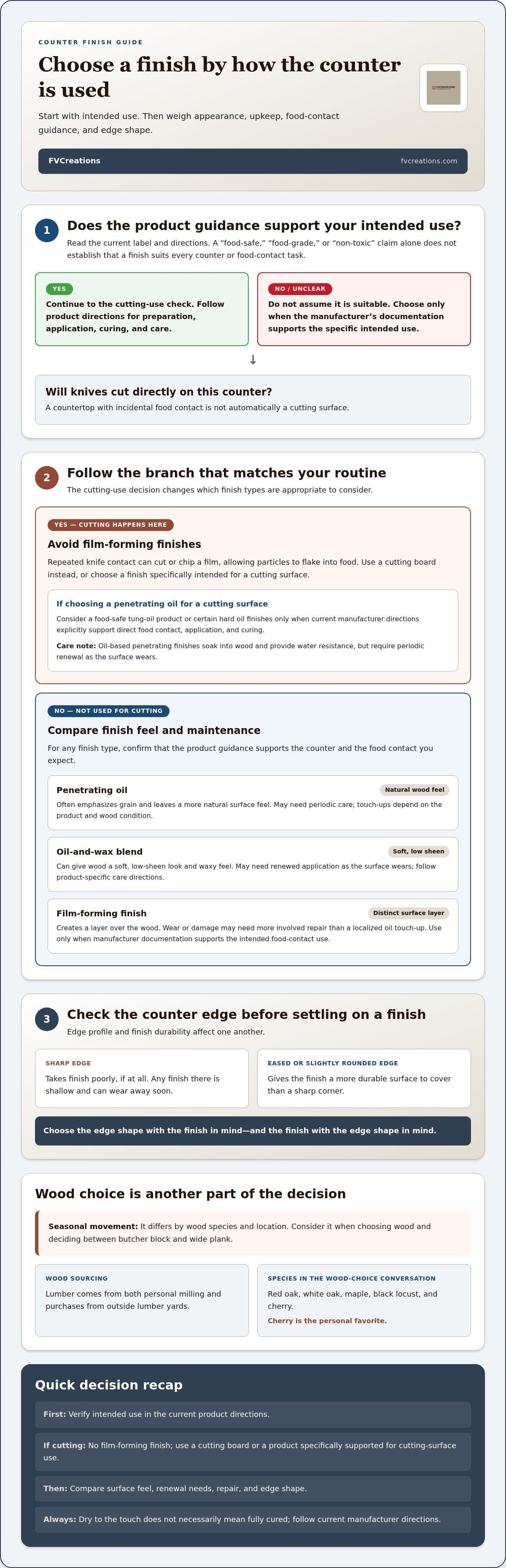
Countertops intended for cutting should never use a film-forming finish. Repeated knife contact can cut or chip the film, allowing particles to flake off into food, and film-forming finishes are rarely food-safe for direct cutting. Use a cutting board instead, or select a finish specifically intended for a cutting surface.
Penetrating oil-based finishes provide water resistance while soaking into the wood, but they require periodic renewal as the surface wears. For cutting surfaces, consider a food-safe tung-oil product or certain hard oil finishes only when the current manufacturer’s directions explicitly support direct food contact, application, and curing.
That’s why I treat counters and boards as separate jobs. We make wooden cutting boards and charcuterie boards, which are used differently from finished counters. For ideas on caring for a serving surface, explore our handmade charcuterie boards. For a counter, let the finish’s stated intended use guide your choice, then weigh its appearance and maintenance needs.
How Kitchen Counter Finishes Differ in Protection and Upkeep
Finish type affects how a wood counter looks, feels, and responds to everyday use. Water around a sink, spilled drinks, scrubbing, and regular cleaning all put demands on the surface. Oils, oil-and-wax blends, and film-forming finishes handle wear differently, so there’s no single best choice for every kitchen. Food-contact suitability depends on the specific product’s stated intended use, not just its finish category.
| Finish type | Appearance and feel | Upkeep and repair | Food-contact suitability |
|---|---|---|---|
| Penetrating oil | Often emphasizes the wood’s grain and leaves a more natural surface feel. | May need periodic care; touch-ups depend on the product and condition of the wood. | Check the product label and directions for the intended use. |
| Oil-and-wax blend | Can give wood a soft, low-sheen look and a waxy surface feel. | May call for renewed application as the surface wears; follow product-specific care instructions. | Suitability depends on the product, not the oil or wax ingredients alone. |
| Film-forming finish | Creates a distinct layer over the wood, with sheen and feel varying by finish. | Wear or damage may require more involved repair than a localized oil touch-up; application affects the result. | Use only when the manufacturer’s documentation supports the intended food-contact use. |
Comparison summary: Oils and oil-and-wax blends tend to preserve a more direct wood feel and may need periodic renewal. Film-forming finishes create a separate surface layer, and repairs may involve addressing that layer. For every category, check product-specific directions for the intended food contact.
Oil and wax finishes for a natural wood feel
Penetrating oils and oil-and-wax blends are often chosen when you want the grain and texture to remain prominent. They can suit a hands-on care routine, but water resistance, stain protection, and reapplication needs vary by formula and use. Farmer Vic personally approves the shop’s finishing and maintenance supplies. Browse our Real Milk Paint Co. finishes to explore finishing options, then read each product’s current directions before using it on a counter.
Film-forming finishes for a more sealed surface
A film-forming finish sits on top of the wood rather than relying on oil or wax worked into the surface. It creates a distinct layer, but how it responds to scratches, worn spots, and cleaning depends on the finish and how it was applied. Don’t assume a coating is suitable for food contact simply because it has dried or feels hard. Look for explicit manufacturer guidance for your intended use.
Edge profile also affects finish durability. Sharp edges hold finish poorly, so the application over the corner is thin and wears away quickly. Easing or slightly rounding an edge gives the finish a more durable surface to cover than a sharp corner.
Which Food-Safe Counter Finish Fits Your Wood and Kitchen?
A natural-looking finish isn’t automatically the best fit, and “food-safe” on a label doesn’t tell you how a surface will handle your routine. Choose by balancing the product’s stated intended use with the counter’s appearance, how you use it, and the maintenance you’re willing to do. The right Food safe finish for kitchen counters is one that fits those needs and has manufacturer directions supporting the intended use.
Consider the counter’s wood species and grain
Wood species affect a finished counter’s appearance, but the species name alone doesn’t establish which finish is appropriate. Red oak and white oak have different grain and color characteristics, while maple is often chosen for its comparatively subtle grain. Black locust offers another distinct appearance and character. Consider the look you want, then check that the selected finish is intended for use on the surface.
Our lumber comes from both personal milling and outside lumber yards. Working with boards from different sources gives us a hands-on appreciation for the variation in grain, color, and character from one piece to another. These differences are worth considering when you test a finish on a sample.
Cherry is Farmer Vic’s favorite wood. Its fine grain and the way its color deepens over time make it especially rewarding to work with. If you’re drawn to cherry, consider whether the finish complements the look you want and whether its care directions suit your kitchen. Choose a finish that works with the wood, not just one that sounds appealing on a label.
Match the finish to how the counter is used
A low-contact serving area may see occasional plates or a serving board, while a busy meal-prep counter can face frequent spills, wiping, and cleaning. Neither setting automatically points to one finish type. Weigh the trade-offs against your habits:
- Natural surface feel: Oils and oil-and-wax blends may appeal if you want the wood to feel less like it has a separate coating. Consider whether you’re comfortable following any ongoing-care directions.
- A more sealed feel: A film-forming finish creates a surface layer. Think about the look you want and how the manufacturer says to care for or repair it if worn.
- Food-contact use: Occasional contact and direct food preparation aren’t interchangeable. Choose a product whose current directions support the way you plan to use the counter.
Be realistic about cleanup, too. If you wipe the counter often or expect water and spills around a sink, the finish’s care instructions matter as much as its initial appearance. Compare those directions with the look and feel you want, and explore our Real Milk Paint Co. finish options.
How to Apply and Maintain a Kitchen Counter Finish
A good result starts before the finish goes on. Identify the counter’s wood and existing surface treatment, then choose a product whose current manufacturer directions support your intended use. A Food safe finish for kitchen counters still requires careful preparation and proper curing. The label’s claims don’t replace following its instructions from start to finish.
Prepare the wood and apply the chosen finish
Use the product’s directions to guide each step. A practical sequence is:
- Identify the surface: Note the wood and whether the counter has an old coating or finish that could affect preparation.
- Prepare the wood: Make it clean, dry, and evenly prepared as directed. Don’t guess at sanding methods or other preparation details.
- Test a sample: Apply the finish to an inconspicuous area or a matching scrap. Check the color, how the wood absorbs it, and the surface feel once it’s ready to assess.
- Apply the finish: Follow the manufacturer’s application instructions, including any specified tools, amount, or sequence.
- Allow it to cure: Respect the product’s stated cure period and use restrictions before putting the counter back into service.
- Maintain the surface: Clean it and address worn areas using methods the manufacturer says are compatible with that finish.
A sample can prevent an unwelcome surprise. Wood may take on a different color or feel than expected, so testing lets you assess the result before treating the whole counter.
The product label and current manufacturer instructions govern application, curing, cleaning, and care for the intended use.
Curing, cleaning, and ongoing care
Drying and curing aren’t always the same. A surface may feel dry even though the product’s directions call for more time before use or food contact. Don’t rely on touch alone. Follow the stated cure period and any limits on use during that time.
Once the counter is in service, use only cleaning and maintenance methods compatible with its finish. If an area looks worn, follow the product’s care instructions rather than adding a coating or maintenance product by guesswork. The finishing and maintenance supplies at FVCreations are personally approved by Farmer Vic. Explore Real Milk Paint Co. finishes, and use each product only as its directions specify.
Choosing a Counter Finish with a Maker’s Practical Perspective
A thoughtful finish choice starts with what the counter needs to do. At FVCreations, we source wood through both personal milling and outside lumber yards. That maker’s perspective is a reminder that every board has its own character. Experience with wood and finishing supplies is useful context, but it doesn’t establish that a particular product suits every countertop or food-contact situation. For a Food safe finish for kitchen counters, let the manufacturer’s stated intended use lead your decision.
A simple checklist before choosing
Before opening a can or bottle, match the finish to your kitchen. These questions can help make the choice practical:
- Intended use: Does the manufacturer specify the product for your counter and the kind of food contact you expect?
- Appearance: Do you want the wood’s grain and feel to stay prominent, or prefer a more distinct surface layer?
- Upkeep: Does the cleaning and maintenance routine fit your household habits?
- Repair: If the surface becomes worn or damaged, are you comfortable with the repair approach described by the manufacturer?
- Directions: Have you read the current instructions for preparation, application, curing, cleaning, and ongoing care?
Consider the whole life of the surface, not just how it looks on the first day. A finish that suits a rarely used serving counter may not be your preference for a busy prep area that gets wiped often. If upkeep feels like a chore, that matters too. Be honest about the routine you’ll actually follow.
Explore finishing guidance and supplies
At FVCreations, Farmer Vic personally approves the woodworking finishes and maintenance supplies we carry. That hands-on selection can help you explore options, but it doesn’t replace checking a product’s own directions for countertop use. Browse Real Milk Paint Co. finishes as a starting point, then use the manufacturer’s label and instructions to decide whether a specific product fits your project. For general context, learn about artisan finishing methods and natural wood oils, while relying on the maker’s documentation for product-specific claims.
Take your time, compare the care routine with your kitchen habits, and choose with appearance and maintenance in mind. Explore woodworking finishes and supplies at FVCreations.
Choose a Finish You Can Care for with Confidence
The best counter finish isn’t simply the one with the most reassuring label. Match the product’s stated intended use to how your counter meets food, then weigh appearance, surface feel, cleaning habits, and repair needs. Follow the manufacturer’s current directions for preparation, application, curing, and ongoing care. A Food safe finish for kitchen counters should fit both the surface and the way you use it.
Farmer Vic personally approves the finishing and maintenance supplies we carry, including Real Milk Paint Co. finishes and woodworking care products. That hands-on product selection is useful context, not proof of a particular food-contact claim. Let the specific product’s instructions guide your decision.
Test the look on a sample and choose a finish whose upkeep feels manageable for your kitchen. Explore woodworking finishes and supplies at FVCreations.
Frequently Asked Questions
What is the best food-safe finish for a kitchen counter?
The best Food safe finish for kitchen counters is one whose manufacturer specifies it for your intended use and whose appearance and care needs fit your kitchen. Oils and oil-and-wax blends can preserve a natural wood feel, while film-forming finishes create a surface layer. Neither type is automatically right for every counter. Check the product’s current label and directions for food-contact use, preparation, curing, cleaning, and maintenance.
Is tung oil food-safe for kitchen counters?
It depends on the specific tung oil product and its intended use. The words “tung oil” alone don’t establish that a finish is suitable for a kitchen counter or food contact. Products can differ in their ingredients and directions, so read the current manufacturer label for explicit guidance on counter use, application, and curing. Don’t use the surface for food contact until you’ve followed the product’s stated requirements.
Can I use butcher block oil on a kitchen counter?
Use butcher block oil on a counter only if the specific product’s manufacturer directions support that use. The name may suggest an application, but it doesn’t establish whether the product suits your counter’s routine or the type of food contact involved. Check its current label for application, curing, cleaning, and reapplication guidance. Consider whether you’re comfortable with the ongoing care it requires.
What is the difference between food-safe and food-grade wood finish?
“Food-safe” and “food-grade” are often used to suggest that a product is suitable around food, but the terms alone don’t establish suitability for every surface or use. They aren’t a substitute for product-specific directions. Look for the manufacturer’s stated intended use and any limits on food contact, then follow application and curing instructions. A finish intended for a counter may not be appropriate for a surface used for direct cutting.
How many coats of finish should I apply to a wood counter?
Apply the number of coats specified in the selected product’s current instructions. There isn’t one correct number for every finish: products have different application processes, and wood preparation and absorption can affect the result. Don’t add extra coats based on a general rule. Follow the manufacturer’s directions for timing between applications and any required preparation, and test the finish on a sample first to check the appearance.
How long should a kitchen counter finish cure before use?
Wait for the product’s stated cure period before using the counter for the activities specified by its manufacturer. Dry to the touch doesn’t necessarily mean fully cured or ready for food contact. Drying and curing are different stages, and the time required depends on the product and the conditions described in its directions. Follow any use restrictions during curing instead of relying on a general timeline or the surface’s feel.
Can I use the same finish on a kitchen counter and a cutting board?
Use the same finish on both only if its manufacturer’s directions support both intended uses. A counter may have routine food contact, while a cutting board faces repeated knife contact that can wear or cut into a finish. That difference affects surface care and repair. Check the product’s current instructions for each use, and don’t assume a finish suitable for a counter is automatically suitable for direct cutting or serving.