

Best Oil for Cedar Wood: An Artisan’s Guide to Lasting Protection (2026)
Most folks think cedar is naturally invincible, but even the toughest heartwood eventually surrenders to the sun and rain. It is frustrating to spend time building or money buying a beautiful piece only to watch it turn a ghostly gray within a year. Whether I am milling timber right here on the property or sourcing high-quality boards from local lumber yards, I have learned that the best oil for cedar wood isn't just about a pretty shine. It is about finding a finish that breathes with the wood's unique structure to stop rot before it starts.
I know you want to keep that warm, reddish glow without soaking your garden planters in toxic chemicals. I've personally vetted dozens of products, including the Real Milk Paint Co. line, to find finishes that are both durable and safe for your soil. In this guide, I'll show you how to preserve your wood for ten years or more using professional techniques. We will look at the real-world differences between tung, linseed, and teak oils while explaining why I often reach for Outdoor Defense Oil to get the job done right. We have a lot to cover, so let's get into the workshop and look at what really works.
Key Takeaways
- Understand why cedar's natural chemistry requires a specific finishing strategy to prevent UV rays from destroying the wood's lignin and turning it gray.
- Discover why pure tung oil is often the best oil for cedar wood compared to linseed or teak oil when you want a deep, matte finish that actually lasts.
- Learn the professional "wet-on-wet" application technique and why removing mill glaze is the most important step before you even open a can of oil.
- Identify the right food-safe finishes for garden beds and planters to ensure your wood survives constant moisture and soil contact for over a decade.
- Get my personal maintenance schedule for re-oiling to keep your cedar looking fresh without having to sand everything back to bare wood every year.
Why Cedar Wood Requires a Specific Oil Strategy
I spend a lot of time in my workshop working with cedar. It's a wood I truly respect. Whether I am milling a log right here on the property or I buy in a lot of outside lumber from various lumber yards, cedar has a personality all its own. Most people assume that because it's naturally rot-resistant, you can just slap any old finish on it and call it a day. That's usually where the trouble starts. Cedar is packed with natural oils called thujaplicins. These are the chemicals that make the wood smell so good and keep the bugs away. However, those same oils can act like a shield, pushing away cheap, generic finishes. If you use a product that just sits on the surface, it's going to peel and flake off in the sun.
A quality finishing oil is a different story. Unlike a thick film-forming stain that acts like a layer of plastic, a penetrating oil actually soaks into the fibers. This is vital for softwoods like cedar because it lets the wood move and breathe as the seasons change. When you find the best oil for cedar wood, it doesn't just sit on top; it becomes part of the wood's defense system. Without this deep protection, UV rays go to work on the lignin, which is the "glue" that holds wood cells together. Once that lignin breaks down, the wood turns that familiar silver-gray. Some folks like that look, but for me, gray wood is often a sign that the surface is starting to weather, crack, and lose its structural integrity.
The Science of Cedar's Natural Resistance
Those thujaplicins I mentioned are great for the tree, but they make bonding a nightmare for some store-bought products. If you use a water-based sealer too soon, the natural oils in the cedar might reject it. This leads to blotchy spots or a finish that fails within a single season. To find the best oil for cedar wood, you need something that works with these extractives rather than fighting them. A true penetrating oil is designed to bypass these natural barriers, saturating the wood grain to provide a moisture-resistant barrier from the inside out.
Moisture Content and Oil Absorption
The way I source my wood changes how I approach the finish. When I am milling cedar on-site, the boards are often air-dried, meaning they might have a higher moisture content for a while. If I am using boards from lumber yards, they are usually kiln-dried and much thirstier. You can't put oil on wet wood; it is like trying to mix oil and water. It'll just trap moisture inside and invite mold to the party. I always recommend the water drop test before you start. Sprinkle a few drops of water on the board. If it beads up, the wood isn't ready. If it soaks in, you are good to go. For my Outdoor Defense Oil, I always make sure the wood is dry so the finish can penetrate deep where it belongs.
Comparing the Top Contenders: Tung, Linseed, and Teak Oil
I've stood in the finish aisle at the lumber yard just as confused as anyone else. Rows of cans promising total protection can make your head spin. After years of testing finishes on both the cedar I mill myself and the bundles of lumber I buy in from various lumber yards, I can tell you that not all oils are created equal. When you are looking for the best oil for cedar wood, you are usually choosing between three big names: Tung, Linseed, and Teak. Each has a different chemistry, and picking the wrong one for an outdoor project can lead to a lot of extra sanding down the road.
Why Tung Oil is the Gold Standard for Cedar
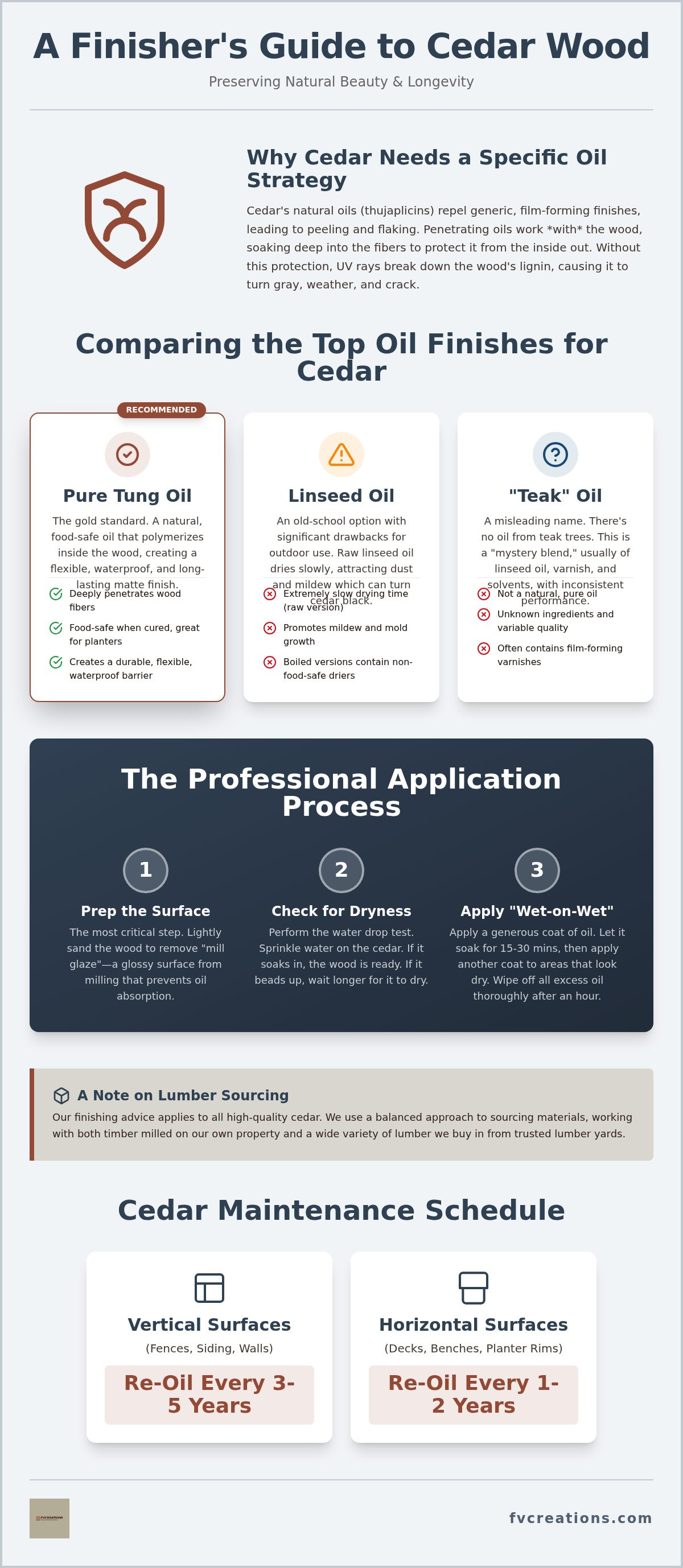
Pure Tung oil is my personal favorite for a reason. It is a natural oil that doesn't just dry on the surface; it polymerizes. This means it turns into a flexible, waterproof solid inside the wood fibers. Because it stays flexible, it moves as the cedar expands and contracts in the sun. If you want the best penetration, I recommend a blend like Real Milk Paint Co. Outdoor Defense Oil. It uses a citrus solvent that helps the oil get deep into the tight grain of the cedar, especially on those dense boards I source from external lumber yards. It's food-safe, which is a huge deal if you are finishing one of my cedar planters meant for growing vegetables.
The Risks of Linseed and 'Mystery' Oil Blends
Linseed oil is the old-school choice, but it has some nasty habits outdoors. Raw linseed oil takes forever to dry. While it's sitting there wet, it acts like a magnet for dust and mold spores. I've seen cedar turn black because the raw linseed oil basically fed the mildew. Boiled Linseed Oil (BLO) dries faster, but it usually contains metallic driers that aren't ideal for garden beds.
Then there is Teak Oil. Here is a secret: there is no such thing as oil from a teak tree. It is usually a mystery blend of linseed oil, varnish, and mineral spirits. It's designed to look good for a month, but it often peels because it creates a thin film on top of the wood. If you want lasting protection, you have to read the label. Avoid anything that doesn't list its ingredients clearly. To make it easier, here is how they typically stack up:
- Pure Tung Oil: Waterproof, food-safe, and won't mold; the best long-term choice.
- Linseed Oil: Cheap and easy to find, but can attract mildew and takes ages to dry.
- Teak Oil: Fast-drying and high sheen, but often contains toxic driers and can peel like a plastic wrap.
I always tell folks that if you can't be sure what's in the can, don't put it on your wood. Cedar is too beautiful to ruin with a cheap mystery finish.
Outdoor Defense vs. Indoor Glow: Choosing Based on Use
I often have two very different projects sitting on my workbench at the same time. One might be a set of cedar planters with legs built from heavy stock I bought at the lumber yard, while the other is a charcuterie board I milled from a cedar log right here on my property. These two items live very different lives, so they can't be treated the same way. When you are hunting for the best oil for cedar wood, you have to think about where that wood is going to spend its time. Outdoor wood faces a brutal cycle of wet soil and baking sun, while indoor pieces need to stay stable without losing that iconic cedar scent.
For anything staying outside, UV protection is your biggest hurdle. Without specific UV inhibitors, the sun's rays act like sandpaper on the wood's surface, bleaching the color and breaking down the fibers. I've found that using a high-quality oil like Outdoor Defense Oil is the only way to keep that rich red hue from fading into a dull gray. It's not just about looks, either. A good oil keeps the wood supple so it doesn't check or split when the temperature swings. If you don't seal both the inside and outside of an outdoor piece, moisture will get trapped and cause the wood to warp or rot from the inside out.
Protecting Your Cedar Planter Boxes
Planters are especially tricky because they hold damp soil against the wood 24/7. I always tell my customers to pay extra attention to the end grain and the interior corners where water likes to pool. Applying the best oil for cedar wood to the inside of the box creates a barrier that prevents the wood from becoming waterlogged. This is a big part of how I build things to last a decade instead of just a couple of seasons. For those looking to integrate these features into a professional landscape, Nu Scape Designs provides custom, low-maintenance designs that perfectly complement high-quality cedar woodwork. For more details on keeping your garden beds in top shape, you can check out my Handcrafted Cedar Planters Guide.
Finishing Cedar Furniture and Decor
Indoor cedar is a whole different animal. If you are finishing a cedar chest or a closet lining, you probably want to keep that natural aroma. In those cases, I often leave the wood raw or use a very light coat of pure tung oil. This level of care in material selection is shared by experts like Wine Rack Concepts, LLC, who specialize in high-quality storage solutions for residential applications. For items like charcuterie boards, you want a finish that feels smooth to the touch but is completely food-safe. I love how a simple oil finish enhances the "live edge" on the boards I mill myself, making the grain pop without looking like it's covered in plastic. You can find my specific tips for these items in the Handmade Charcuterie Boards Guide.
The Professional Application Process for Cedar
I've spent a lot of time in my shop perfecting the way I apply finishes. Whether I am working with a piece of cedar I milled right here on the property or boards I've bought in from local lumber yards, the process remains the same. It doesn't matter if you've found the best oil for cedar wood; if you don't prepare the surface correctly, the oil won't do its job. One of the biggest hurdles with lumber yard stock is "mill glaze." This happens when high-speed planer blades at the mill generate enough heat to essentially seal the wood's surface. If you don't sand that glaze off, your expensive oil will just sit on the surface like a puddle and eventually peel away.
Sanding Cedar for Success
Cedar is a soft wood, and it's easy to over-sand it. I see folks all the time trying to get a mirror finish by going up to 400 or 600 grit. Don't do that. When you go above 220 grit, you are actually burnishing the wood and closing up the very pores that need to drink in the oil. I prefer using professional-grade sandpaper in the 120 to 150 grit range for outdoor projects. This leaves the fibers open and thirsty. If you notice the wood getting "fuzzy" after sanding, it's just the soft summerwood lifting up. A quick, light pass with a fresh sheet usually knocks those fibers down without sealing the grain.
Applying the Oil: Step-by-Step
The "wet-on-wet" technique is how I ensure maximum saturation. I don't just wipe on a thin layer; I flood the surface. Here is the process I use in my workshop:
- Step 1: Apply a heavy first coat. Watch the board closely for about 15 to 20 minutes. If you see "dry spots" where the oil has disappeared, the wood is telling you it wants more. Add more oil to those thirsty areas immediately.
- Step 2: Once the wood stops drinking, use a clean rag to buff away all the excess. This is critical. If you leave puddles, they will turn into a sticky, gummy mess that never dries properly.
- Step 3: Wait about 24 hours and apply a second, lighter coat. This "burnishing" step helps build a soft sheen and ensures no spots were missed.
Keep in mind that "dry to the touch" isn't the same as "fully cured." Most oils take 7 to 14 days to fully polymerize and reach their maximum hardness. Also, please be careful with your rags. Oil-soaked rags can actually catch fire on their own through a chemical reaction called spontaneous combustion. Always lay your rags out flat on a non-combustible surface or hang them over a metal fence to dry completely before throwing them away. If you want to get started with a finish that I've personally vetted for safety and durability, grab a bottle of Outdoor Defense Oil for your next project.
Farmer Vic’s Recommendations for Cedar Longevity
I have spent years experimenting with different finishes on every type of cedar imaginable. I take a lot of pride in the logs I mill right here on my property, but I also buy in a lot of outside lumber from various lumber yards to keep up with the demand for my planters and beds. Whether the wood is air-dried from my own mill or kiln-dried from a yard, it needs a finish that respects its natural character. After countless trials, I have found that the best oil for cedar wood is one that prioritizes penetration and safety over a quick, temporary shine.
Choosing a natural oil isn't just a "green" choice; it is a practical one. Chemical-heavy stains often create a brittle shell that cracks as the wood expands. Once that shell breaks, water gets trapped underneath, and the wood starts to rot. Natural oils, on the other hand, stay flexible. They live with the wood. This approach is better for the environment, but more importantly, it is better for the longevity of your project.
Why Outdoor Defense Oil is My Shop Staple
I don't put anything on my products that I wouldn't use in my own backyard. That is why I personally use and recommend Outdoor Defense Oil. It contains zinc, which acts as a natural sunscreen for your wood. This is the secret to stopping that fast graying process in cedar planters. Because it is 100% natural and VOC-free, I feel completely safe using it on garden beds where folks are growing their own food. If you want a bit of color, you can even use it over a base of Real Milk Paint. This combination gives you a beautiful, decorative look while keeping the deep protection of a high-quality oil.
Long-Term Maintenance: What to Expect
Cedar is a living material, and it will eventually get "thirsty" again. I tell my customers to look for signs of fading or areas where water no longer beads on the surface. That is your signal that it's time for a fresh coat. When that time comes, please put away the power washer. The high pressure shreds cedar's soft fibers and causes permanent damage. Instead, use a stiff brush and some mild soapy water to clean the surface. Once it is bone dry, you can apply a fresh maintenance coat of oil right over the old one. There is no need for heavy sanding or stripping. A little bit of simple maintenance every year or two will keep your cedar looking like it just left my workshop for a decade or more. Taking the time to care for your wood now saves you from a full, expensive replacement later.
Ready to Preserve Your Cedar for the Long Haul?
Choosing the right finish shouldn't be a guessing game. We have looked at how cedar's natural oils can reject cheap sealers and why penetrating oils are the only way to go for lasting protection. Whether you are working with air-dried boards from a private mill or kiln-dried stock from local lumber yards, the goal remains the same: stop the silver-graying and keep the wood healthy. I've found that the best oil for cedar wood is one that works with the wood's fibers instead of just sitting on top like a layer of plastic.
I use Outdoor Defense Oil on all my handcrafted planters because it is a 100% natural and food-safe formula. It is the same product trusted by professional woodworkers across the country; it is what I rely on in my own workshop to ensure my builds handle the weather for a decade or more. If you're ready to give your outdoor projects the artisan treatment they deserve, I've got you covered right here.
Protect Your Wood with Farmer Vic's Choice: Outdoor Defense Oil
I can't wait to see how your next project turns out. Keep those tools sharp and your wood well-protected.
Common Questions About Finishing Cedar
Can you use tung oil on cedar wood?
Yes, you can certainly use tung oil on cedar. It is actually one of my favorite finishes for the cedar I mill here on the property. It penetrates deep into the fibers and hardens into a flexible solid. This makes it a top contender for the best oil for cedar wood because it allows the wood to breathe while keeping moisture out. Unlike surface stains, it won't peel when the wood expands and contracts.
What is the best food-safe oil for cedar garden planters?
Pure Tung oil or a personally vetted blend like Outdoor Defense Oil are the best options for garden planters. These are 100% natural and don't leach chemicals into your soil. I use these finishes on all the cedar planters with legs I build in my shop because they are completely food-safe. It gives me peace of mind knowing your vegetables are growing in a clean, non-toxic environment.
How often should I oil my outdoor cedar furniture?
You should plan to re-oil your outdoor furniture every 1 to 2 years. Cedar is a natural material that eventually gets thirsty as the sun and rain work on it. If water stops beading on the surface or the color starts to fade, it's time for a fresh maintenance coat. A quick wipe-down with oil once a year is much easier than a full restoration project down the road.
Does oiling cedar stop it from turning gray?
Oiling cedar will stop it from turning gray if the product contains UV inhibitors. That silver-gray color is caused by the sun breaking down the wood's lignin. By using the best oil for cedar wood with added zinc or UV blockers, you create a sunscreen for your wood. This preserves that rich, reddish hue that makes cedar so attractive in the first place.
Is linseed oil better than tung oil for cedar?
In my experience, tung oil is superior to linseed oil for cedar wood. Raw linseed oil takes a long time to dry and can actually attract mold and mildew in humid climates. Tung oil is naturally more water-resistant and doesn't provide a food source for spores. It's a more durable choice for the thirsty boards you get from local lumber yards or the timber I mill myself.
Can I apply oil over old cedar that has already turned gray?
You can apply oil over gray cedar, but the results won't be as vibrant. If you want to bring back the original color, you'll need to clean the wood first with a wood brightener or a light sanding. This removes the dead gray fibers so the oil can reach the fresh wood underneath. If you just oil over the gray, it will look darker and more weathered rather than bright and new.
How long does it take for oil to dry on cedar wood?
It usually takes about 24 to 48 hours for oil to be dry to the touch, but a full cure takes longer. Depending on the humidity, you should wait 7 to 14 days before putting your cedar furniture into heavy use. Cedar sourced from lumber yards is often kiln-dried and might drink the oil up faster than air-dried wood, but the chemical curing time remains the same.
Do I need to oil both sides of my cedar fence or planter?
Yes, it is a good idea to oil both sides of your cedar whenever possible. If you only finish the outside, the wood will absorb moisture unevenly from the back. This is a major cause of warping and cupping over time. For my cedar inground raised planting beds, I make sure the oil is applied to every surface to ensure the wood stays stable and straight for years.