

Custom Outdoor Wood Furniture: A Guide to Artisan Quality and Longevity
You spend a Saturday afternoon putting together a "bargain" patio set from a big-box store, only to watch the joints wobble by July and the wood turn a sickly grey by next spring. It's a frustrating cycle that many of my neighbors have faced when looking for custom outdoor wood furniture that actually lasts. I know how it feels to want a backyard that looks like a home, but finding pieces that fit your specific deck layout or stand up to the rain is harder than it should be. Most mass-market options just aren't built for the long haul.
I want to show you that there's a better way to build your sanctuary. You can invest in artisan quality that's designed to last ten years or more while supporting authentic American craftsmanship. In this guide, I'll walk you through the process of commissioning bespoke pieces that fit your space perfectly. We'll look at why certain woods like cedar survive the elements, how proper joinery prevents rot, and what it takes to bring a bit of artisan soul to your own backyard. It's about moving away from disposable items and toward furniture with a real story.
Key Takeaways
- Stop the cycle of replacing wobbly store-bought sets by understanding how heirloom joinery creates furniture that actually survives the elements.
- Learn the benefits of property-harvested timber and how sourcing wood directly from the land leads to a more sustainable, high-quality product.
- Follow a simple two-step process to measure your space and commission custom outdoor wood furniture that solves your unique patio layout problems.
- Discover why expertly applied, durable finishes are the secret to keeping your cedar looking beautiful for years instead of just seasons.
- Understand the value of the "one-man workshop" approach, where personal accountability means every detail of your piece is handled with care.
Table of Contents
- Why Custom Outdoor Wood Furniture Outperforms Mass-Market Options
- The Artisan Difference: Sourcing Sustainable, Property-Harvested Wood
- Evaluating Construction: Joinery and Finishes for the Elements
- Designing Your Space: How to Commission a Custom Piece
- The FVCreations Process: Handcrafted by Farmer Vic
Why Custom Outdoor Wood Furniture Outperforms Mass-Market Options
I've spent a lot of time in my workshop thinking about why some pieces stand the test of time while others crumble. When I talk about custom outdoor wood furniture, I'm not just talking about choosing a color from a catalog. I'm talking about a piece that is built specifically for your life. This means hand-selecting every piece of timber for its grain and strength, tailoring the dimensions so it actually fits your patio, and using techniques that have worked for generations. It's the difference between a mass-produced item and something with an artisan soul.
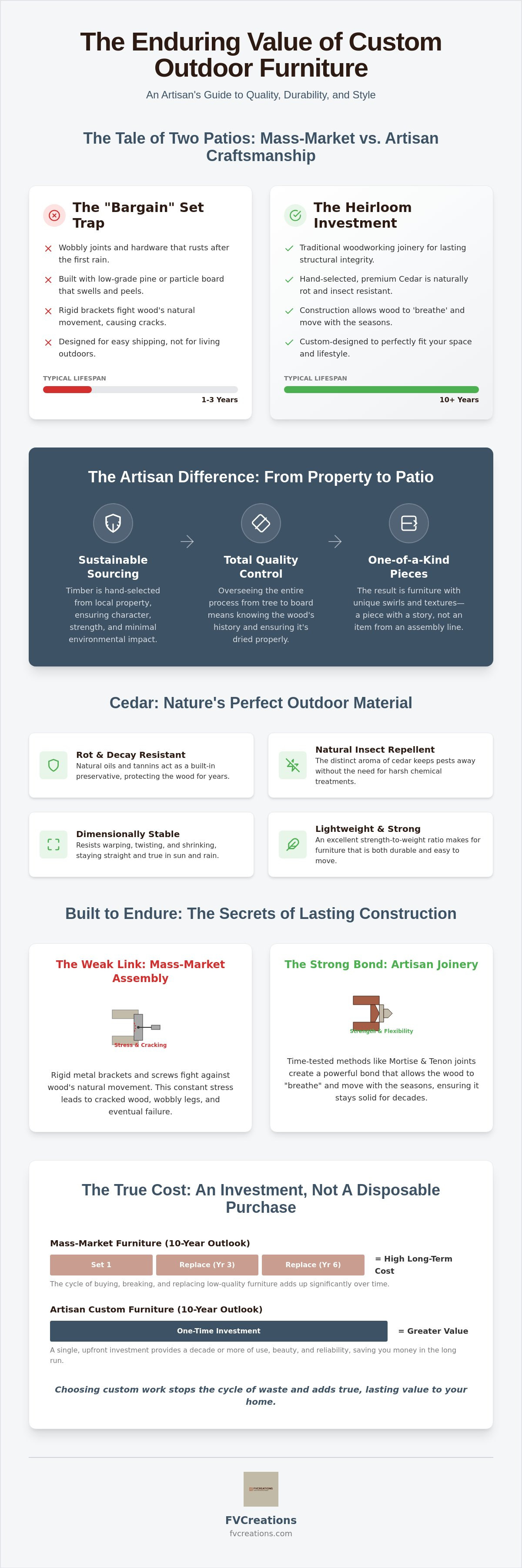
Wood is a living material. It breathes, expanding when the air is thick with humidity and shrinking when the dry winter winds blow. Most big-box sets ignore this reality. They use rigid metal brackets that fight against the wood's natural movement, which eventually leads to cracks and wobbly legs. In my work, I rely on traditional woodworking joinery. These time-tested methods allow the furniture to shift slightly with the seasons without losing its structural integrity. It's a bit more work, but it's the only way to ensure a bench or table stays solid for a decade or more.
The Flaw in "Flat-Pack" Outdoor Decor
The "disposable furniture" trap is real. Many "ready-to-assemble" sets rely on cheap cam locks, thin veneers, and hardware that rusts the moment it gets wet. Once moisture finds its way into the low-grade soft pine or particle board used in these sets, the wood swells and the finish peels. These off-the-shelf designs are built for a generic warehouse, completely ignoring how a humid coastal climate or a high-altitude sun will affect the material differently. They are designed to be shipped easily, not to live outdoors.
The Investment Value of Bespoke Craftsmanship
If you look at the "cost per year," the value of custom work becomes clear. You might pay more upfront for a set of cedar planters with legs than you would for a plastic or cheap pine alternative, but you won't be replacing them in three years. Cedar is naturally rot-resistant and handles the elements without the need for toxic chemical treatments.
- Maximize your space: Custom sizing means you don't have to settle for a table that blocks your walkway or a bench that leaves an awkward gap.
- Heirloom quality: Well-built wooden furniture actually gains character over time and holds its resale value far better than mass-market junk.
- Personal connection: There's a certain pride in knowing exactly who built your furniture and where the wood came from.
Choosing custom work is a way to stop the cycle of waste. It's an investment in your home that supports a real craftsman and results in a backyard you'll actually want to spend time in.
The Artisan Difference: Sourcing Sustainable, Property-Harvested Wood
I've always believed that a piece of furniture starts with the tree, not the saw. For me, that means walking out onto my own land and selecting the timber myself. I call it my "Property-to-Patio" philosophy. Most commercial lumber yards prioritize volume and speed, but when I'm crafting custom outdoor wood furniture, I'm looking for character and strength that you just can't find in a stack of pre-cut boards. This approach ensures that every piece of custom outdoor wood furniture leaving my shop has a story that begins right here on the property.
Sourcing wood this way gives me total quality control. I see the tree before it's a board, so I know its history and how it was dried. It also cuts out the "timber miles" that come with imported hardwoods. While some folks prefer shipping heavy wood across oceans, I think there's more value in supporting our local ecosystem. Plus, the grain patterns in property-harvested wood are far more interesting. You get unique swirls and textures that make your piece a one-of-a-kind original rather than something that looks like it came off an assembly line.
Cedar: The King of North American Outdoor Wood
Cedar is the backbone of my workshop for a good reason. It's packed with natural tannins and oils that act as a built-in defense system. These properties repel insects and resist rot naturally, so you don't have to worry about the wood falling apart after a few rainy seasons. It also has incredible dimensional stability. This means it stays straight and true while other woods might twist or warp under the hot sun. There's also the smell. That fresh, grounding aroma of cut cedar is one of the best parts of having these pieces in your backyard.
Sustainability as a Standard, Not a Trend
I don't believe in clear-cutting or industrial logging. Instead, I practice selective harvesting. This means only taking what the land can spare and leaving the rest to thrive. Sustainable woodworking isn't just a buzzword; it's a cycle of growth and creation that respects the land as much as the final product. I try to use every single part of the tree to minimize waste. Even the smaller scraps that aren't big enough for a bench get turned into something useful. If you're looking for a way to start your own backyard fire with some of these natural materials, you can find my handmade firestarters and other small-batch items on my site. It's all about making sure nothing goes to waste.
Evaluating Construction: Joinery and Finishes for the Elements
Building furniture that sits on a deck is a whole different animal than building a dresser for a bedroom. While interior specialists like Bois & Design focus on the precision of custom interior fittings and furniture, outdoor pieces require a unique approach to durability. Out here, the rain, sun, and snow are constantly trying to pull the wood apart. If you want your custom outdoor wood furniture to last more than a few seasons, you have to look closely at the bones of the piece. It's not just about the surface. It's about how the joints are cut and how the wood is protected from the inside out. When I'm in the shop, I'm thinking about how a bench will look in ten years, not just how it looks on the day it's delivered.
The secret to a piece that doesn't wobble after two summers is what I call "heirloom joinery." While a factory might use metal brackets or simple pocket screws, I rely on the mortise and tenon joint. This is an interlocking connection where one piece of wood fits perfectly into a hole carved into another. It creates a massive surface area for bonding and a mechanical strength that metal fasteners can't match. Screws and nails can rust or eventually "wall out" the wood as it expands and contracts, but a well-cut wood joint moves with the piece. It's a traditional method, but it's still the best way to handle the heavy-duty demands of a garden bench or a large outdoor table.
Why Joinery Matters More Outdoors
Wood is going to move; there's no stopping it. An artisan understands this and builds "breathing room" into the design. By using interlocking wood joints instead of rigid metal fasteners, we allow the timber to swell in the humidity and shrink in the dry cold without cracking the frame. When you're looking at a piece of custom outdoor wood furniture, check the corners. You should see tight, clean fits where the wood meets. If you see gaps or rely solely on visible screw heads, that piece is likely to struggle when the weather turns. I also use high-performance anchors like BOSSDOG Glues for structural bonds and Starbond Adhesives for filling grain or securing details. These aren't your average hardware store glues. They are professional tools that ensure the joints stay sealed against moisture.
Finishing for Decades of Defense
Most people think a thick, shiny layer of varnish is the best way to protect wood. Actually, those "film-forming" finishes are often the cause of rot. They act like a plastic wrap that eventually gets brittle and cracks in the sun. Once water gets under that crack, it's trapped against the wood with nowhere to go. I prefer a different approach. I use Real Milk Paint Co. Finishes and natural oils because they soak deep into the wood fibers. They don't sit on top; they become part of the wood.
- Breathability: Natural oils let moisture escape so the wood doesn't rot from the inside.
- Easy Maintenance: You don't have to sand the whole piece down to bare wood to refresh it.
- The "Glow": These finishes highlight the natural grain of the cedar rather than hiding it under a layer of plastic.
Keeping your furniture looking new doesn't have to be a chore. A simple application of wax or a fresh coat of oil every year or two is usually all it takes to maintain that deep, healthy cedar glow. It's a simple way to honor the material and keep the "soul" of the piece alive for decades.
Designing Your Space: How to Commission a Custom Piece
Commissioning custom outdoor wood furniture shouldn't feel like a cold transaction. It's a partnership. We start by looking at what you actually need. Maybe you're tired of bending over to tend to your garden and need a set of Cedar Planters with Legs. Or perhaps you have a specific corner on your porch that's always felt empty. Whatever it is, identifying the "why" behind the piece is the first step in creating something that will serve you for years. I find that the best projects come from a shared understanding of how the furniture will be used every day.
Once we know what we're building, we move into the details of style and material. I love working with folks to decide if they want a clean, modern look or a more property-inspired live edge that shows off the natural curves of the timber. We'll talk about the best finish for your specific environment, whether it's sitting in the direct afternoon sun or tucked away in a shaded nook. This collaboration is where the soul of the piece really starts to take shape. It's about more than just dimensions; it's about making sure the custom outdoor wood furniture feels like it belongs in your home. For those looking to upgrade their entire outdoor living area, check out Cascade Outdoor Services for professional hardscaping and deck restoration that provides a beautiful foundation for your new pieces.
Measuring for Success
One of the biggest mistakes I see is people forgetting to account for "walking room." A table might fit on your patio, but can you actually pull the chairs out without hitting the railing? I always suggest using painter's tape to mark out the footprint of the furniture on your deck. It's a simple way to visualize the scale before any wood is cut. If you're looking at something like elevated cedar planters, consider the height that feels comfortable for you to avoid back strain. Getting these numbers right early on saves a lot of headaches later.
Communicating Your Vision to the Artisan
You don't need to be a designer to work with me. If you have a few reference photos of styles you like, that's great. But don't be afraid to ask for a "Farmer Vic" original that plays to the strengths of the specific wood I have in the shop. A clear brief about the intended use helps me choose the right boards and joinery for the job. Providing a clear picture of your vision leads to a better bespoke result every time.
Quality takes time. Because I'm a one-man shop, I don't have a warehouse full of pre-made items. Every piece goes through a methodical production cycle, from selecting the timber to the final coat of oil. I'm always transparent about my current schedule, so you'll know exactly when to expect your delivery. If you're ready to get started, you can reach out to me today to talk about your ideas. It's the best way to ensure your backyard is ready for the next season.
The FVCreations Process: Handcrafted by Farmer Vic
When you reach out to FVCreations, you aren't talking to a customer service department or a sales rep. You're talking to me. My workshop is a one-man operation because I believe that quality happens when one person takes responsibility for every cut, every joint, and every coat of finish. This isn't high-volume manufacturing. It's a deliberate process where I personally vet every board for your custom outdoor wood furniture. If a piece of cedar doesn't meet my standards for grain or stability, it doesn't make it into your backyard. It's that simple.
My work doesn't stop once the sawdust is swept up. I want to make sure your investment stays beautiful for years. That's why I also provide the same supplies I use in my own builds, like Real Milk Paint Co. Finishes and specialized waxes. I've personally tested these on my own property, so I know they work. Buying custom outdoor wood furniture is just the beginning of our relationship. I'm here to help you understand how to care for the wood so it ages gracefully with your home.
From the Workshop to Your Door
The journey of a cedar planter is a steady one. It starts with timber sourced right here on the property, moving through the drying process before I ever touch it with a saw. Once the build is complete, I handle the packing myself. Shipping handcrafted goods nationwide requires a bit of extra care to ensure they arrive safely. When you open your delivery, you'll see the results of that patience. You'll smell the fresh cedar and see the hand-rubbed finish. It's a tactile experience that big-box stores just can't replicate.
Joining the Artisan Community
I like to think of my customers as part of a community that values things made by hand. These custom pieces eventually become part of your family’s story, the backdrop for summer dinners and quiet mornings in the garden. If you ever have a question about maintenance or need a recommendation for a touch-up, I'm just an email away. I take a lot of pride in seeing my work live on in your spaces. If you're ready to see what's currently on the bench or want to start a conversation about a new project, you can view our current handcrafted collection or request a custom quote through the site. Let's build something that lasts.
Building a Backyard That Lasts
You don't have to settle for the cycle of replacing flimsy, greyed-out patio sets every few years. Investing in custom outdoor wood furniture is a way to bring artisan soul to your backyard while ensuring your investment actually stands up to the elements. We've looked at how hand-selected wood from my own property, combined with traditional joinery methods, creates a level of durability that mass-market alternatives simply can't match. It's about moving away from disposable decor and toward pieces that carry a real story and a sense of place.
I handle every step of the process in my one-man workshop, from the first cut of the timber to the final coat of protective oil. I also provide nationwide shipping on all handcrafted goods, so you can have a piece of this craftsmanship no matter where you live. If you're tired of guessing at quality and want to start building a space you'll love for a decade or more, I'm here to help. You can start your custom outdoor furniture commission with Farmer Vic today. Let's create something beautiful together.
Frequently Asked Questions
How long does custom outdoor wood furniture typically last?
High-quality custom outdoor wood furniture should last 10 years or more with basic maintenance. I build my pieces using cedar because it's naturally resistant to rot and insects. When you combine those natural defenses with traditional joinery that doesn't rely on flimsy staples, you get a piece that can withstand the seasons much longer than mass-market alternatives.
Do I need to seal my cedar furniture every year?
You don't necessarily need to apply a fresh sealer every single year. It really depends on how much direct sun and rain your furniture faces. I recommend checking the finish each spring; if water no longer beads on the surface, it's time for a quick refresh with some natural oil or wax to keep the wood fibers protected from the elements.
What is the best wood for outdoor furniture in wet climates?
Cedar is the top choice for wet climates because of the natural oils and tannins found deep within the wood. These properties act as a built-in defense system against moisture and fungal decay. Unlike other woods that might warp or swell when things get soggy, cedar stays dimensionally stable and holds its shape through heavy rain and humidity.
Can I request custom sizes for the cedar planters on your site?
Yes, I can certainly adjust the dimensions for Cedar Planters with Legs or any other items to fit your space. Since I handcraft everything in my workshop, I'm not limited to standard factory sizes. Just reach out with your measurements, and we can figure out a design that works for your specific deck layout or garden path.
What is the difference between property-sourced wood and store-bought lumber?
Property-sourced wood allows me to oversee the quality from the moment the tree is selected on my land. Store-bought lumber is often mass-produced and kiln-dried too quickly, which can lead to hidden cracks and more warping later on. Sourcing timber from my land is a big part of why my custom outdoor wood furniture looks and performs differently than store-bought options.
How do I maintain the color of my cedar bench?
To keep your cedar from turning that weathered grey color, you'll want to use a finish with UV inhibitors. I use Real Milk Paint Co. Finishes because they soak deep into the grain and block the sun's rays. If the wood does start to fade, a light cleaning and a fresh coat of oil will bring back that warm, healthy glow immediately.
Are the finishes used on FVCreations furniture safe for vegetable gardening?
The finishes I use, including Real Milk Paint, are completely safe for vegetable gardening. I'm very careful about what I put on pieces like Cedar Inground Raised Planting Beds because I know you'll be growing food for your family in them. These natural finishes provide solid protection without leaching harmful chemicals into your soil or your harvest.
How long does the custom commission process take?
The timeline for a custom commission varies depending on my current shop schedule and the complexity of the project. Since I'm a one-man operation, I focus on quality over speed to ensure every joint is perfect. Most garden items have a lead time, so it's a good idea to check in early if you want custom outdoor wood furniture ready for the spring.