

Food-Safe Wood Wax for Cutting Boards: How to Choose and Use It
What if a wax labeled “food-safe” still isn’t the right choice for your cutting board? The words on the front aren’t the whole story. To choose food safe wood wax for cutting boards, check the complete formula and confirm that the product is intended for this kind of food contact.
Ingredient lists can be unclear, and it isn’t always obvious whether a board needs oil, wax, or both. A finish that leaves a sticky surface or residue is not the result you want on a board used with food.
This guide explains how to assess a product’s label and ingredients, understand how oil and wax differ, and apply a suitable finish without overdoing it. You’ll also learn when to review the care instructions and how to look after your board between applications.
At FVCreations, Farmer Vic personally approves the shop’s maintenance supplies. Good care starts with understanding what you’re putting on the wood, so we’ll walk through the checks that can help you choose and use a finish with confidence.
Key Takeaways
- Choose food safe wood wax for cutting boards by checking the complete formula and whether the product is intended for food-contact use, not by relying on broad claims like “natural.”
- Wax and oil have different roles, and some board-care routines use both.
- Compare product directions and ingredient information. Contact the manufacturer if key details are unclear.
- Start with a clean, fully dry board, then follow the label for how much wax to apply and how long to wait.
- Board woods can differ in grain and appearance. FVCreations offers handcrafted boards and sources lumber through personal milling and outside lumber yards.
What makes wood wax food-safe for a cutting board?
A wood wax is suitable for a cutting board only when the complete product is intended for that use and its directions support applying it to a food-contact surface. A familiar ingredient or reassuring label alone isn’t enough. For food safe wood wax for cutting boards, look for clear information about the finished formula, its intended use, and how to apply it.
Words such as “natural,” “non-toxic,” and “homemade” describe a product, but don’t explain whether the complete finish is suitable for a board used with food. A wax might contain beeswax or a plant-derived wax, but that doesn’t tell you what else is in the formula or how the product should be used. Check the full ingredient information and manufacturer’s directions rather than relying on one appealing ingredient or broad claim.
A finish’s food-contact suitability doesn’t clean or sanitize a cutting board. Wash and care for the board separately. Wax is a maintenance finish, not a substitute for routine cleaning. For a wider introduction to finishes and their purposes, see Wood finishing.
What should a food-safe wax label tell you?
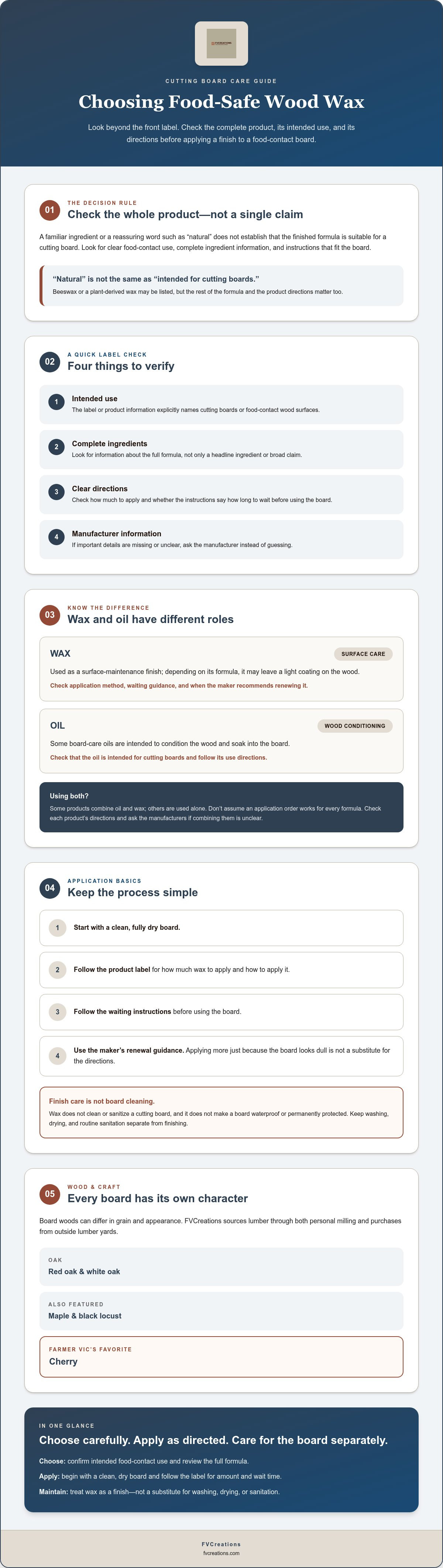
Start with the intended use. The label or manufacturer’s product information should explicitly say the wax is for cutting boards or food-contact wood surfaces. Then check that the ingredient information and application directions are clear enough to follow, including any instructions about when the board can be used after application. If a safety claim appears without a clear intended use or application guidance, ask the manufacturer before using the product.
Use this quick check:
- Intended use: The label names cutting boards or food-contact wood surfaces.
- Ingredients: The complete formula is disclosed, not just a headline ingredient.
- Directions: Application instructions and any waiting guidance are provided.
- Manufacturer information: There’s a way to ask questions if details are missing.
Does natural wax automatically mean food-safe?
No. “Natural” describes an ingredient’s origin, not necessarily the suitability of the finished product for a particular use. Beeswax and plant-derived waxes may appear in wood finishes, but their presence alone doesn’t establish that the whole formula is appropriate for a cutting board. The other ingredients and the directions matter too.
If you’re unsure, check with the manufacturer instead of guessing. A clear, specific answer is more useful than a broad reassurance. Once you’ve found a finish whose stated use and directions fit your board, apply it as directed. FVCreations’ handcrafted cutting boards offer a look at the boards we make. Choose a finish based on its own label and intended use.
How cutting-board wax works and how it differs from oil
Wax and oil can both be part of board care, but they aren’t interchangeable. Wax is generally used as a surface-maintenance finish. Depending on its formula, it may leave a light barrier on the wood, but it won’t make a board waterproof or permanently protected. Some board-care oils are intended to condition the wood. Check the specific product’s directions rather than assuming every wax or oil behaves the same way.
| Board-care product | Typical role | What to check |
|---|---|---|
| Wax | Surface maintenance; may leave a light coating on the wood. | How to apply it, how long to wait, and when the maker recommends renewing it. |
| Oil | Wood conditioning; some oils are intended to soak into the board. | Whether it’s intended for cutting boards and how often or how much to use. |
This is a general comparison, not a rule for every product. Some finishes combine oil and wax, while others are meant to be used alone. If you’re considering both, check the directions for each product and contact the manufacturers if they don’t explain whether combining them is suitable. Don’t assume one application order works for every formula.
What does wax add to a wooden cutting board?
A suitable wax can be one part of routine board maintenance, helping refresh the surface when used according to its directions. It doesn’t promise stain-proofing or lasting protection. Use the amount and method on the label, and follow the manufacturer’s renewal guidance rather than applying more just because the board looks dull.
Wax can’t replace washing, drying, or routine sanitation. Keep those care steps separate from finishing. The USDA’s cutting board safety guidelines cover cleaning and safe handling practices. A finish is not a substitute for them.
Should you use oil, wax, or both?
It depends on the board and the products. An oil may be intended to condition the wood, while a wax may be intended for surface care. Some people use products with both roles, but there’s no universal sequence for every formulation. Check whether each manufacturer allows its product to be combined with the other, and follow the stated directions.
For more on choosing and caring for handmade serving boards, see our handcrafted cutting boards. A suitable routine depends on the specific board and finish, as well as the makers’ instructions.
How to compare cutting-board wax claims and wood types
A board’s wood species can shape its appearance and grain, but it can’t tell you whether an unspecified wax is suitable for food contact. Judge the finish by its own intended use and directions, then follow care guidance for the particular board. These are separate questions: what the board is made from and what the finish is made from.
Which questions should you ask before choosing a wax?
Use this checklist before applying a product. If an answer is missing, ask the manufacturer rather than filling in the gaps yourself:
- Is the complete formulation intended for food-contact cutting boards? Look for a specific statement about this use, not a general safety phrase.
- Are the ingredients disclosed? Check the full list, not only a featured ingredient.
- What do the directions say? Review application, any stated waiting or curing time, reapplication, and cleaning instructions.
- Who can clarify the claim? Contact the maker if the ingredients, intended use, or directions aren’t clear.
The University of Maine Cooperative Extension offers cutting board conditioning and safety guidance, including food-safe mineral oil or beeswax as conditioning options. Treat that as general board-care information, not approval of every product containing one of those ingredients. For food safe wood wax for cutting boards, the finished product and its label still need to suit the intended use.
Does the board’s wood species change the care routine?
Species can differ in grain and appearance, but don’t use the name of a wood as a shortcut for choosing a finish. Red oak has more open pores than white oak, while white oak is generally described as having a tighter grain. Hard maple is a familiar dense-grained board wood. Black locust is another species woodworkers may encounter, but species alone doesn’t establish which finish is appropriate. Follow product-specific instructions and verify the board’s species before making care assumptions.
Cherry deserves a mention of its own. Farmer Vic calls it his favorite species, a personal preference rather than a safety claim or confirmation that a particular board is made from cherry. Its warm color and fine, straight grain give it a distinctive look, but choose the finish by its own label. The handcrafted cutting-board selection lets you explore board styles without assuming which species a specific board uses.
At FVCreations, lumber comes from personal milling and purchases from outside lumber yards. Wherever a board’s wood originated, confirm its species and follow the guidance for the exact finish you plan to use.
How to apply food-safe wood wax to a cutting board
Prepare the board before opening the wax. Check the product label, then follow its instructions for the amount to use, application method, and waiting time. These details vary by formula, so don’t rely on a routine intended for another product.
- Wash and dry the board. Clean it according to the board’s care instructions, then let it dry thoroughly. Waxing a damp or dirty surface gives you a poor starting point.
- Inspect the surface. Check for damage, leftover food, or residue from an earlier application. If the board needs attention first, address that before applying another finish.
- Test first if directed. Some product makers recommend trying the wax on an inconspicuous area. Follow that advice and check the result before treating the whole board.
- Apply as the label instructs. Use the stated amount and method. More wax doesn’t necessarily mean better care.
- Wait as directed, then check the surface. Follow the product’s stated waiting time. If the directions call for removing excess, wipe it away as instructed to avoid unwanted buildup.
What should you do before applying wax?
Start with a clean, fully dry board, then check its condition. If you see damage or residue, don’t simply cover it with a new layer of product. Follow the board maker’s care guidance, and contact the wax manufacturer if the label doesn’t explain how to handle the situation. Do the same if you’re unsure whether the product is appropriate for your board.
How do you know when to renew the finish?
Use the product maker’s reapplication guidance rather than setting a fixed schedule. A surface that looks unusually dry or feels different may be a cue to review the board’s and finish’s care instructions, not an automatic signal to add more wax. Too much product can leave residue, so let the label guide your next step.
Wax doesn’t replace prompt cleaning and thorough drying after use. Keep those everyday habits in place, and treat finishing as a separate part of board care. For more general advice, read our wooden cutting-board care guidance. If you’re choosing a board, explore FVCreations’ handcrafted cutting boards.
Choosing a board-care finish with an artisan’s eye
Choose a finish based on the product, not just the promise on the front of the container. Read the label, check the complete ingredient information, and make sure the directions fit your board and how you plan to use it. That’s the practical way to assess food safe wood wax for cutting boards without relying on broad claims or guesswork.
At FVCreations, founder Farmer Vic personally approves the shop’s maintenance supplies, including products such as oils, waxes, sanding paper, and glues. That hands-on approach reflects care in selecting shop supplies, but it doesn’t make every product suitable for every board. Check current product information, and ask the maker if you can’t confirm a finish’s intended use or application instructions.
What can an artisan’s experience help you evaluate?
A maker can help explain what a finish is intended to do, how to read its directions, and what care the board may need afterward. That perspective is useful, but the label and current manufacturer information remain the guide for a specific product. For broader context on finishes and traditional methods, explore our traditional wood-finishing guidance.
Materials matter, too. FVCreations’ lumber comes from two sources: lumber Farmer Vic mills personally and lumber purchased from outside lumber yards. Knowing where a board’s wood came from can be part of understanding its craftsmanship, but it doesn’t replace checking the finish instructions. Choose care products based on the board maker’s guidance and the specific finish label.
How can you care for a board after waxing?
Keep the routine simple and follow the board maker’s care instructions. After use, clean the board promptly by hand and dry it thoroughly. Wax is a maintenance finish, not a reason to leave food residue on the surface or skip everyday care. If you’re unsure about a cleaning method, check with the board maker rather than assuming every board can be treated the same way.
Keep the wax label and care instructions where you can find them. They’ll help you confirm the application method and the maker’s guidance for renewing the finish. If product information changes or you’re considering a different finish, review the instructions again instead of relying on memory.
If you’re choosing a board to care for, take a look at FVCreations’ handcrafted cutting boards. Each board needs a care routine suited to its maker’s guidance and the finish you’ve selected.
Choose a finish with confidence and care for your board
The right food safe wood wax for cutting boards is one whose complete formulation and directions suit food-contact use. Don’t rely on a “natural” or “non-toxic” label alone. Check the ingredients, intended use, and application instructions. Remember that wax and oil have different roles, and keep up with regular cleaning and thorough drying whichever finish you choose.
At FVCreations, founder Farmer Vic personally approves the shop’s maintenance supplies. We also make handcrafted cutting and charcuterie boards. A thoughtful finish is only one part of board care. Choose a product you understand and can use as directed.
Ready to explore? Explore handcrafted cutting boards and practical wood-care guidance. Review the finish instructions and follow a steady care routine to keep your board in good condition.
Frequently Asked Questions
Is beeswax safe to use on a cutting board?
Beeswax may be suitable for a cutting board, but its presence alone doesn’t establish that the finished product is appropriate for food contact. Check that the wax is specifically intended for cutting boards or food-contact wood surfaces, and read the complete ingredient information and directions. If the label is unclear about the formula or intended use, contact the manufacturer before applying it.
Can I use any wood wax on a cutting board?
No. A wax meant for furniture or other wood surfaces isn’t automatically suitable for a board used to prepare food. Choose a product whose label clearly states that it’s intended for cutting boards or food-contact wood surfaces. Check its ingredients and instructions, too. If the manufacturer doesn’t clearly explain its intended use, ask before using it on the board.
How do I know if wood wax is food-safe?
Look for a clear statement that the finished product is intended for food-contact cutting boards or wood surfaces, then review its complete ingredients and application directions. Broad terms such as “natural” or “non-toxic” don’t answer that question by themselves. For food safe wood wax for cutting boards, the intended use of the complete formula matters, not just one ingredient. Contact the maker if details are missing.
Can I apply wax over oil on a cutting board?
You may be able to use both, but don’t assume every oil and wax are compatible or that one application order suits all products. Check the directions for each finish and look for guidance on combining them. If the labels don’t address this, contact their manufacturers before layering products. Follow any stated application and waiting instructions, and don’t apply wax over oil that hasn’t been handled as directed.
How often should I wax my wooden cutting board?
Follow the wax maker’s reapplication guidance rather than using a fixed schedule. A board that looks dry or feels different may be a reason to review its care instructions, but it doesn’t automatically mean more wax is needed. Applying extra product can leave residue. Keep the label or a copy of its directions so you can check the recommended application and renewal guidance when the board needs attention.
Does food-safe wax sanitize a cutting board?
No. Wax is a maintenance finish, not a cleaning or sanitizing method. Wash the board promptly after use and dry it thoroughly, following the board maker’s care instructions. Don’t rely on a wax coating to remove food residue or replace routine cleaning. If you’re unsure which cleaning practices suit your particular board, check its care guidance rather than assuming the finish changes those instructions.
Should I wax a new cutting board before using it?
Not necessarily. First check the board maker’s instructions to see whether the board is already finished and whether additional wax is recommended. If you plan to apply a product, confirm that its label identifies cutting boards or food-contact wood surfaces as an intended use. Follow its directions for preparing the surface and applying the finish, including any stated waiting time before use.