

How to Choose the Best Lumber for Your Next Wood Project
You're standing in a dusty lumber yard, staring at a stack of boards that all look identical, but one of them is destined to warp into a propeller the moment you take it home. It's a frustrating feeling that every woodworker knows. Learning how to choose lumber for a project isn't just about picking the prettiest grain; it's about understanding the life the tree lived before it hit my saw. In my workshop, I see wood from two worlds. I mill quite a bit myself right here on the property to find those unique, wild pieces, but I also head to the local yard for specific needs.
I know the confusion of sorting through hardwood labels or worrying if an expensive slab of White Oak will crack. You want to walk into any shop with the confidence of an artisan who knows exactly what to look for. This guide will teach you my personal checklist for inspecting boards and help you distinguish between Red Oak, White Oak, sturdy Black Locust, or versatile Maple. We will even dive into why Cherry remains my absolute favorite wood to work with. By the time we're done, you'll have a clear path from the lumber pile to a finished piece that lasts.
Key Takeaways
- Learn why I use a mix of my own property-milled wood and lumber yard finds to get the best of both worlds for any build.
- Master the essentials of ho to choose lumber for a project by understanding the unique physics behind species like Maple and rot-resistant Black Locust.
- See the clear differences between Red Oak and White Oak so you don't accidentally use the wrong one for an outdoor planter.
- Find out why Cherry is my favorite wood in the workshop and how its natural grain responds to traditional finishes like Real Milk Paint.
- Follow my workshop inspection guide to catch warping and moisture issues before you bring a board home.
Hardwoods vs. Softwoods: Understanding the Physics of Your Project
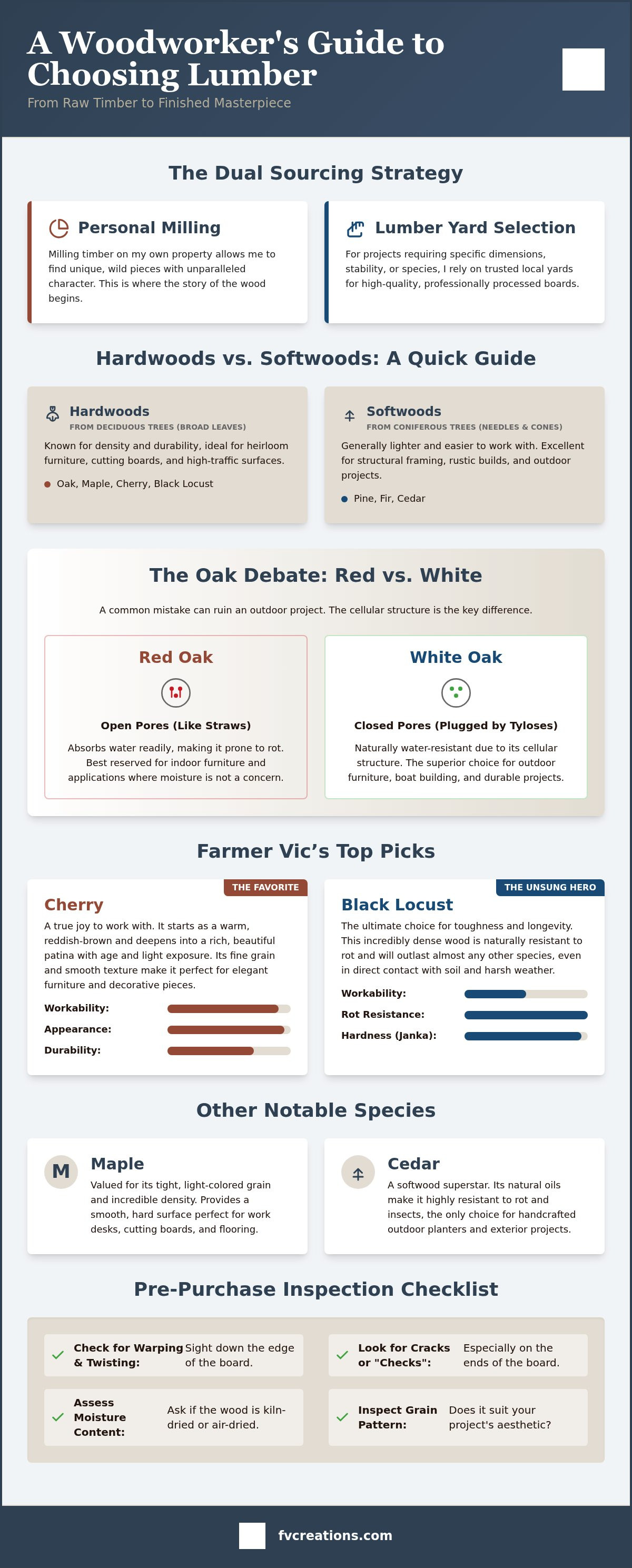
When you're standing in the workshop trying to figure out ho to choose lumber for a project, the first step is settling the hardwood versus softwood debate. It sounds like a test of physical strength, but it's actually about how the trees reproduce. Hardwoods come from deciduous trees with broad leaves that usually drop in the fall. Softwoods come from conifers, which are the ones with needles and cones.
I've learned through years of milling my own timber on the property and visiting local yards that these names can be a bit of a trick. A soft wood like Cedar is actually one of the toughest fighters against rot you'll ever find. Your choice really comes down to the environment where the final piece will live. If it's going to sit in the rain, you need the biology of the wood to work for you, not against you.
When to Reach for Softwoods
Softwoods like Pine and Fir are the backbone of most structural framing. They're lighter and easier to move around, which makes them great for wall decor or rustic builds. However, the real star in my shop is Cedar. It is technically a softwood, but its natural oils make it the only choice for my handcrafted cedar planters. Whether I'm milling a Cedar log myself or picking up a batch from a reputable yard, I trust its ability to stay stable in the mud and sun.
The Strength of Hardwoods
Hardwoods are where we find the heirloom quality. If you're making handmade charcuterie boards, you want a surface that won't scar every time a knife touches it. This is where the Janka hardness scale comes in. It's a lab test that measures how much pressure it takes to embed a steel ball into the wood. I often use Maple for desk tops because it's incredibly dense and bright. For something even tougher, Black Locust is a beast that outlasts almost anything. Then there is Oak. I make a big distinction between Red Oak and White Oak; White Oak has a closed cellular structure that keeps water out, while Red Oak is porous like a bundle of straws. And of course, there's Cherry. It's my personal favorite species because of how the grain warms up over time. Knowing these physical traits is the secret to ho to choose lumber for a project that will last for generations.
When looking at hardwoods, consider these specific traits for your build:
- White Oak: Very high rot resistance and a closed grain, perfect for heavy furniture.
- Black Locust: Extremely high Janka rating, making it nearly indestructible for outdoor use.
- Maple: A tight, light-colored grain that provides a smooth, hard surface for work desks.
- Cherry: A rich, fine grain that darkens beautifully with exposure to light.
A Closer Look at Species: From Sturdy Oak to My Favorite Cherry
Selecting the right tree for the job is where the real fun begins in my workshop. Whether I'm pulling a fresh slab off my own mill or walking the aisles of a commercial lumber yard, I look for a balance of character and utility. If you want to know ho to choose lumber for a project, you have to look past the surface color. Every species has a distinct personality. Some are stubborn and prone to splintering, some are forgiving for beginners, and a few, like Cherry, are just a joy to have on the workbench.
The Oak Debate: Red vs. White
People often group all Oak together, but that is a mistake that can ruin an outdoor build. Red Oak has a distinct pinkish hue and an open grain. If you look at the end of a board, those pores are like open straws. It'll soak up water and rot quickly if left outside. White Oak is different. It contains a cellular growth called tyloses that effectively plugs those pores, making it naturally water-resistant and much more durable. It also has higher tannin levels, which can react with iron and turn the wood black, so I always recommend being mindful of the hardware you choose for White Oak builds.
Farmer Vic’s Top Picks: Cherry and Black Locust
If you want to talk about my absolute favorite species to work with, it's Cherry every single time. This hardwood starts as a warm, reddish-brown and gets darker and deeper as it ages. It has a "soul" that other woods just can't match, and it mills like butter under a sharp plane. For projects that need to live in the dirt or handle the harshest weather, I skip the fancy grains and go for Black Locust. It's the unsung hero of the woods. It is incredibly dense and will outlast almost any other species, even when it's in direct contact with the ground.
Finally, there's Maple. It's my go-to for clean, modern looks or heavy-duty shop jigs because it is so hard and bright. It provides a stable, dent-resistant surface that stays beautiful for years. Because these hardwoods are so reliable, I love using them for my handmade charcuterie boards, where the natural grain can really shine. Understanding these specific traits is the best way to ensure you don't waste money on a species that isn't up to the task you have in mind.
Sourcing Your Boards: Personal Milling vs. The Lumber Yard
When you're deciding ho to choose lumber for a project, you have to decide where that wood is coming from. In my workshop, I take a dual approach. I mill a good portion of my lumber right here on the property, but I also rely on professional lumber yards for specific needs. Sourcing wood from your own land is the ultimate way to ensure sustainability. It's a deep, personal connection to the material. When I build a piece from a tree I watched grow, there's a level of accountability and pride that you just can't buy at a big box store.
The Journey of Property-Harvested Wood
Milling your own timber is a slow process that requires a lot of patience. Unlike the kiln-dried boards you find at a yard, property-harvested wood usually needs to be air-dried. The rule of thumb is often one year of drying for every inch of thickness. It's a long wait, which is why some woodworkers prefer using professional services like Bourbon Bigfoot Woodworking for custom sawmilling and vacuum kiln drying to stabilize the wood much faster. Regardless of the method, the result is wood with incredible character. You get to work around natural inclusions and knots that commercial yards might grade out as defects. To me, those "defects" are the fingerprints of the tree. Whether it's a piece of my favorite Cherry or a sturdy slab of White Oak, home-milled wood offers grain patterns that are truly one of a kind.
There are times when a project needs the consistency of a commercial yard. If you need perfectly flat, kiln-dried boards in specific dimensions, the yard is your best friend. Understanding the lingo is half the battle. You'll see terms like FAS, which stands for First and Seconds. This is the top grade, meaning the boards are mostly clear of knots. You'll also see thicknesses listed as 4/4 or 8/4. A 4/4 board is roughly one inch thick in its rough state, while 8/4 is two inches thick.
Don't be afraid to talk to the sawyer or yard manager. They're usually folks who love wood as much as we do. Tell them what you're building. If you're looking for Maple for a desk or Black Locust for a fence post, they can point you to the right stack. Learning ho to choose lumber for a project at a yard means being willing to dig through the pile to find the straightest grain. It's all about finding the right balance between the wild beauty of home-milled slabs and the reliable standards of the professional yard. If you want to see how these high standards translate into finished architectural elements, you can check out Arborfield Joinery for examples of expertly crafted doors, windows, and stairs.
The Workshop Inspection: How to Spot Quality Lumber and Avoid Defects
Picking out wood is like a first date; everything looks great until you get it home and the light changes. When I'm teaching folks ho to choose lumber for a project, I tell them to trust their eyes but verify with their tools. Whether I'm looking at a slab of my favorite Cherry that I milled last year or a stack of Maple at the yard, the inspection process is the same. You have to be willing to get your hands dirty and look at the wood from every angle.
The Four Horsemen of Warping
There are four main ways a board can try to ruin your day: cup, bow, twist, and crook. Cupping happens across the width, making the board look like a shallow trough. Bowing is a curve along the face, like a literal archer's bow. A crook is a bend along the edge, while a twist is the most frustrating of all, where the corners aren't in the same plane. I always peer down the length of a board like I'm aiming a rifle. If it's twisted, I usually put it back. You can plane out a little bit of a cup or a bow, but a heavy twist in a piece of Black Locust or White Oak is often a losing battle. Remember that wood is a living thing. A board that sits flat in a climate-controlled yard might start moving the second it hits the humidity of your workshop.
Checking for Hidden Flaws
Some problems aren't visible to the naked eye. Case hardening is a common one in kiln-dried lumber, where the outside is dry but the inside is under massive tension. You won't know it's there until you rip the board and it suddenly pinches your saw blade. This is why I always carry a moisture meter. If I'm working with Red Oak or Maple, I want to know the moisture content matches my shop's environment. I also take a second to read the end grain. If the growth rings are tight and vertical, that board is going to be much more stable than one with wide, flat rings. I also look for tiny pinholes that suggest powderpost beetles. If I see those in rough-sawn lumber, that board stays where it is. I don't want those guests in my workshop.
Sometimes, though, a board is too beautiful to reject just because of a small crack or a check at the end. In those cases, I reach for Starbond adhesives. A little bit of CA glue can stabilize a knot or seal a minor check in a piece of Cherry, saving a board that might otherwise end up in the scrap pile. It's about knowing when to fight for a piece of wood and when to let it go. If you want to keep your own projects stable, you can shop my favorite Starbond adhesives here to handle those minor workshop repairs.
Finishing Strong: Matching Your Wood Choice to the Right Treatment
Once you have navigated ho to choose lumber for a project and finished your joinery, you are at the most rewarding stage. Finishing isn't just about slapping on a coat of protection. It is about a final conversation with the grain. If I am working with a piece of Cherry that I milled myself, I want a finish that lets that reddish-brown soul shine through rather than hiding it under a thick, artificial layer. The goal is to highlight the natural origin of the material, whether it came from a professional yard or my own timber stand.
Species like Oak and Cherry have a lot of character in their pores and grain lines. For a traditional, non-toxic look that feels right at home on an heirloom piece, I often reach for Real Milk Paint. It provides a breathable, matte surface that doesn't feel like a layer of plastic. It is a favorite in my workshop because it honors the manual craftsmanship of the build while staying safe for the home environment.
Natural Oils vs. Film Finishes
I have always preferred the tactile feel of wood under my hand. Polyurethanes can sometimes make a beautiful piece of Maple look like it is encased in a candy coating. Maple is also notorious for blotching if you use heavy stains, so I prefer clear oils that soak in evenly. Oak is different. Its deep pores act like tiny reservoirs for oil, creating a rich, three-dimensional effect that you just can't get with film finishes. I want my wood to breathe and age naturally, not stay frozen under a synthetic shell.
Protecting Your Investment
When you spend time selecting the perfect Black Locust or Cedar for an outdoor build, you have to think about the sun and rain. I use Outdoor Defense Oil to keep these species from graying too quickly and to maintain their structural integrity. For my handmade charcuterie boards, the priority shifts to food safety. A regular maintenance schedule of re-oiling every few months keeps the wood hydrated and safe for the kitchen.
Remember that wood like Cherry is famous for its patina. It will naturally darken and gain depth over the years as it is exposed to light. Don't fight that process. Embrace the way the wood changes. Learning ho to choose lumber for a project is only half the battle; knowing how to care for it ensures that your work stays beautiful for decades to come.
- Outdoor Maintenance: Re-apply UV-protectant oils annually for furniture and cedar planters.
- Kitchen Gear: Use only food-grade oils and refresh them whenever the wood starts to look dull or dry.
- Indoor Furniture: Dust with a damp cloth and avoid harsh chemicals that can strip away natural oil finishes.
Building with Confidence and Character
Every great build starts long before the first cut is made. By now, you know that ho to choose lumber for a project involves more than just looking at a price tag. It is about understanding the cellular difference between Red and White Oak or appreciating the extreme durability of Black Locust. Whether I am milling unique slabs right here on the property or picking out kiln-dried Maple at a yard, I look for stability and soul in every board.
I personally vet every piece of wood used in my workshop, focusing on sustainable sourcing from my own property and ensuring every item is handcrafted in the USA. If you aren't ready to start your own build just yet, you can browse our handcrafted goods to see these woods in action. From the deep warmth of my favorite Cherry to the rugged reliability of Cedar, the right material makes all the difference. Get out into the shop, trust your eyes during that inspection, and start creating something that will stand the test of time.
Common Wood Selection Questions
What is the difference between red oak and white oak for woodworking?
White Oak is naturally rot-resistant because of tyloses that plug its pores, while Red Oak is porous. This makes White Oak the only choice for outdoor items like my planters. Red Oak is better kept indoors for furniture. When you're learning ho to choose lumber for a project, remember that White Oak also has a higher tannin content, which can react with certain finishes to create a beautiful, dark patina.
Why is cherry wood considered a favorite for furniture makers?
Cherry is my absolute favorite species because of how it matures. It starts as a warm, light reddish-brown and darkens into a deep, rich color as it's exposed to light. It is a dream to work with because it mills cleanly and takes a finish beautifully. For furniture makers, that natural aging process gives the piece a soul that you won't find in species that stay the same color forever.
Is it better to buy lumber from a home center or a dedicated lumber yard?
A dedicated lumber yard is almost always better for furniture-grade wood. Home centers focus on construction-grade softwoods which are often still wet and prone to warping. At a yard, you'll find a wider variety of hardwoods like Maple and Black Locust. I use a dual approach in my own shop, sourcing specific kiln-dried boards from reputable yards while milling unique, character-filled slabs from trees right here on my property.
What are the most common wood defects to look for when choosing lumber?
You need to watch out for the four horsemen of warping: cup, bow, twist, and crook. Cupping happens across the width, while a twist is a corkscrew-like warp that's nearly impossible to fix. I also look for checking, which are small cracks at the ends of the boards, and knots that might compromise structural integrity. Peering down the length of the board like a rifle sight is the best way to spot these issues.
Can I use black locust for indoor furniture projects?
You certainly can use Black Locust for indoor projects, though it's usually prized for its outdoor durability. It is one of the hardest woods available, even tougher than White Oak. This makes it incredibly dent-resistant, which is perfect for high-traffic items like bench tops or desks. Just be prepared for its density; it can be hard on your tools, so keep your blades sharp and take shallow passes during the build.
How do I know if my lumber is dry enough to start building?
The only reliable way to know if wood is dry enough is to use a moisture meter. For indoor furniture, you typically want a moisture content between 6% and 8%. If you are building outdoor planters, 12% to 15% is usually acceptable. If the wood is too wet when you start, it will shrink and crack as it dries in your home's climate, potentially ruining all your hard joinery work and finishing.
What is the best wood species for a beginner woodworking project?
If you're just starting to learn ho to choose lumber for a project, I recommend beginning with a forgiving hardwood like Poplar or a clear Pine. They are softer and easier to cut, which builds confidence. Once you're comfortable, moving up to Maple or Cherry is a great next step. These hardwoods are stable and provide a beautiful finish that makes all the effort of a first project feel worthwhile for years to come.
Do I need to mill my own wood to get high-quality lumber?
You don't need to mill your own wood to get high-quality results, but it does offer a unique connection to your materials. I mill lumber on my property to capture grain patterns and defects that commercial yards usually grade out. However, I still buy from lumber yards when I need specific dimensions or the consistency of kiln-dried boards. Combining both methods gives you the widest range of creative options for your workshop builds.