

How to Fix a Warped Wooden Cutting Board: A Careful, Step-by-Step Guide
Can you flatten a warped wooden cutting board without making the problem worse? If your board rocks on the counter or holds a puddle after washing, it’s tempting to reach for heat, water, or a heavy stack of books. But the right fix depends on what caused the warp and whether the wood can still move back into shape. Learning how to fix a warped wooden cutting board starts with a careful diagnosis, not a quick fix.
Conflicting repair advice can make it hard to distinguish a temporary moisture imbalance from lasting damage. Wood responds to changes in moisture, and a board’s construction and grain affect how it moves. At FVCreations, Farmer Vic works with lumber he mills himself as well as wood purchased from outside lumber yards. Cherry is his favorite species, and each kind of wood has its own character.
This guide will help you check the board, understand likely causes, and choose a cautious repair approach. You’ll also learn when sanding may help, when it’s better to stop, and which everyday care habits can help your board stay flatter over time.
Key Takeaways
- Recognize cupping, bowing, twisting, and rocking so you can describe the board’s condition before choosing a fix.
- Clean and dry the board, then let it stabilize before deciding whether its shape has truly changed.
- Approach how to fix a warped wooden cutting board cautiously. Match the next step to the board’s condition instead of assuming heat or pressure will work.
- Compare repair options and know when to stop if cracks widen, joints move, or the board becomes unstable.
- Build simple care habits, including washing promptly, avoiding soaking, and drying both faces. Recognize when replacement may be the safer choice.
Why a Wooden Cutting Board Warps, and What to Check First
Warping means a board has changed shape so it no longer lies evenly flat. A cupped board curves across its width, while a bowed board curves along its length. A twisted board has corners or sections that sit in different planes. Rocking is what you may notice on the counter. It can signal a warp, but it doesn’t tell you which kind or what caused it. Moisture imbalance is one common possibility, not a diagnosis on its own.
How to tell cupping from bowing or twisting
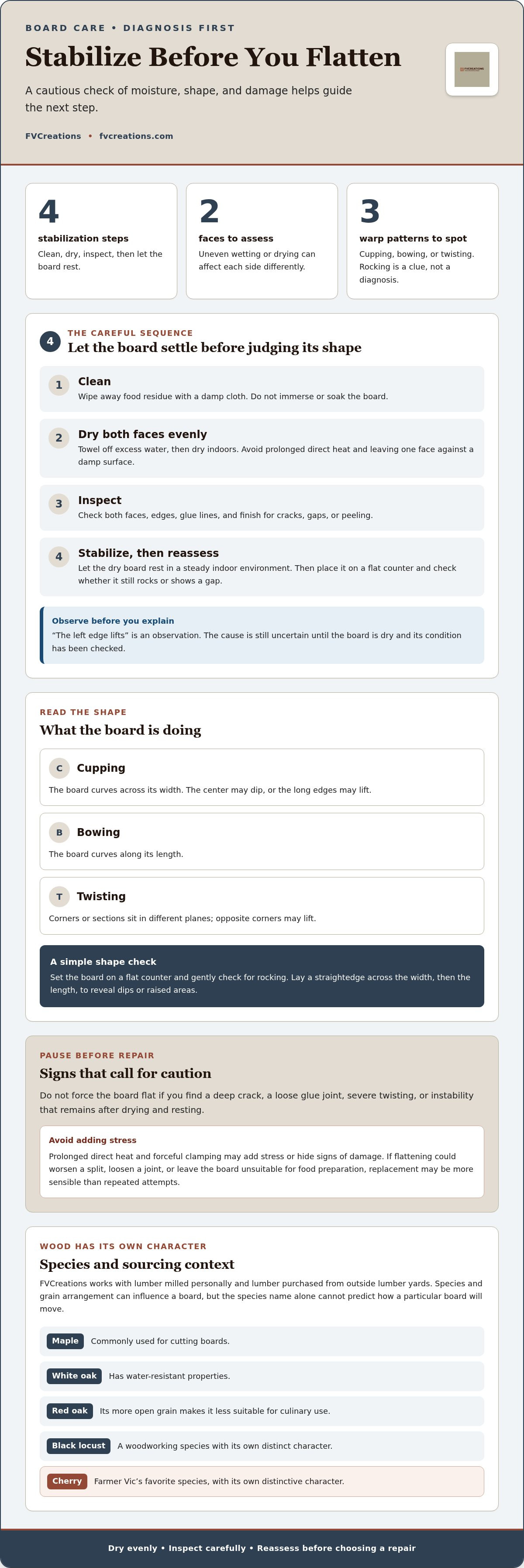
Look across the board rather than relying only on how it feels under your hand. With cupping, the center may dip or the long edges may lift, leaving a visible gap beneath part of the board on a flat surface. Bowing creates a lengthwise curve. With twisting, opposite corners may lift, preventing the board from sitting level.
Place the board on a flat counter and gently check whether it rocks. A straightedge laid across the width and then the length can help reveal dips or raised areas. Inspect both faces and all edges, including glue lines, cracks, and the finish. These checks help distinguish a surface irregularity from damage that could affect a repair.
Why wood boards change shape
Wood can take in or release moisture. If one face gets wetter or dries faster than the other, the board may move unevenly. Prolonged wetness, drying with one face against a damp surface, or heat exposure can contribute to movement, though none proves the cause by itself. The basic relationship between moisture and shape changes is described in Wood warping.
How species and construction affect board behavior
Species and grain arrangement can influence a board’s character, but neither tells the whole story. Maple is commonly used for cutting boards. White oak has water-resistant properties, while red oak’s more open grain makes it a less suitable choice for culinary use. Black locust is another wood used in woodworking, though the species name alone can’t predict how a particular board will move. Cherry is Farmer Vic’s favorite, a distinctive choice among the woods he works with.
FVCreations sources lumber through both personal milling and purchases from outside lumber yards. Each species has different characteristics: maple is a common cutting-board wood, white oak has water-resistant properties, and red oak’s more open grain makes it less suitable for culinary use. Black locust and cherry have their own distinct character, with cherry Farmer Vic’s favorite. Whatever the species, grain direction and construction matter too. Before deciding how to fix a warped wooden cutting board, note where it lifts and whether the shape curves across the width, along the length, or twists between corners. That gives you a clearer starting point than rocking alone.
Before You Fix a Warped Cutting Board, Stabilize It
Before trying to flatten the board, give it a chance to settle. A board that has just been washed or left near a heat source may not reflect its stable shape yet. The goal isn’t to force it flat. It’s to get a fair read on its condition before choosing what to do next.
Assess both faces before repair, because uneven moisture or drying on one side can affect the board’s shape differently from the other. Follow this order:
- Clean: Wipe away food residue with a damp cloth. Don’t immerse or soak the board.
- Dry: Towel off excess water, then let both faces dry evenly indoors. Avoid prolonged direct heat or leaving one face against a damp surface.
- Inspect: Check both faces, the edges, glue lines, and finish for cracks, gaps, or peeling.
- Stabilize: Once dry, let the board rest in a steady indoor environment before checking its shape again.
Clean, dry, and reassess the board
Moisture can change how wood sits, so judging a board while it’s still damp may lead you to mistake a temporary change for a lasting warp. After it has dried, place it on a flat counter and note whether it rocks or still shows a gap beneath an edge. Separate what you see from what you suspect: “the left edge lifts” is an observation; “the board warped because I washed it” is a guess until you have more evidence.
Don’t try to speed drying with prolonged direct heat or pull the board into shape with forceful clamping. Either approach may add stress or hide signs of damage instead of solving the underlying issue. A cautious approach to how to fix a warped wooden cutting board starts with a dry, stable board and an honest inspection.
When a DIY repair is not the right next step
Pause if you find a deep crack, a loose glue joint, severe twisting, or instability that remains after the board has dried and rested. These signs can point to structural damage. If flattening could worsen a split, loosen a joint, or leave the board unsuitable for food preparation, don’t keep forcing it. Replacement may be more sensible than repeated attempts to make a damaged board sit flat.
Once you’ve checked the board’s condition, compare the possible next steps with a clearer picture of what you’re dealing with. If you’re also looking at board construction for a future kitchen piece, explore handcrafted wooden cutting boards.
Compare Repair Options for a Warped Wooden Cutting Board
There isn’t one reliable fix for every warp. A sound board that has shifted with moisture may respond differently from one with a loose joint or lasting twist. Compare approaches by the condition they suit, and reassess any changes rather than assuming a particular method will work.
| Method | Possible use case | Main risk | When to stop |
|---|---|---|---|
| Careful moisture balancing | A sound board that may have moved after uneven exposure to moisture | Adding water or drying one face unevenly may worsen movement | If cracks, loose joints, or instability appear or worsen |
| Heat-based method | Only a board and finish with validated instructions for that specific approach | Heat may damage the finish or treat the surface unevenly | If safe, board-specific instructions aren’t available |
| Flattening by removing material | A stable board with persistent distortion and enough sound material to work with | Material removal can reduce thickness and won’t stop active movement | If the board is cracked, structurally weak, or still changing shape |
| Replacement | A board with serious structural damage or persistent unsafe instability | The board is no longer kept in use | Choose this when a repair would compromise soundness or food use |
Can an iron flatten a cupped cutting board?
Some videos show an iron being used on a cupped board, but one successful-looking result doesn’t make the method suitable for every board. Heat, moisture, the board’s finish, and how evenly the surface is treated can all affect the outcome. Because this is a food-contact surface, don’t try an iron method without validated instructions that address the specific board and its finish. A general online demonstration isn’t enough to establish that it’s safe or appropriate.
When sanding or professional flattening makes sense
Sanding removes wood. It may help make a stable, sound board more even, but it isn’t a cure for active moisture-related movement or severe deformation. Let the board stabilize first, then consider whether careful surface work is reasonable. If sanding is appropriate, use a controlled approach with suitable woodworking sandpaper, taking care not to remove more material than needed.
For persistent distortion in a structurally sound board, professional flattening may be an option. That’s different from trying to pull a damaged board flat with pressure. If cracks widen, glue joints move, or the board remains unstable, stop rather than keep removing material or applying force. Knowing how to fix a warped wooden cutting board also means recognizing when a repair attempt could do more harm than good.
How to Try a Cautious, Step-by-Step Board Repair
A careful repair starts with observation, not pressure. First see whether the board’s shape changes after it’s clean, fully dry, and settled. Then choose a next step that fits its condition. If you’re weighing how to fix a warped wooden cutting board, use this sequence as a guide, not a promise that every board can be flattened.
A measured repair sequence for a sound board
- Record what you see. Take photos of both faces and edges. Note where the board rocks, where a gap appears, and whether the shape looks like cupping, bowing, or twisting.
- Let it dry and stabilize. Don’t soak it or use prolonged direct heat to speed the process. Let both faces dry evenly indoors, then check whether the warp has changed.
- Reassess on a flat surface. Place the board on a flat counter and check it from different directions. Look again at cracks, glue lines, and the finish before deciding what to try.
- Choose a suitable next step. Don’t apply heat, forceful clamping, or pressure unless you have validated instructions for that board and its finish. If it remains distorted but is sound and stable, consider whether careful surface work is appropriate.
Wait until the board is fully dry and its shape has stabilized before removing any material. Sanding can make a surface more even, but it removes wood and won’t stop a board that’s still moving. If you proceed with suitable surface refinishing, work carefully with woodworking sandpaper and avoid taking off more material than needed.
Stop immediately if cracks widen, glue joints shift, or the board becomes unstable. Those are signs to reassess, not to add more pressure or keep sanding. A repair shouldn’t compromise the board’s structure or make it unsuitable for food preparation.
How to know whether the repair worked
Set the board on a flat surface and check it across its width and length. Turn it around and look for rocking or lifted corners from more than one direction. If it seems stable, observe how it behaves after returning to ordinary kitchen use. A returning warp or new damage means the repair hasn’t held. Stop and reassess rather than repeating the same method.
If the board can’t be made stable without risking its structure, replacement may be the more sensible choice. Explore handcrafted wooden cutting boards when it’s time for a new one.
Prevent Future Warping and Decide When to Replace the Board
Good care can help limit uneven moisture exposure, but it can’t guarantee a wooden board will stay flat forever. Wood responds to its surroundings, and construction, grain, and everyday use all play a part. Aim for balanced habits rather than trying to seal the board away from moisture entirely.
Everyday habits that help limit moisture imbalance
Wash the board soon after use, wipe it clean without soaking it, and don’t leave it sitting in standing water or against a damp counter. After washing, towel it off and let both faces dry evenly in a suitable indoor spot. Avoid leaving one face against a wet surface or exposing the board to prolonged direct heat.
For ongoing care, follow the directions for the board’s finish and any maintenance product you use. Only use an oil or conditioner labeled for food-contact use, and apply it as directed. Conditioning can help maintain the wood, but it isn’t a substitute for balanced washing and drying.
Repair, refinish, or replace?
Consider the board’s structure as well as its shape. If it’s stable, has no serious cracks or moving joints, and remains suitable for food preparation, continued care may be reasonable. Surface work is a separate decision: refinishing removes material, so consider it only after the board has stabilized and if the remaining wood is sound. A deep crack, loose joint, persistent rocking, or damage that makes the surface difficult to clean points toward retiring the board rather than repeatedly forcing it flat.
Species and construction can affect how a board behaves, but the wood name alone doesn’t determine whether it can be repaired. FVCreations sources lumber through both personal milling and purchases from outside lumber yards. The woods include maple, black locust, red oak, white oak, and cherry, Farmer Vic’s favorite. Grain direction and how pieces are joined matter alongside species.
Knowing how to fix a warped wooden cutting board also means knowing when not to keep repairing it. If the board is no longer stable or its food-contact surface is compromised, replacing it is a sensible choice. For a closer look at handcrafted board styles and materials, browse the wooden cutting board collection. Steady care can help you enjoy a sound board for longer, even though no routine can promise it will never move.
Give Your Cutting Board a Careful Second Look
A board that rocks or lifts at the edges needs a closer look before it needs a quick fix. Check its shape and condition, let it dry and stabilize, then choose a repair that suits the board. If cracks widen, joints shift, or it stays unstable, replacement may be wiser than forcing it flat.
That’s the heart of how to fix a warped wooden cutting board: be patient, reassess before removing material, and don’t assume one method will work for every piece. For everyday care, wash promptly, skip soaking, and let both faces dry evenly. These habits can help support a board’s longevity, though wood can still move.
At FVCreations, Farmer Vic approves woodworking maintenance supplies, and the shop offers handcrafted wooden goods and cutting boards. Explore handcrafted wooden goods and shop for a cutting board to enjoy and care for in your kitchen.
Frequently Asked Questions
Can you fix a warped wooden cutting board at home?
Sometimes, especially if the board is structurally sound and the distortion is limited. Let it dry evenly, then inspect both faces for cracks or loose joints and check whether it still rocks on a flat surface. The best approach to how to fix a warped wooden cutting board depends on what you find. Don’t force it flat if it remains unstable or shows damage. Careful flattening or replacement may be safer.
How do you flatten a cupped wooden cutting board?
First, make sure the board is fully dry and confirm that its edges lift consistently when it rests on a flat surface. A slight cup may change as moisture levels equalize, but results depend on the board and its construction. Avoid soaking it or improvising with heat. After it stabilizes, reassess the shape. Consider flattening or sanding only if the board is structurally sound and the method suits its condition.
Can an iron fix a warped cutting board?
An iron-based method appears in videos, but that doesn’t establish that it’s safe or suitable for every board. Heat may affect the surface, finish, glue joints, or moisture balance, particularly if applied unevenly. Don’t improvise with an iron on a food-contact board. Use this approach only if you have validated instructions for the board’s material and finish, and stop if you find cracks, loose joints, or structural instability.
Why did my wooden cutting board warp?
Uneven moisture change is a common possible cause. One face may absorb water or dry faster than the other, and soaking, heat exposure, or leaving the board on a damp surface may contribute. The shape alone can’t confirm what happened. Think about how the board was washed and dried, inspect both faces and edges, and consider its construction. These clues can guide your next step, but may not identify the cause with certainty.
Should I sand a warped wooden cutting board?
Sanding removes wood, so it won’t solve the underlying problem if the board is still changing shape. Let the board dry evenly and stabilize, then check whether it’s flat enough and structurally sound for careful refinishing. Avoid sanding through the finish or creating an uneven surface. If you refinish it, follow suitable food-contact guidance for the surface treatment before using the board for food preparation.
How do I keep a wooden cutting board from warping again?
Wash the board promptly without soaking it, then dry both faces instead of leaving one damp against the counter. Avoid standing water, prolonged contact with wet surfaces, and prolonged heat exposure. Follow care directions suited to the board’s finish and construction. These habits can help reduce avoidable moisture imbalance, but they can’t guarantee the board will remain flat. Wood responds to its surroundings, so keep an eye on how it sits over time.