

How to Identify Handcrafted Wood Furniture: A Practical Inspection Guide
What if the clearest clue to handcrafted furniture isn’t a perfect surface, but the way the choices work together? If you’re wondering how to identify handcrafted wood furniture, look beyond a handmade label or a few knots in the grain. A rustic mark can be intentional, but it isn’t proof of careful work on its own.
As a woodworker, I look at the whole piece: how the boards are selected and arranged, whether the joinery suits the design, and whether the finish fits the furniture’s intended use. I source lumber in two ways, by milling some myself and purchasing other lumber from outside yards. Each board brings its own character. Cherry is my favorite for its warmth, while red oak, white oak, maple, and black locust each have qualities worth considering.
This guide offers a practical inspection process for viewing furniture in person or studying product photos. We’ll look at wood and grain, joinery, seasonal movement, design details, and finish, so you can recognize thoughtful craft without woodworking experience or relying on unsupported claims.
Key Takeaways
- To learn how to identify handcrafted wood furniture, assess the whole piece rather than treating tool marks or rustic details as proof.
- Use grain, color, and board differences as clues, then look closer to distinguish solid wood from veneer or engineered panels.
- Check how joints meet and whether the piece feels aligned and stable. Decoration alone can’t tell you how well it’s built.
- Consider how seasonal wood movement and the furniture’s intended use should shape its construction and finish.
- For counters meant to be cut on, choose a food-safe penetrating oil finish, such as tung oil or some hard-oil finishes, and avoid film-forming finishes.
How to identify handcrafted wood furniture: start with the whole piece
Handcraft is best judged by the choices you can see across the whole piece, from how its parts fit together to how its surface suits its purpose. No single detail tells the full story. A handmade label can provide context, but the furniture itself gives you practical clues to examine.
Handmade doesn’t mean every step was completed with hand tools or that the maker left tool marks on display. Machines can help a maker cut parts accurately and work efficiently. What matters is the maker’s involvement in decisions about how the piece is shaped, assembled, and finished, and whether those choices suit its design and use.
For a useful first pass, follow the same sequence each time:
- Material: Look at the wood and how its parts are arranged.
- Joinery: See how the components connect and align.
- Surface: Check the finish and the quality of the work beneath it.
- Use: Consider whether the design suits its intended job.
This order helps you avoid being distracted by decoration. A distressed finish, for instance, can create an aged look, but it doesn’t tell you how the piece was built or whether its construction suits its purpose. Consider visible style and underlying workmanship separately.
What does handcrafted wood furniture actually mean?
Handcraft describes a process shaped by a maker’s direct decisions and work, not a particular look. A maker may guide how components are shaped, arranged, assembled, and finished, considering how each choice contributes to the finished piece. The approach varies with the design: a simple bench and a desk with drawers call for different forms and details.
Rustic styling and distressed surfaces can be applied to furniture made in different ways. Likewise, a clean, modern design can be carefully handcrafted. Look for a coherent result: the material, construction, and details should feel considered together. Machines can support that care without taking the maker out of the process.
Why one visual clue cannot prove a piece is handmade
Grain variation is natural, but it appears in many kinds of wood furniture. Tool marks can be added for effect, and small irregularities may come from ordinary production rather than skilled handwork. A close-up photo might reveal an interesting surface detail while hiding the underside, the connections, or how the piece feels in use.
No single surface clue proves how furniture was made. Look for consistent, thoughtful choices across the whole piece. In person, view it from more than one angle and notice whether parts meet cleanly and the furniture feels stable. In photos, compare several views rather than relying on a styled front-facing image. A general overview of woodworking joints can help you recognize common ways components connect, though seeing a joint alone won’t establish who made the piece.
That’s the starting point for how to identify handcrafted wood furniture: assess material, joinery, surface, and suitability for use as parts of one design. The next step is to read the wood itself. Remember that these clues suggest how a piece was considered, but can’t confirm the maker’s process with certainty.
Read the wood: grain, species, and where the lumber came from
Start by following the grain across the surface. Notice whether the lines run in one direction, change at a joint, or form a deliberate contrast between neighboring boards. Then compare the face with an exposed edge or the underside. These views can reveal more about how the material is put together than a carefully framed top view alone.
Visible variation belongs to a particular board and species, not to a blanket rule about quality. A maker might arrange boards to create a quiet, consistent surface or let their differences stand out as part of the design. Neither approach proves handcraft by itself. Finish, lighting, and photography can all change how color and grain appear, so treat them as clues rather than a test.
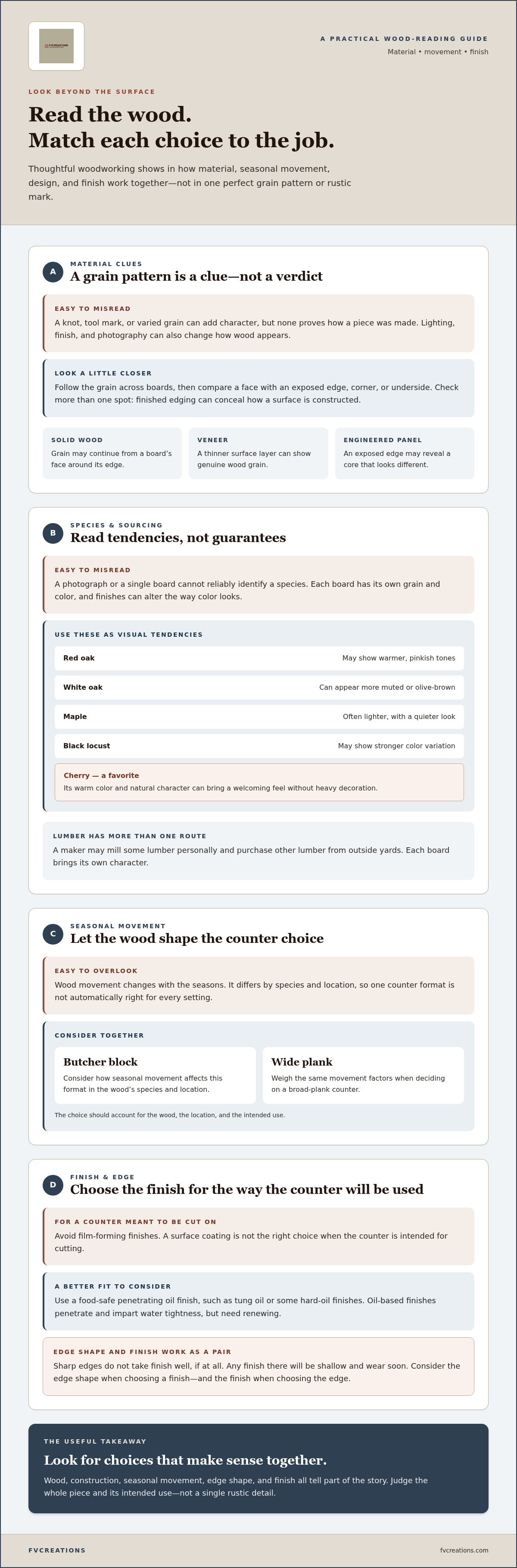
To distinguish solid wood from veneer or engineered panels, compare visible surfaces at edges, corners, and openings. On solid wood, grain may continue from a board’s face around its edge. Veneer can show genuine wood grain on a thinner surface layer, while an engineered panel may have a core that looks different at an exposed edge. Finished edging can conceal these details, so check more than one location before drawing a conclusion. None of these construction types automatically proves or disproves that a piece was handcrafted.
Compare oak, maple, black locust, and cherry with care
Species can offer a starting point, but appearance varies and finishes can alter color. Red oak may show warmer, pinkish tones; white oak can appear more muted or olive-brown. Maple often has a lighter, quieter look, while black locust may show stronger color variation. These are visual tendencies, not a reliable identification test from a photograph.
Cherry is my favorite. I’m drawn to its warm color and natural character, which can bring a welcoming feel to a piece without relying on heavy decoration. A description that names the wood is useful context, but each board still has its own grain and color.
Look for thoughtful lumber selection, not a single perfect grain pattern
Board layout can tell you something about the design. A tabletop with closely matched grain may feel calm and continuous; a surface with contrasting boards can make their differences a feature. At a corner or where a part changes direction, notice whether the grain layout appears intentional and suits the shape. The goal isn’t to find a flawless pattern, but to see whether the material feels thoughtfully placed.
A product description or maker’s account of the wood can add context, especially if it explains the species or why the boards were arranged as they were. Material origin may help you understand the piece’s story, but it doesn’t establish construction quality or prove how the piece was made. For another perspective on how material choices inform furniture, the Handcrafted Wood Desks: The Artisan’s Guide to Quality and Sourcing offers a related example.
Read the grain, species, and available material details together. Each can help you understand the design, but none settles the question on its own.
Inspect joinery and design choices that reveal thoughtful woodworking
Connections tell you how a piece is assembled, but a joint’s name isn’t a quality grade. Look at how adjoining parts meet, whether corners align, and whether the construction makes sense for the furniture’s job. A well-made joint can be simple and discreet. A more decorative one can still be poorly fitted.
In person, inspect visible corners and connections for gaps, shifting, or excess glue. Run your fingers lightly over the meeting points. They should feel even, without catching on an unexplained ridge or opening. Open drawers if you can and notice whether they move smoothly and sit evenly in their openings. Gently check whether a table or chair feels stable during ordinary use; don’t force or rock it hard.
Hardware offers another detail to consider. Handles, hinges, and drawer pulls should appear aligned with the parts they serve. A crooked pull might point to a rushed detail, but it doesn’t prove the whole piece was made carelessly. Read each clue in context.
Read the fit, not just the joint style
Some joints are visible; others are concealed beneath a surface or inside a frame. Either can be made thoughtfully. Look for consistent alignment and components that appear securely connected. A dovetail or mortise-and-tenon joint may be familiar, but its name alone can’t tell you how accurately it was cut or fitted. The quality of the finished connection matters more than a dramatic or supposedly traditional label.
Handcrafted furniture doesn’t need rough edges, uneven assembly, or obvious tool marks to prove a maker’s involvement. Careful work can produce a clean, refined result. When reviewing photos, compare matching corners or drawer fronts. Consistent spacing can be more useful than a single close-up chosen to showcase one joint.
Visible clue: A tight, even joint.
What it may suggest: Careful fitting and assembly.
What it can’t prove: Who made the piece or which tools were used.
Visible clue: Aligned hardware and an even drawer gap.
What it may suggest: Attention to layout and fit.
What it can’t prove: How the furniture will hold up under every condition.
Visible clue: A concealed connection.
What it may suggest: A design that keeps the joint out of sight.
What it can’t prove: That the construction is either weak or strong without further inspection.
Look for design that respects the wood
Keep seasonal wood movement in mind as you inspect a tabletop or other broad surface. Look for signs that the design accounts for the material rather than treating every component as fixed. The way parts meet, the support beneath a top, and the overall layout can offer clues about whether the construction was considered as a working whole.
Joinery is one part of how to identify handcrafted wood furniture, not a stand-alone test. Notice whether the connections, alignment, and design feel coherent together. A single joint may catch your eye, but the way the entire piece is assembled tells you more.
Check the finish and surface against the furniture's intended use
A finish should suit the work a surface is expected to do. Is it mainly for display, everyday handling, serving food, or direct cutting? The answer changes what makes sense to inspect. A glossy, glass-smooth top may look polished, but sheen alone doesn’t tell you how durable the finish is, how it will wear, or whether it’s right for the job.
Look closely at the surface in good light. Check for missed spots, rough patches, drips, or an uneven feel where the top meets the edges. These details can reveal how carefully the finish was applied, but they don’t establish the whole making process. A well-finished piece can be handcrafted or machine-made; the useful question is whether the surface and finish suit the furniture’s intended use.
Match finish type to the surface's job
For furniture that isn’t meant for cutting, the finish can be chosen around appearance, handling, and expected wear. On a counter intended for direct cutting, avoid film-forming finishes because knives can cut into the surface film. Instead, consider food-safe tung oil or some food-safe hard-oil finishes, following the finish maker’s directions for application and curing.
Oil-based finishes penetrate the wood and help impart water resistance, but they need renewing as the surface wears. A counter used for serving food isn’t necessarily used the same way as one intended for cutting, so don’t assume one finish suits both. Match the finish to the counter’s actual job.
For a closer look at how finish choices shape a piece, the guide Real Milk Paint: The Artisan’s Guide to Traditional Wood Finishing offers related context. You can also explore Real Milk Paint finishes for furniture finishing projects.
Check how edge shape and finish work together
Edges deserve a closer look. Consider the finish and edge profile together: a sharp edge doesn’t take finish well, if at all. Any finish there sits shallow and can wear soon. A rounded or eased edge gives the finish a different surface to cover. Check whether the chosen profile and finish seem suited to the way the counter will be used and maintained.
On a charcuterie board, for example, the edge is part of a food-serving surface, so its finish and shape should feel considered together. Don’t read a glossy edge or a rounded profile as proof of handcraft. Instead, notice whether the finish reaches the edges evenly and whether the overall surface fits its purpose.
These are practical clues for how to identify handcrafted wood furniture, but finish quality isn’t a shortcut to certainty. Consider the surface’s use, the finish’s upkeep, and the way the edges are handled alongside the construction and design. A thoughtful finish is one that makes sense for the piece, not simply one that shines.
Use a simple inspection checklist, then consider the maker's process
Once you’ve looked at the material, construction, and surface, bring those observations together. This is the practical heart of how to identify handcrafted wood furniture: don’t look for one magic sign; notice whether the choices make sense as a whole. Use this checklist in person or with clear photos that show more than a styled front view.
A five-step check for handcrafted wood furniture
- 1. Read the wood. Notice grain direction, color, and differences between boards. Consider whether the material’s character supports the design, rather than treating a particular grain pattern as a quality guarantee.
- 2. Inspect the connections. Look at joints, corners, hardware, and the places where components meet. Check for alignment, gaps, and signs of stability. In photos, look for views of the underside or interior where available.
- 3. Match the finish to the use. Ask whether the surface is for display, everyday use, serving food, or direct cutting. Consider how it may wear and what care it needs. For a counter intended to be cut on, the finish should be food-safe and suitable for that use.
- 4. Consider movement and edges. Wood movement varies by species and location. A butcher-block or wide-plank design should account for that movement, while the edge shape and finish should work together. Look for a coherent choice, not a prescribed profile.
- 5. Put the clues together. Ask whether the material, construction, surface, and intended use feel like parts of the same plan. A detail that looks imperfect isn’t automatically evidence of craft, just as a polished appearance alone can’t confirm it.
Follow the story from lumber to finished piece
A maker’s process can help explain why a piece looks and works the way it does. At FVCreations, I personally mill some lumber and purchase other lumber from outside yards. From there, I make design choices around the wood, dimensions, and intended use. That process informs the furniture I handcraft, including tables, benches, and desks.
Custom dimensions can shape those decisions too. The proportions, connections, and finish that suit one piece may not be right for another, so look for choices that respond to the specific design rather than a generic claim of being handmade. For more examples across different kinds of work, the Unique Handcrafted Wood Products: 2026 Artisan Guide offers another way to explore how materials and design come together.
Use the checklist as a steady guide, not a pass-or-fail test. Photos can help you notice details, while seeing and handling a piece can reveal more about its fit and feel. Explore handcrafted wooden goods and consider the full story behind each one. No single clue guarantees quality; thoughtful craft is easier to recognize when the material, construction, finish, and purpose all make sense together.
Take your next step toward furniture made with care
Let your next furniture decision start with curiosity, not a label. Take time to look closely, notice what feels considered, and think about how the piece will fit into your home and daily routines. You don’t need woodworking expertise to use what you’ve learned about how to identify handcrafted wood furniture. A patient look at the whole piece can help you choose something suited to your space and the way you’ll use it.
At FVCreations, Farmer Vic designs and handcrafts wooden furniture and goods, with custom furniture made to customer-provided dimensions and specifications. Each project is a chance to shape a useful piece around the needs of the person who’ll live with it.
Explore handcrafted wood furniture and goods at FVCreations and find a piece that feels at home in your space. Trust your eye, take your time, and enjoy choosing something made with care.
Frequently Asked Questions
Can you tell if wood furniture is handmade just by looking at it?
Sometimes you can spot clues, but appearance alone can’t confirm how a piece was made. For a useful first check, compare details in different areas: does the back show the same care as the front, and do repeated parts look consistently fitted? Clear photos of the underside, drawer interiors, or back can offer more context than a single styled image. Treat each observation as a clue, not a verdict.
How can you tell solid wood furniture from wood veneer?
Check an exposed edge or an unfinished area, such as the underside of a tabletop. Solid wood typically shows grain continuing from the face around the edge, while veneer has a thin real-wood layer over another material, and its surface grain may not continue through the core. Engineered panels can also have veneer. A finished edge may hide the construction, so one photo or one spot may not settle it.
Does handcrafted furniture have to show tool marks?
No, visible tool marks aren’t required. A handmade piece may have a smooth, even surface because the maker sanded and finished it carefully or used machines for certain steps. Conversely, scratches or uneven marks can come from wear or damage rather than deliberate handwork. If you’re assessing a used piece, look for whether marks appear consistently placed and integrated with the design, instead of assuming every rough spot signals craftsmanship.
What wood species are commonly used in handcrafted furniture?
Handcrafted furniture can be made from many species, chosen for appearance, availability, and the needs of the design. Red oak and white oak have different visual character, while maple often offers a lighter look; black locust and cherry bring their own grain and color. Cherry is my favorite for its warmth. Species identification from a photo can be tricky, since lighting and finish can change how wood appears.
Can handmade furniture include machine-cut joints?
Yes. Handcrafted furniture can include joints cut with machines, hand tools, or a combination of both. A machine-cut joint can still reflect a maker’s decisions about placement, fit, and how the piece will be used. When reviewing a product listing, look for a clear description of the construction, then use close views of corners and connections to understand how the parts come together.
How does seasonal wood movement affect handcrafted furniture?
Wood can expand or contract as moisture conditions change, and the amount varies by species and location. That movement matters in broad panels, tabletops, and counters. Butcher-block and wide-plank construction handle a surface differently, so design choices should suit the wood and the setting. If a piece will be in a space with changing indoor conditions, consider whether its construction appears designed with movement in mind.
What should I look for in the finish on a wooden countertop?
Start by deciding whether the counter is for serving or direct cutting. A cutting surface should not have a film-forming finish; food-safe tung oil and some hard-oil finishes are options to consider. Penetrating oil-based finishes need renewal as they wear. Also look at the edge: a sharp profile holds only a shallow layer of finish, which can wear sooner. Follow the finish maker’s care and curing instructions.