

Paste Wax for Wood: How to Use It and When It Makes Sense
Paste wax can give wood a soft sheen and smooth feel, but it won’t do the work of a durable, protective coating. It’s easy to see why wax appeals, and just as easy to wonder how it compares with oil, whether it belongs on a food-contact surface, or how long it will last.
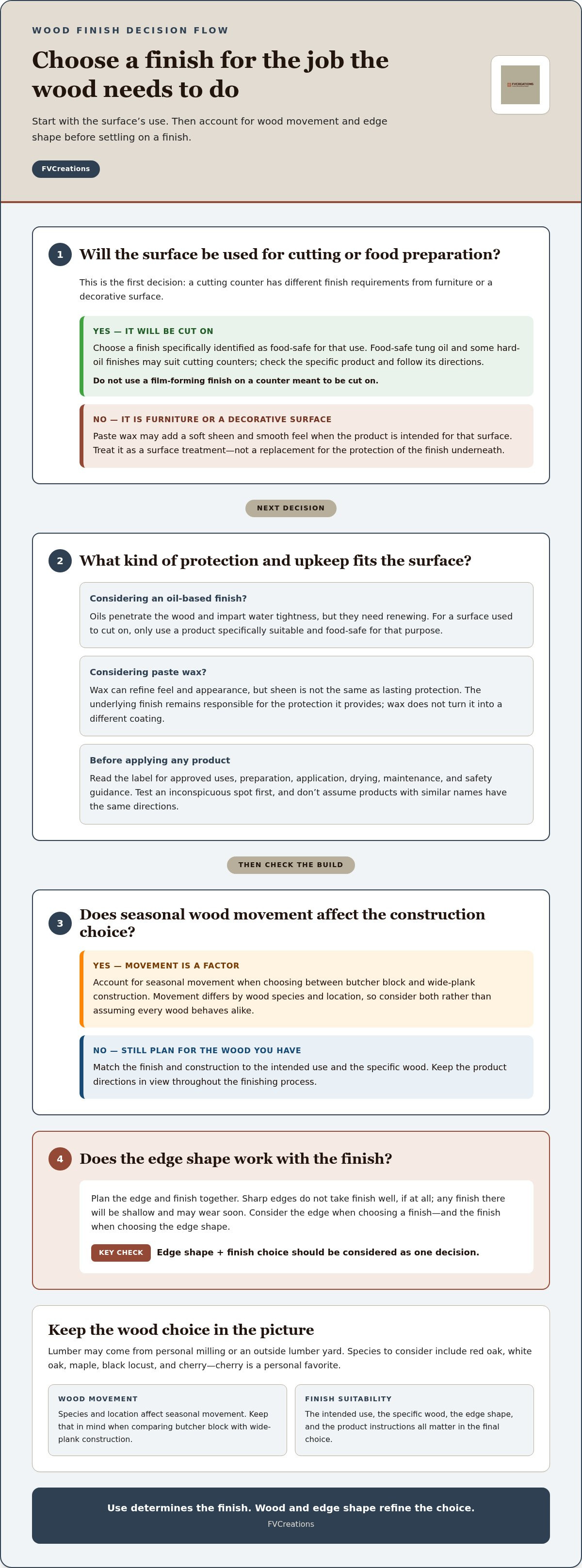
The right choice starts with how the wood will be used. In this guide, I’ll explain what paste wax can and can’t do, how to apply and maintain it, and when a penetrating oil or another finish makes more sense. A counter meant for cutting needs a food-safe finish suited to that use, not a film-forming coating. We’ll also look at wood movement, edge shape, and species, from maple and the two oaks to black locust and cherry, my personal favorite. Whether lumber is personally milled or bought from an outside lumber yard, the goal is the same: choose a finish that fits the wood and the work it needs to do.
Key Takeaways
- Use paste wax for the effect it’s suited to, and don’t mistake added sheen or a smooth feel for lasting protection.
- Prepare the wood carefully, then follow the product label for application and drying.
- Compare finishes by their purpose: oils penetrate and need renewing, while film finishes create a surface layer.
- Account for seasonal movement, which varies by species and location, when choosing between butcher block and wide-plank construction.
- Plan the edge and finish together. Sharp edges hold finish poorly, so any coating there may be shallow and wear sooner.
What Paste Wax Does for Wood, and What It Does Not Do
Paste wax is a surface-applied finish or maintenance material that can change the look and feel of wood. Depending on the product and the surface underneath, it may add a soft sheen and a smoother feel. That can be useful, but appearance and protection aren’t the same thing. A surface can feel silky without being ready to withstand frequent spills, abrasion, or food preparation.
Paste wax can refine the feel and appearance of wood, but it doesn’t replace choosing a finish suited to the surface’s job. Think of sheen as what catches the light, feel as what your hand notices, and protection as how well the finish stands up to the conditions the wood faces. Those qualities may overlap, but one doesn’t guarantee the others.
How paste wax changes a finished wood surface
On prepared furniture or a decorative surface, wax may add a subtle luster and a smooth, hand-rubbed feel. The result depends on the product, the wood, and what’s already on the surface. Wax sits at the surface; it doesn’t turn the underlying finish into a different kind of coating. A waxed table, for example, still relies on its original finish for the protection that finish provides.
That distinction matters during upkeep. A wax treatment may be refreshed, but it isn’t a shortcut for repairing a worn or damaged finish. If the surface has grime, old polish, or residue, another layer can leave the result uneven. Good wood finishing techniques depend on understanding each layer and its purpose, rather than judging the work by shine alone.
Where paste wax may fit, and where caution matters
Wax may suit furniture and decorative wood that benefits from a soft sheen and pleasant feel, provided the product is intended for that surface. A bookshelf or display piece has different demands from a busy worktop. Frequent handling, cleaning, and moisture can affect how well a treatment holds up, so don’t assume every wax performs the same way.
Take extra care with food-contact surfaces, especially counters used for cutting. A cutting counter needs a suitable food-safe finish, not a film-forming coating. Food-safe tung oil and some hard-oil finishes may suit counters intended for cutting, but suitability depends on the specific product and its directions. Don’t infer food-contact safety from a product’s name, a natural-looking finish, or someone else’s project.
Before applying any wax, read its label for approved uses, preparation, application, and safety guidance. Follow those directions rather than relying on a general rule that may not fit the formulation. The sensible choice is the one that matches both the wood’s intended use and the finish maker’s instructions.
How to Apply Paste Wax Without Rushing the Finish
A good result starts before the wax reaches the wood. Dust, polish, grease, or leftover residue can interfere with an even application, and an existing finish may not be compatible with the product. Check the surface first. That small pause can save you from an uneven sheen or a finish you need to remove and redo.
Prepare a clean, suitable surface, test an inconspicuous spot, apply sparingly, then buff and maintain the finish according to the product label. The label is the authority on that product’s use, application method, buffing, and safety guidance. Don’t substitute directions from another wax or a general rule of thumb.
Prepare the wood before applying wax
Start with a close look and a clean, dry surface, following the product directions for preparation. Dust trapped under a surface treatment can feel gritty, while old residue may show through or affect how evenly the wax spreads. If you’re unsure how the product will look over the existing finish, test it somewhere discreet first. Let the patch show you how the surface responds before treating the whole piece.
Sanding can help prepare bare wood or smooth a surface when the finish instructions call for it, but don’t sand through an existing finish unless that’s part of your plan. Choose sandpaper for wood preparation that suits the work, and remove sanding dust before moving on. A clean surface makes it easier to see the finish itself, without bumps and specks caught beneath it.
Apply, buff, and maintain with realistic expectations
Once the test area looks right, work methodically across the piece. Keep the application restrained. A heavy layer doesn’t necessarily improve the result and may be harder to buff evenly. Use the applicator and motion specified on the label, paying attention to corners, edges, and other spots where excess can gather. Follow the stated instructions for buffing rather than guessing at pressure or timing.
- Read the label. Check the intended uses, preparation steps, application method, and safety directions.
- Clean and assess the surface. Remove dust and residue as directed, and make sure the existing finish is suitable.
- Test first. Apply the product to an inconspicuous area and evaluate the result before continuing.
- Apply and finish as directed. Use a modest amount, work evenly, and buff according to the maker’s instructions.
There isn’t one maintenance schedule for every piece. Care depends on the product, the wood surface, and how often the piece is handled, cleaned, or exposed to wear. Watch how the finish looks and feels over time, and use the label’s care guidance rather than adding more by habit. If the surface becomes uneven or sticky, pause and revisit the product directions before applying another layer. Patience is part of a good finish.
Paste Wax vs. Oil and Film Finishes: Choose by the Job
A finish should suit the work a surface needs to do, not just the sheen you want to see. Wax, penetrating oil, and film-forming finishes play different roles. None is a universal answer. Protection depends on the specific product, how it’s applied, and how the wood will be used.
| Finish type | Typical role | Keep in mind |
|---|---|---|
| Paste wax | Can add a soft sheen and smooth feel to a prepared surface. | It isn’t a substitute for a suitable finish on a working counter. |
| Penetrating oil | Soaks into the wood rather than forming a surface film. | Oil-based finishes penetrate, impart water tightness, and need renewal as they wear. |
| Film-forming finish | Creates a coating over the wood, with performance depending on the product. | Never use one on a counter intended to be cut on. |
The table is a starting point, not a product specification. A decorative shelf and a counter face very different demands. Match the finish to the surface’s use, then follow the maker’s directions for that product. A glossy look doesn’t tell you how well a finish will hold up to daily use.
When a penetrating oil may suit a working surface
For a counter intended for cutting, consider food-safe tung oil or a hard-oil finish specifically suited to that use. Read the label carefully; don’t assume every oil product is appropriate for food contact. Oils need renewal as the surface wears, so maintenance is part of caring for a working counter, not a sign that the finish has failed. The right interval depends on the product and how the surface is used.
Oil-based finishes penetrate the wood and impart water tightness, but that doesn’t make every oil finish waterproof or right for every surface. The finish’s label and intended use matter. For a closer look at finishing options, explore the Real Milk Paint finishing products as you compare approaches.
Why paste wax is not a one-finish-fits-every-project answer
Consider appearance and performance separately. If you want a soft luster on a decorative piece, wax may be worth considering. If the wood will face cutting, spills, or regular cleaning, start with a finish made for those conditions. A wax layer can change how a surface feels, but it shouldn’t replace a suitable counter finish.
My practical advice is simple: name the job first, then choose the finish. For a cutting counter, rule out film-forming finishes and look for a food-safe penetrating option intended for that use. For a mainly decorative piece, consider the look you want and the care the product requires. FVCreations’ woodworking finishing supplies, including oils and waxes personally approved by Farmer Vic, offer practical options for wood care.
Match Paste Wax and Finish Choices to Wood, Movement, and Edges
Wood choice and finish choice belong in the same conversation. Grain, board width, the counter’s intended use, and the shape of its edges all affect decisions at the bench. There isn’t one wax or finish that suits every species and project.
Consider species and seasonal wood movement
Cherry is my favorite. I love the warmth it brings to a piece, and its character is a pleasure to work with. Red oak and white oak differ in their pore structure: red oak generally has more open pores, while white oak commonly has pores blocked by tyloses. That distinction can matter when considering moisture and finish, so treat each species as its own project rather than assuming they’ll behave alike. Maple and black locust bring their own character, too. Follow the directions for the specific finish you choose.
Seasonal movement deserves equal attention. Wood responds to changing moisture conditions, but how much it moves depends on the species and location. That’s one reason to think carefully about construction as well as appearance. Butcher-block and wide-plank counters handle wood movement differently, so the right format depends on the project, the wood, and the conditions where it will live. There’s no single rule that settles every case.
Our lumber comes from both personal milling and purchases from outside lumber yards. Either way, the boards need to be considered as wood that can move with the seasons. Plan the design around that reality, then select a finish for the surface’s use. Paste wax may suit some prepared furniture or decorative surfaces, but don’t assume a treatment that works on one species will suit another.
Choose the counter edge and finish together
Edge shape affects how a finish reaches the wood, and the finish you choose should inform the edge design. A softened edge gives a finish more surface to cover than a crisp, sharp corner. Sharp edges take finish poorly, if at all, so any finish there is shallow and wears soon.
That matters on a counter, where edges see regular contact and may be wiped often. Consider how the counter will be used, which finish is appropriate, and whether the chosen edge can hold that finish well. If you prefer a very sharp edge, account for its limited finish coverage rather than expecting it to perform like a broad, flat surface.
For a finish that fits your project, explore FVCreations’ personally approved woodworking oils and waxes, and match your choice to the wood, edge, and intended use.
A Maker’s Practical Finish Checklist for Your Next Wood Project
A sound finish decision doesn’t start with a can or a jar. It starts with the surface and the way you plan to use it. I like to work through a few questions before finishing a piece, whether it’s furniture, a serving board, or a counter. That order helps keep the finish choice grounded in the job, not just the shine.
Use this checklist before finishing
- Identify the use. Is the wood mainly decorative, handled often, used for serving food, or intended for cutting? A surface that will be cut on needs a suitable food-safe finish, never a film-forming one.
- Assess the wood and shape. Consider the species, existing finish, and edge profile. Account for seasonal movement as you plan the counter’s construction and finish.
- Choose a finish for the job. Paste wax may suit some decorative surfaces, while another finish may be better for frequent use or food contact. Don’t assume a product suits every wood or purpose; check its stated uses.
- Read the directions and test first. Follow the product label for surface preparation, application, safety, and care. Try the finish in a discreet spot before treating the full piece, especially if you’re applying it over an existing finish.
That sequence is useful for serving boards, too. A charcuterie board brings wood into contact with food, so choose care products with that use in mind and follow their directions. You can explore handmade charcuterie boards while thinking through the demands of a serving surface. For broader context on wood finishes, FVCreations’ Real Milk Paint finishing information is another helpful resource.
Continue exploring wood finishing and care
There’s no need to rush the choice. A finish that works beautifully on a decorative shelf might not be suited to a cutting counter, and an attractive sheen doesn’t tell the whole story about care. Match the finish to the surface, then keep the product directions nearby for maintenance.
Farmer Vic personally approves the woodworking finishing supplies offered at FVCreations, including oils and waxes. Explore the woodworking finishes and care supplies to find an option that fits the work you have in mind.
Choose a Finish You Can Care for With Confidence
Before your next project reaches the finishing bench, picture how it will be used a few months from now. A decorative piece, a serving surface, and a counter each ask something different of their finish. Choosing with that future use in mind helps you decide whether paste wax belongs in the plan and what kind of care you’re willing to give the wood over time.
Choose a finish that suits the project, keep its care directions handy, and give the work the attention it deserves. To explore options for your own wood surfaces, browse FVCreations’ woodworking finishing supplies.
Frequently Asked Questions
Is paste wax food safe for a wooden cutting board?
Don’t assume paste wax is food safe just because it’s used on wood. Check the product label for explicit food-contact directions, and make sure it’s suitable for a board that will be cut on. For cutting surfaces, use a food-safe finish intended for that purpose, such as food-safe tung oil or some hard-oil finishes. If the wax’s suitability isn’t clear, choose a finish with explicit directions for cutting boards instead.
Can you apply paste wax over an oil finish?
Sometimes, but only if both products’ directions allow it and the oil finish is ready for another treatment. Don’t rely on the surface feeling dry; follow the oil maker’s guidance about when additional products can be applied. Wax over an oil finish may alter the surface’s look or feel, so first test a hidden spot. If the patch stays tacky or looks uneven, stop rather than covering the whole piece.
Does paste wax make wood waterproof?
No. Paste wax shouldn’t be treated as a waterproof barrier. A waxed tabletop may still be affected by standing water, spills, or damp items left in place. Wipe up moisture promptly and follow the care directions for the existing finish beneath the wax. If the wood will regularly encounter water, choose a finish intended for that exposure rather than relying on wax alone.
How do you remove old paste wax from wood?
Start by checking the wax maker’s removal guidance, since the right method depends on the product and the finish underneath. Test any recommended cleaner or removal method in an inconspicuous place first, and work gently so you don’t damage the wood or strip its finish unintentionally. Avoid adding another coat to hide a cloudy or sticky patch. If you plan to refinish the piece, make sure old wax is removed as directed before applying a new finish.
Can paste wax be used on painted wood?
It may be suitable for some painted surfaces, but the paint and wax directions need to allow it. Wax can change the sheen and feel of paint, and an incompatible product may leave an uneven appearance. Test a small, hidden area first and let the result guide you before treating the whole piece. Take extra care with freshly painted wood, and follow the paint maker’s directions before adding any top treatment.
Does paste wax change the color of wood?
It can change how the color appears, even if the wood itself hasn’t changed. A wax treatment may make a surface look richer or more pronounced, and the effect can vary with the wood, existing finish, and product. Check the result in a discreet spot under the lighting where the piece will usually sit. That small test is especially useful on pale woods or pieces where an even color matters.
How often should paste wax be reapplied to furniture?
There isn’t one schedule that fits every piece. A cabinet that’s rarely touched may need attention less often than a tabletop that’s handled, cleaned, or used every day. Follow the wax label’s care advice and watch for a change in sheen or feel rather than adding more automatically. Before reapplying, clean the surface as directed; layering wax over dust or residue can leave a dull, uneven finish.