

Square Foot Gardening in a Raised Bed: A Practical Beginner’s Guide
What if the easiest garden to manage starts with a grid that fits your bed, not a standard plan? If you’re wondering how to set up and plant square foot gardening in a raised bed, the hard part often isn’t drawing the lines. It’s deciding what each section can hold while leaving enough room for crops to grow.
Spacing, soil, and crop combinations can feel like a lot to figure out at once. A neat grid won’t help if plants are crowded or parts of the bed are difficult to reach. Instead, build a plan around your bed’s inside dimensions, the crops you want to grow, and the space those crops need when mature.
This guide shows you how to measure and divide the bed, choose plant spacing based on mature size and growth habits, and prepare a suitable growing medium. You’ll also find a practical planting and care routine, including watering, harvesting, and adjusting the plan as the season unfolds. Whether you’re using a cedar raised bed or one you already have, you can start with a layout that’s clear and manageable.
Key Takeaways
- Plan square foot gardening in a raised bed around its measured interior dimensions, rather than squeezing it into a standard layout.
- Use crop-specific spacing guidance to decide how many plants belong in each section, and account for mature size and support needs.
- Sketch your planting plan and check that you can comfortably reach every section before planting.
- Label crops and note planting dates so you can track what’s growing and make useful adjustments.
- Choose a bed size and placement that suit your space, access needs, and the crops you want to grow.
Square Foot Gardening in Raised Beds: Who Is It For?
Can a raised bed become a productive, organized garden without turning planning into a project of its own? Yes. Square foot gardening in a raised bed gives you a simple way to map planting space before seeds or starts go into the soil. The grid makes your plan visible, so you can see what you intend to grow and where each crop belongs.
Square-foot gardening is a method of dividing growing space into marked sections and planning crops for each section according to their mature size and spacing needs. The sections are a planting guide, not a promise of a particular harvest. For a general overview of the method’s origins and principles, see Square Foot Gardening on Wikipedia.
How does the square-foot gardening method work?
Instead of treating the bed as one open patch, you mark out a grid and assign crops to individual sections. A section can hold one crop or several plants when their spacing allows. The right planting plan depends on the plant’s mature size, variety, and growth habit, not simply on how many seeds fit on planting day.
That distinction matters. A grid helps you organize and remember your plan, but it doesn’t replace crop-specific instructions or care. Check seed packets or reliable growing guidance for spacing, planting depth, and support needs. If plants grow larger than expected, thin or adjust them rather than treating the original grid as a rule you can’t change.
Is this method a good fit for your raised bed?
A marked layout can be especially helpful if you’re new to gardening or working with a defined space. Give each crop a clear place, avoid defaulting to a whole bed of one vegetable, and keep track of what you planted. The grid is a useful starting point whether you have one bed or several.
The best layout depends on the bed and how you plan to use it. A long, narrow bed, an irregular shape, and a compact planter don’t all call for the same grid. Consider the crops you want, the space they need as they grow, and whether you can comfortably reach the sections you’ll tend. Plan for access before the bed is full.
- Choose crops you’ll enjoy growing and eating.
- Check each crop’s spacing and mature size.
- Place taller or supported crops with their growth habits in mind.
- Keep the sections reachable for watering, weeding, and harvesting.
The method still takes hands-on care. You’ll need to water, observe how plants respond, and adjust when growth differs from your plan. That’s part of gardening, not a sign the grid has failed. If you like having a clear plan for a small growing space, square-foot gardening can be a practical place to begin.
How to Measure and Grid a Raised Bed for Square-Foot Gardening
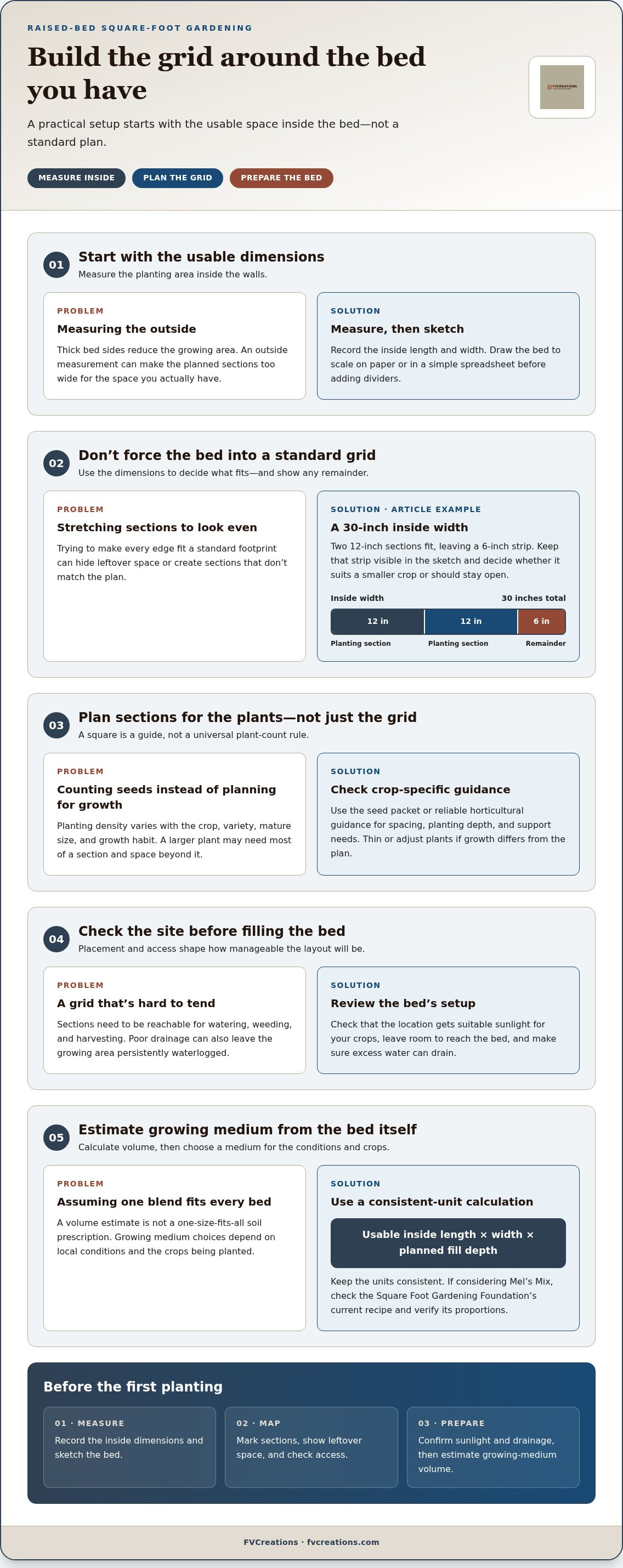
A useful grid starts with the bed you actually have. For square foot gardening in a raised bed, measure the planting area inside the walls, not the outside edges. Thick sides reduce usable space, so a plan based on the outer dimensions can leave the final sections too narrow for the crops you intended to plant.
How do you divide a raised bed into planting squares?
Start with a tape measure and a quick sketch. Write down the inside length and width, then draw the bed to scale on paper or in a simple spreadsheet. Mark consistent sections on the drawing before adding dividers to the bed. This helps you see how many full sections fit and what to do with any leftover space at the edges.
A standard one-foot grid may suit some beds, but don’t force the bed’s dimensions to match a standard footprint. For example, a 30-inch-wide interior could fit two 12-inch-wide sections with a remaining 6-inch strip. Show that strip on your sketch and decide whether it suits a smaller crop or should remain open. Don’t stretch the grid to make the dimensions look even.
Once the drawing makes sense, transfer the marks to the bed. Choose visible dividers that stay in place without getting in the way of planting or routine care. Check that you can see the lines from above, and secure the dividers so they don’t shift as you work the soil. For wooden options, FVCreations’ outdoor garden items include cedar planters and raised planting beds.
What should you prepare before filling the bed?
Before adding growing medium, check the bed’s placement and setup. Make sure the location gets suitable sunlight for the crops you plan to grow, and leave enough room around the bed to reach the sections you’ll plant and tend. Consider drainage as well. The bed and its location should allow excess water to drain instead of leaving the growing area persistently waterlogged.
Estimate the amount of growing medium you need by multiplying the bed’s usable inside length by its width and the depth you plan to fill. Use the same units throughout. This gives you a volume estimate, not a one-size-fits-all soil prescription. Choose a growing medium based on local conditions and the crops you’re planting rather than assuming one blend suits every bed.
The Square Foot Gardening Foundation’s Mel’s Mix is one named approach to growing medium. Before mixing it, consult the Foundation’s current recipe and verify the proportions rather than relying on a remembered ratio. Once the bed is measured, the site checked, and the grid marked, you’ll have a clear setup for planning each crop.
How to Choose Crops and Planting Density for Each Square
A square is a planning space, not a universal plant-count rule. The right density for square foot gardening in a raised bed depends on the crop, the specific variety, and its growth habit. A compact crop may leave room for several plants, while a larger plant may need most of a section and space beyond it.
Use the seed packet or reliable horticultural guidance for the variety you’re growing. Check whether the spacing refers to plants within a row, distance between rows, or both. Then apply those directions to your grid: mark the recommended distances inside the relevant section and adjust the plan if they don’t fit neatly. Don’t crowd plants just to make the drawing look tidy.
How many plants can go in one square?
There isn’t one count that safely applies to every crop. Variety, mature size, and the plant’s spacing directions all matter. Treat the seed packet or reliable growing guidance as your starting point, then make the grid fit those instructions. If the recommended spacing won’t fit in one section, plan fewer plants or give the crop more room.
| Growth habit | Spacing source | Support needs | Access considerations |
|---|---|---|---|
| Compact leafy crops or herbs | Packet or verified guidance for the crop and variety | Plan according to the crop’s listed needs | Leave room to harvest without disturbing neighboring plants |
| Root crops | Check instructions for the crop and how it’s planted | Follow crop-specific guidance | Keep a clear way to reach the planting area for thinning or harvest |
| Tall or upright crops, such as some tomatoes | Use variety-specific spacing guidance | Check whether the crop needs support | Consider height and shade before placing it beside shorter plants |
| Climbing or sprawling crops, such as peas or zucchini | Verify spacing and growth habit for the variety | Plan a support where suitable | Allow for growth beyond the planted spot and keep paths reachable |
Where should tall, climbing, and spreading crops go?
Plan for more than the seedling’s footprint. A tall plant can shade nearby sections, while a vine may reach into space you meant for another crop. Consider mature height and the direction of growth. If a crop can grow upward with a suitable support, include that structure in the plan and make sure it won’t block access or interfere with the bed.
Zucchini and other space-demanding crops deserve special attention. Their eventual spread can crowd neighboring sections, so don’t assign them a fixed count from a generic chart. Check the variety’s guidance and decide whether it needs more room or a position near the edge. Leaving some space open on paper can be more useful than packing the grid so tightly that it’s hard to tend.
How to Plant and Maintain Your Raised-Bed Square-Foot Garden
A clear plan makes planting easier, but the garden still needs attention once the seeds are in. Use the first week to check that the layout works in practice. With square foot gardening in a raised bed, early observations can help you catch dry soil, unclear labels, or awkward access before they become bigger problems.
What is the simplest planting sequence to follow?
Start with your finished grid and the crop-specific spacing information you’ve gathered. Check locally relevant planting guidance for suitable timing, since planting windows vary with local conditions and crop. Then work through one section at a time, following seed or transplant instructions rather than planting every section the same way.
- Gather and sort. Keep seeds or starts with your plan so each crop is easy to identify.
- Plant by section. Follow the crop’s instructions for depth and spacing, and avoid disturbing neighboring sections as you work.
- Label clearly. Write the crop name and planting date on a marker, then place it where it won’t obstruct care.
- Do a final check. Make sure supports are stable, labels are legible, and you can reach each planted area without stepping into the bed.
Note whether you planted seeds or transplants. That detail can help explain differences in growth when you look back later.
How do you keep a densely planted bed manageable?
Make a regular walk-by to check soil moisture, plant condition, and how much space neighboring crops are taking up. Don’t rely on one fixed watering schedule for every bed. Weather, soil, crop needs, and the bed’s location all affect how often plants need water. Check the growing medium and respond to what you observe.
During the first week, look for sections that seem unusually dry or plants that appear stressed. Check whether a support has shifted or a label has gone missing. As growth continues, watch for crowding, leaves that block access, or one plant overshadowing another. Make small changes where needed, such as guiding a vine toward its support or removing a plant that is clearly competing for limited space. Follow crop-specific guidance before pruning or thinning.
Keep a simple garden record beside your plan. Note planting dates, observations, and changes, such as moving a support or adjusting a section. At the end of the season, record which crops fit comfortably, which were hard to reach, and where plants competed. These notes give you a practical starting point for improving next season’s layout.
Your routine can stay simple: observe, respond, and keep track of what you learn. If you’re setting up a garden space, explore cedar planters and raised planting beds as options for organizing your growing area.
Choosing a Raised Bed That Works for Your Square-Foot Garden
The right bed is the one that suits your growing space and the way you’ll use it. For square foot gardening in a raised bed, choose dimensions that hold your planned crops while leaving room to reach, water, and harvest comfortably. A familiar bed size isn’t automatically the best fit for your yard, patio, or planting plan.
What should you consider when choosing a bed’s size and placement?
Look at the whole site, not just the bed footprint. Account for the space you need to walk around it, reach the planting area, and tend plants without leaning across sections you can’t comfortably reach. If you’ll approach the bed from only one side, plan its width accordingly. Everyday care should feel practical.
Next, consider the crops you intend to grow. A bed for compact crops may suit a different shape than one that includes tall plants, supports, or spreading crops. Check the site’s sunlight and drainage, too, and think about whether nearby walls, fences, or paths affect how you can use the space. A thoughtfully placed bed in a nonstandard size can work better than a standard footprint that doesn’t suit your garden.
How do wood species and sourcing fit into the decision?
Wood is one option among several possible bed materials, alongside choices such as metal or masonry. Don’t assume a species is suitable for a garden bed or food-growing use based on its name alone. Consider the specific material and how the bed will be built. FVCreations makes cedar planters and raised beds, and its outdoor garden items offer a starting point for considering wooden bed options.
FVCreations sources its wood from the owner’s property, with lumber obtained through personal milling. When comparing wood species, it helps to distinguish red oak from white oak: white oak is generally more resistant to moisture than red oak, but neither should be treated as an automatic choice for every outdoor design. Maple is a dense hardwood, while black locust is known for its natural durability. Cherry is Farmer Vic’s favorite species, though that preference doesn’t make it right for every raised bed. Suitability depends on the design, exposure, and intended use.
Seasonal wood movement is another design consideration. Wood can change dimension as moisture conditions shift, and the amount of movement varies with species and location. That matters when planning a wooden bed’s joints and overall construction. Allow for movement when designing with wood, while also choosing a material and construction suited to the intended use.
Before settling on a bed, picture your routine: how you’ll reach the farthest planting area, where supports might sit, and whether the site gives crops suitable light and drainage. Then match the bed’s shape and material to those needs. A raised bed should make your garden easier to plan and tend, not force your crops or available space into someone else’s template.
Make Your Garden Plan Your Own
Your first planting plan doesn’t have to be perfect. Treat it as a starting point, then let what you notice in the garden guide your next choices. As you decide what to grow, square foot gardening in a raised bed can become a personal project shaped around your space and the crops you look forward to tending.
The bed is part of that plan, too. If standard dimensions don’t suit your space, custom woodworking commissions can be made to customer dimensions and specifications, so you can plan beyond a one-size-fits-all footprint. A well-chosen growing space can make it easier to settle into a routine and enjoy each small harvest.
FVCreations offers handcrafted cedar planters and inground raised planting beds for gardeners planning a new growing space. Explore handcrafted cedar planters and raised beds and take the next step toward a garden that feels like yours. Start with the space you have, keep learning as you grow, and let the garden take shape one season at a time.
Frequently Asked Questions
What is square-foot gardening in a raised bed?
It’s a way to organize a raised bed into marked planting areas, with each area assigned to a crop or planting group. The grid helps you keep track of what’s growing where, which is useful when several vegetables share one bed. Treat the lines as a planning tool, not a guarantee of a particular harvest or a substitute for each crop’s growing instructions.
Can you use square-foot gardening in a raised bed that is not four by four feet?
Yes. The method can work in a bed of another size or shape. Base the layout on the interior growing area, then draw sections that fit instead of stretching the bed to match a standard plan. If part of the bed doesn’t fit a full section, leave it open or use it for a crop whose spacing suits that space.
How many plants should you put in each square?
Use spacing guidance for the exact crop and variety. There isn’t one safe count for every square. Check the seed packet or a reliable horticultural source, then mark the recommended distances within the section. If the spacing doesn’t fit, give the crop more room or plant fewer. You can thin seedlings later if several emerge too close together.
What soil should you use for square-foot gardening in a raised bed?
Choose a growing medium suited to the crops you plan to grow and the conditions at your site. Check that the bed drains appropriately, and don’t assume one recipe works for every garden. If you’re following a named method’s soil blend, use its current instructions rather than relying on remembered proportions. Local growing guidance can help account for your conditions.
Does square-foot gardening work for large plants like tomatoes or zucchini?
It can, but plan around how each variety grows, not just the spot where you plant it. A tomato may need support and room above nearby crops, while zucchini can spread into surrounding areas. Check variety-specific spacing guidance, consider where supports will sit, and keep neighboring sections accessible as the plants mature.
How often should you water a square-foot raised bed?
There’s no single watering interval that suits every raised bed. Check the soil and plants regularly, then water according to moisture and crop needs. Weather, the bed’s location, and the growing medium all affect how quickly it dries. Pay closer attention during hot or dry spells, and avoid watering by the calendar if the soil is still adequately moist.
Do you need a grid for square-foot gardening?
A grid is useful because it makes planting areas visible and helps you keep crops organized, but it doesn’t need to be a permanent structure. Mark sections with dividers or another clear guide that stays put during planting and care. If you prefer not to install dividers, keep a drawn bed plan nearby and mark each section as you plant.