

Starbond VOX: How to Assess the Adhesive for Your Woodworking Project
Searching for Starbond VOX? The name alone won’t tell you what an adhesive is made for. Before choosing a glue, identify the exact product and use its label and manufacturer instructions to understand its intended applications and handling requirements.
That matters because an adhesive suited to a small repair may not be right for a structural joint. The wood, joint fit, surface condition, and working environment all affect what to consider. In my woodworking, whether I’m using lumber I’ve milled myself or wood purchased from an outside lumber yard, I start with the material and the job in front of me.
This guide explains what product details to look for, how to compare adhesives for different woodworking tasks, and how a representative scrap test can help you avoid surprises on visible work. We’ll also cover surface preparation and safe handling. At FVCreations, Farmer Vic personally approves the woodworking supplies we offer, including Starbond Adhesives, with a maker’s practical eye.
Key Takeaways
- For starbond vox, identify the exact adhesive and follow its manufacturer instructions rather than relying on the name alone.
- Match the adhesive’s documented uses to your materials, joint design, and working conditions.
- Compare adhesive categories according to the job they’re intended to do.
- Prepare surfaces as directed and test on a representative scrap before applying adhesive to visible work.
- Explore Starbond Adhesives at FVCreations, where Farmer Vic personally approves woodworking supplies.
Starbond VOX: What to Identify Before You Choose This Adhesive
What does “VOX” tell you about an adhesive, and what do you still need to know? A product name alone doesn’t establish the formula, intended use, or working characteristics. Starbond’s adhesive line includes cyanoacrylate adhesives, but the name “Starbond VOX” by itself doesn’t tell you whether a particular adhesive belongs to that category or what it is designed to do.
Definition: Cyanoacrylate adhesives are a category of fast-bonding adhesives. The name “Starbond VOX” alone doesn’t establish that a specific product is a cyanoacrylate adhesive. For background on the category, see Understanding Cyanoacrylate Adhesives. For product-specific details, use the manufacturer’s description and instructions.
Which Starbond VOX details should you verify?
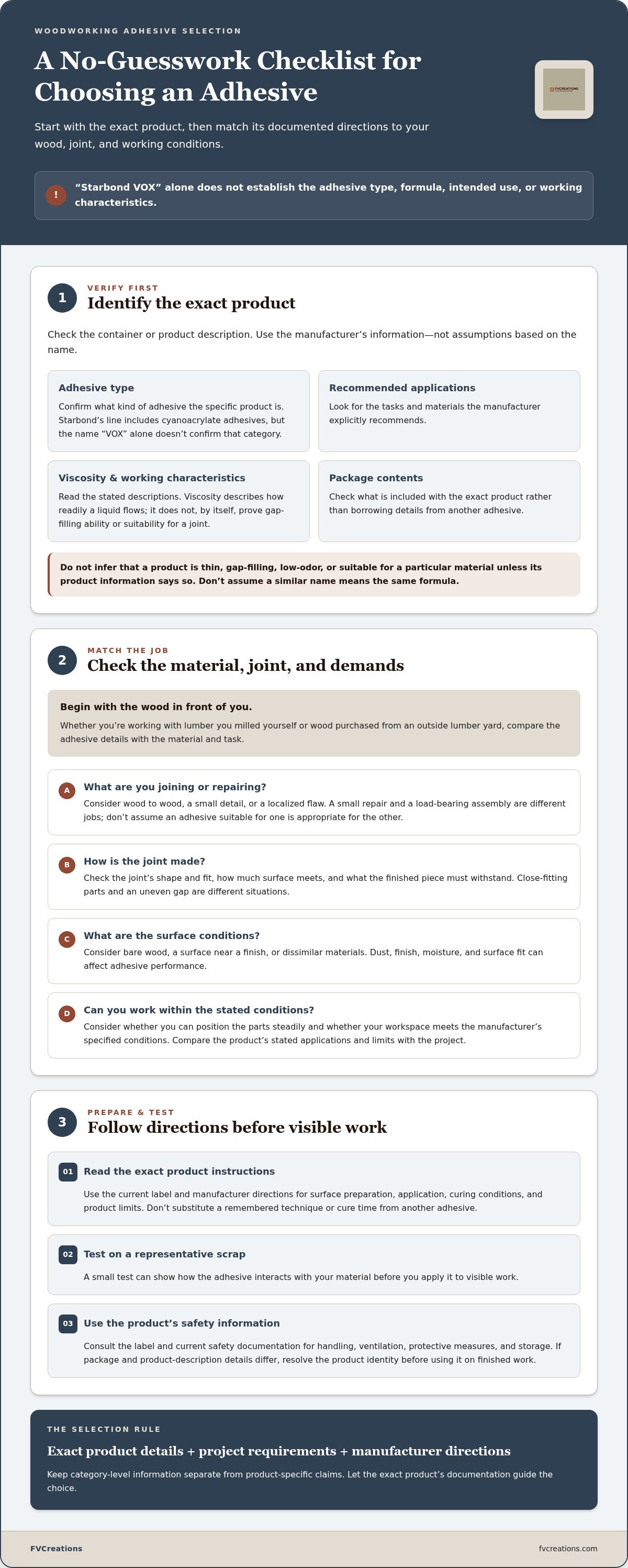
Start with the exact product name on the container or product description. Then look for the stated adhesive type, recommended applications, viscosity, working characteristics, and package contents. Don’t infer that an adhesive is thin, gap-filling, low-odor, or suited to a particular material just because its name includes certain letters. Those features should be stated in the product information.
At the workbench, this distinction helps you avoid choosing by assumption. General information about an adhesive category can explain terms, but it can’t tell you how a specific product performs. Keep verified product details separate from general selection advice, and follow the label and manufacturer instructions for the adhesive you’re using.
What does the project need the adhesive to do?
Start with the wood and the joint. Are you joining wood to wood, securing a small detail, or repairing a localized flaw? Check whether the parts fit closely, how much surface meets at the joint, and what the finished piece will need to withstand. A bond to bare wood may also involve different surface conditions from one made near a finish or between dissimilar materials.
A small repair and a load-bearing assembly are different jobs. Don’t assume an adhesive that suits a detail repair is appropriate for a joint carrying substantial force. Consider the joint’s shape, fit, and intended use, then compare those needs with the product’s stated applications and limits.
Think about the working conditions as well. Can you position the parts steadily during application? Does the workspace meet the conditions specified by the manufacturer? These practical details can influence your choice as much as the wood itself.
FVCreations carries Starbond Adhesives, selected with a woodworking perspective. Start with the product’s documented properties and compare them with your materials, joint design, and intended use.
How to Read Starbond VOX Features Without Guessing
A useful product description explains what the adhesive is, how to apply it, and what tasks the manufacturer recommends it for. The name “VOX” doesn’t provide those details by itself. Starbond’s adhesive line includes cyanoacrylate products with variations in viscosity, color, and specialty formulation. Don’t assign any of those features, or a particular cure time or application, to a product based on its name alone.
Keep general guidance about cyanoacrylate adhesives separate from product-specific directions. Category information can help you understand label terms, but the exact product’s current manufacturer information should guide how you use it.
What do viscosity and application details tell you?
Viscosity describes how readily a liquid flows. It can help you understand how an adhesive may be applied and whether it can reach a narrow or awkward area. It doesn’t, by itself, prove that the product will fill a gap or suit a particular joint. Those uses depend on the product’s documented instructions and the conditions of your project.
Look for an explicit viscosity description and application guidance on the manufacturer’s product page or label. Don’t borrow specifications from another Starbond adhesive or assume a similar product name means the formula is the same. A sound comparison starts with the exact product identity.
Which instructions matter for a reliable bond?
Surface preparation and working conditions are part of the bond, not an afterthought. Dust, finish, moisture, surface fit, and the materials being joined can all affect how an adhesive performs. A close-fitting joint and an uneven gap are different situations, so follow the product’s directions rather than relying on a general rule.
Read the label and manufacturer instructions for surface preparation, application, and curing conditions. Don’t substitute a remembered cure time or technique from another adhesive. If the instructions specify limits for materials or working conditions, treat those limits as part of your product choice.
Give safety information the same attention. Use the product label and current safety documentation to guide handling, ventilation, protective measures, and storage. If the package and product description differ, resolve the product identity before applying the adhesive to finished work. A small test on a representative scrap can show how it interacts with your material without putting the visible project at risk.
For a practical look at Starbond Adhesives for woodworking, browse the options at FVCreations and compare each product’s documented details with the task at your bench.
Starbond VOX Compared with Other Adhesive Choices
A useful comparison starts with the job, not the label. The name Starbond VOX doesn’t establish product-specific properties, so use the exact product’s instructions to compare it with other adhesives. Consider the materials, joint design, surface preparation, and conditions the finished piece will face.
Let the materials, joint, and working conditions guide the adhesive choice, not the product name alone.
For a small repair or detail: A CA adhesive may suit a localized woodworking task if its manufacturer instructions cover the materials and intended use. Consider access, fit, and the appearance of the finished area.
For a wood-to-wood assembly: Compare a woodworking glue whose instructions describe the joint and use you have in mind. Don’t assume a CA adhesive is a universal replacement; different products can be intended for different tasks.
For a joint affected by wood movement: Consider the joint design, board width, species, and conditions where the finished piece will live. Then follow the selected adhesive’s instructions.
When might a CA adhesive suit a woodworking task?
Woodworkers may consider CA adhesives for small repairs or detail work. That’s general guidance about the category, not a claim about a product named VOX. A close-fitting detail repair differs from a broad assembly joint, and a visible area calls for care with placement and appearance. Check that the product’s stated applications cover the materials and intended use.
For a larger wood-to-wood joint, choose according to the joint design and the adhesive’s stated purpose instead of assuming one glue suits every scale of work. A bench test on scrap can help you assess the result on the same wood before committing to the finished piece.
How should wood movement affect adhesive decisions?
Wood responds to changing moisture conditions, and seasonal movement varies by species and location. A joint that restrains movement may face different demands from a small repair. This applies whether the boards were milled personally or purchased from an outside lumber yard. The source doesn’t remove the need to plan for the wood itself.
Butcher block and wide-plank construction use different layouts and present different joint considerations, so neither is the automatic answer for every project. Think about board width, how the wood is joined, and the conditions where the finished piece will be used. Species matters, too: red oak and white oak are distinct choices, as are maple and black locust. Cherry is my favorite, but its appeal doesn’t establish adhesive compatibility. Assess the actual wood and follow the product instructions.
For a final comparison, review the documented uses of Starbond woodworking adhesives alongside your project requirements. If the label doesn’t support the intended joint, choose an adhesive with instructions that do.
How to Prepare and Test Starbond VOX on a Woodworking Project
A small test can help you avoid an unwelcome surprise on a finished piece. Begin by identifying the exact product and reading its current manufacturer instructions. Then identify the materials and joint, prepare a matching sample, apply the adhesive as directed, and assess whether the result suits the project.
What should you prepare before applying adhesive?
Start with the actual job. Identify the wood, any other materials in the joint, how the parts meet, and whether the area will be visible or carry a load. Check whether the surfaces are bare, finished, or otherwise treated, since the adhesive maker’s preparation directions may depend on their condition.
Next, read the label for the exact adhesive. Follow its directions for preparing surfaces, applying the product, and allowing it to cure. Don’t transfer a preparation method or timing from a different adhesive. Set up on a stable, organized work surface where you can position the parts as intended, and follow the manufacturer’s safety guidance.
When possible, make a test piece from an offcut of the same material. Match the joint as closely as practical, including the surface condition. A scrap with a freshly prepared face may not show how the adhesive behaves on a finished, rough, or previously treated surface. If sanding is part of your preparation, woodworking sandpaper can help create a consistent surface. Follow the adhesive maker’s directions for the final preparation.
How can a small test help you judge the result?
Apply the adhesive to the sample exactly as its instructions direct. Keep the test modest but representative. If the real project has a narrow joint or awkward access, reflect that in the offcut. Don’t deliberately test a different amount or method and assume the result predicts what the manufacturer describes.
A scrap test lets you see how the adhesive behaves on your material and joint before it touches visible, finished work. After following the manufacturer’s stated cure conditions, inspect the sample for the results that matter to your project. Look at the bond, the appearance around it, and whether the joined parts hold as intended. A test doesn’t replace product instructions or prove suitability for every use, but it can reveal a mismatch early.
If the result isn’t right, pause before moving to the finished piece. Revisit the surface condition, joint fit, and product directions rather than changing several things at once. For Starbond Adhesives and product information to compare with your project needs, explore the Starbond selection at FVCreations.
Where to Find Starbond Adhesives and Make a Confident Choice
A confident adhesive choice comes from matching documented properties to the work, not relying on a name alone. For a product described as Starbond VOX, identify the exact item and use its manufacturer information to understand its properties and intended applications. Then weigh those details against your materials, joint design, preparation needs, and the conditions the finished piece will face.
Use this straightforward buying check:
- Confirm the product: Read its label and manufacturer description, including stated applications and instructions.
- Match the job: Consider the materials, joint fit, and whether the task is a small repair, detail, or assembly.
- Plan the process: Account for surface preparation, safe handling, and the working conditions specified for the adhesive.
- Test thoughtfully: Use a representative scrap when possible before applying adhesive to visible finished work.
This checklist separates documented details from what a product name might suggest. It also gives you a clear basis for comparing adhesive categories and deciding whether a product’s stated use fits your project.
What makes a practical adhesive buying checklist?
Picture the joint before browsing: what materials meet, how closely do they fit, and what will the finished piece need to withstand? Use the label and current instructions to guide product use, preparation, and handling. Don’t fill a gap in the product information with an assumption based on another formula or a general adhesive category.
A small decorative repair and an assembly that must carry a load call for different scrutiny. The brand name can help you find a product, but compare its stated applications and instructions with the actual job.
How does a maker-led shop support the decision?
A woodworking perspective keeps the focus on practical questions: What material is on your bench? How will you prepare it? Can you test the adhesive on a representative offcut? These checks help you make a deliberate choice without treating a product name as a substitute for its instructions.
As you weigh the options, browse the Starbond adhesive collection and compare the product information with your project checklist. Take your time, check the details, and choose what fits the work in front of you.
Bring a More Deliberate Eye to Your Next Project
Before your next glue-up, note what you want the joint to do and what the finished piece will encounter in use. That habit makes it easier to compare adhesives, especially when a product name like starbond vox doesn’t tell you enough on its own. Let the work guide your choice, and try a small sample before committing to a visible piece.
Good woodworking comes from thoughtful decisions, one step at a time. Whether you’re planning a repair or starting something new, choose supplies that fit the task and follow their instructions.
Explore woodworking supplies at FVCreations and find supplies for the work ahead. Take your time, trust your hands, and enjoy bringing the next project together.
Frequently Asked Questions
What is Starbond VOX?
Starbond VOX is a name that needs to be matched to an exact product before you can determine its formula or intended use. If you’ve seen the name on a listing or container, compare the label and product description with the manufacturer’s information. Product identity matters when you’re matching an adhesive to a particular material or repair.
Is Starbond VOX a CA glue?
Starbond’s adhesive line includes cyanoacrylate products, but the name VOX alone doesn’t establish that a particular adhesive belongs to that category. Check the exact product label or manufacturer description for the adhesive type. Don’t rely on shorthand or assume that a similar name means the formula is the same.
What projects can Starbond VOX be used for?
The intended projects depend on the exact product and its manufacturer’s stated applications. Before using an adhesive described as Starbond VOX, identify the product and read its instructions. A small decorative repair, a joint that supports weight, and a bond involving dissimilar materials have different demands. Choose an adhesive whose instructions cover the intended use.
How do I apply Starbond VOX to wood?
Identify the exact adhesive, then follow its label for wood preparation, application, and curing. Don’t apply a remembered technique from another glue because product directions can differ. A repair on bare wood, for example, may involve different surface preparation from a bond near an existing finish. Keep the work area steady and organized, and test on a scrap from the project wood before treating a visible surface.
Can Starbond VOX fill gaps in a wood joint?
Check the exact adhesive’s manufacturer instructions for any stated gap-filling use, then compare that guidance with the joint you’ve built. Don’t use an adhesive to bridge an open joint based on its name alone. A poorly fitting joint may need a woodworking adjustment rather than a glue chosen to conceal the mismatch.
How is Starbond VOX different from wood glue?
The difference depends on the adhesive type identified for the exact product. In general, CA adhesives and woodworking glues are different product categories, and their instructions may specify different materials, joint conditions, and uses. For a broad wood-to-wood assembly, compare a woodworking glue’s stated applications with the joint design. For any other adhesive, rely on its own label rather than assuming it can replace wood glue.
How should I store Starbond VOX?
Use the storage directions for the exact product. Check the container and manufacturer guidance for temperature, closure, and storage conditions, and keep the adhesive in its original packaging so its identity and instructions remain available. Don’t apply storage advice for another Starbond formula by assumption.