

The Real Benefits of Custom Built Furniture: Why Handcrafted Wins in 2026
You finally find the perfect dining table online, but six months later, the legs start to wobble and that "oak" finish begins to peel like a cheap sticker. It's a frustrating cycle that many of us have fallen into while trying to furnish a home with pieces that actually last. When you look at the true benefits of custom built furniture, it becomes clear that the value isn't just in the dimensions; it's in the soul of the wood and the hands that shaped it.
I know how hard it is to find a piece that fits your room perfectly without sacrificing quality. Whether I'm milling a fallen log from my own property or hand-selecting boards from a local lumber yard, my goal is always the same: to build something your grandkids will fight over. In this guide, I'll show you why bespoke woodworking outperforms mass-market options in 2026. We will dig into the durability of species like white oak and black locust, and I'll share why cherry remains my absolute favorite wood to work with. From artisan joinery to transparent sourcing, you're about to discover why handcrafted is a legacy worth starting today.
Key Takeaways
- Learn how to calculate the true cost-per-year of your furniture to see why heirloom quality actually saves you money over mass-produced alternatives.
- Discover the transparency of a dual-sourcing model, where wood is either milled right on my property or hand-picked from trusted lumber yards.
- Explore the functional benefits of custom built furniture by designing pieces that fit your home's unique architectural quirks and your specific physical needs.
- Find out why selecting the right species, from durable black locust to my personal favorite, cherry, is the most critical step in creating a lasting piece.
- Understand how solid wood joinery and natural finishes make your furniture repairable and allow it to develop a beautiful character as it ages.
What is Custom Built Furniture and Why Does it Matter?
Imagine sitting at a table where you know exactly where the wood came from, maybe even the specific tree. That's the heart of custom furniture. It's not just a transaction; it's a handshake between you and the person making it. When we work together, we aren't just picking a catalog item. We're talking about your life, your space, and how a piece of wood can serve you for decades. One of the biggest benefits of custom built furniture is this direct collaboration. You get to be part of the process, from the first sketch to the final coat of finish.
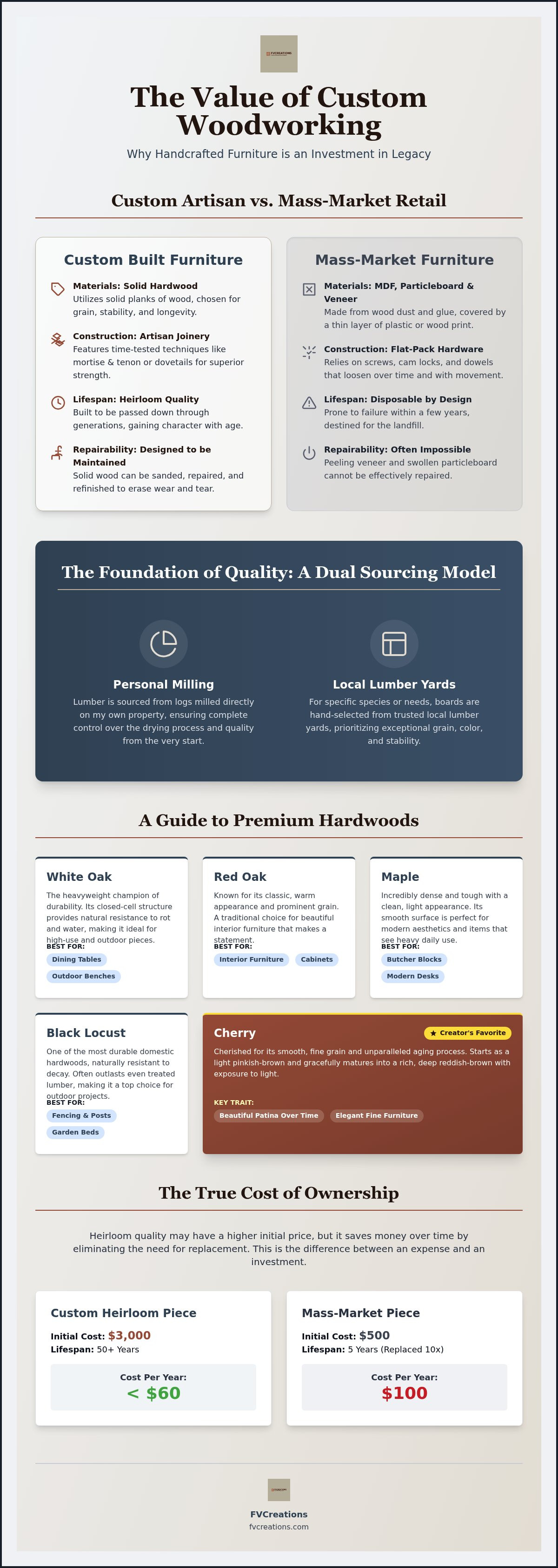
Most modern furniture is built for a shipping container, not a home. It's often made of MDF or thin veneers that look okay for a year but fall apart the moment you move or spill a glass of water. Real custom work relies on solid wood joinery, where the wood itself is locked together for strength. There's a deep emotional connection in owning something that isn't a carbon copy of a million other pieces. Bespoke furniture is an investment in both function and material integrity.
The Artisan Difference vs. Big Box Retail
Big box stores prioritize "shipping ease." This means they use lightweight, lower-grade materials that can be flat-packed. Quality control is often a checkbox on a factory floor thousands of miles away. When you work with an individual maker like me, Farmer Vic, accountability is built into every cut. I see every knot in the board. I feel the grain. This level of attention is what defines Studio Furniture, where the focus is on the craft rather than the volume. If a joint isn't perfect, it doesn't leave my shop. You don't get that at a warehouse.
Custom Furniture as a Sustainable Choice
We live in a "throwaway culture" where furniture is treated like a fast-fashion t-shirt. Choosing handcrafted pieces stops that cycle. It starts with the lumber. I use a dual-sourcing approach: I mill some wood right here on my property, and I buy the rest from select local lumber yards. You'll know if your table is made from a local white oak or a sturdy black locust. I work with many species, including red oak and maple, but I have a real soft spot for cherry. It's my favorite species because of how it matures into a rich, deep color over time. Starting small with something like handmade charcuterie boards is a great way to see the difference real wood makes. When you weigh the benefits of custom built furniture against the buy-and-replace cycle, the choice becomes clear.
The Soul of the Piece: Choosing the Right Wood Species
Choosing the right wood is the most critical step in the entire building process. It's about more than just picking a color; it's about understanding how a tree's biological traits will handle the life you're going to give it. One of the primary benefits of custom built furniture is that we aren't limited to whatever "mystery hardwood" a factory has on hand. Instead, we look at the grain, the density, and the history of the wood itself. I take a transparent approach to where my materials come from. I mill a good portion of my lumber right here on my property, which lets me see the wood from the moment it's a log. For other projects, I hand-select boards from local lumber yards to ensure the moisture content and grain patterns are exactly what we need for a stable, long-lasting piece.
Grain patterns aren't just for show. They dictate how the wood will move as the seasons change and how it will hold a joint together. When we talk about the soul of a piece, we're talking about that perfect marriage between the tree's natural growth and the furniture's final purpose. This level of detail is why handcrafted work stays solid while mass-produced alternatives start to rattle and lean.
The Oak Standard: Red Oak vs. White Oak
Oak has been a staple in workshops for centuries, but not all oak is created equal. White oak is the heavy-hitter when it comes to durability. It has a closed cellular structure that makes it naturally resistant to rot and water. This is why it's my first choice for heavy-duty dining tables or handcrafted outdoor benches that have to survive the elements. Red oak has a more open grain and a classic, warm look that many people love for interior furniture. It's slightly more porous, so it's best kept inside where it can show off its beautiful, traditional character without the worry of moisture.
Hardwood Heavyweights: Maple and Black Locust
If you want a clean, modern aesthetic, maple is hard to beat. It's incredibly dense and tough, making it perfect for surfaces that see a lot of daily use. On the other end of the spectrum is black locust. This wood is practically undefeated against rot and decay. It's often used for fence posts because it can sit in the dirt for decades without failing. In the workshop, I use it for pieces that need to be absolute tanks. Matching the species to the room's function ensures you aren't just buying furniture; you're buying a solution that fits your life.
Farmer Vic’s Top Pick: The Beauty of Cherry
If you've spent any time in my shop, you know that cherry is my absolute favorite species. There's just something special about the way it behaves under a chisel and how it looks once it's in a home. Cherry is unique because it actually "tans" over time. A piece that starts as a light, creamy pink will deepen into a rich, dark reddish-brown as it's exposed to light. Cherry wood possesses a remarkably tight grain that takes a finish so smoothly it feels almost like satin under your hand. It's a wood that gets better with age, much like the memories you'll make around it. If you're curious about how these different woods feel, starting with one of my charcuterie boards is a great way to see the grain up close.
Tailored Functionality: Built for Your Specific Life
Standardized furniture assumes everyone is the same height and lives in a perfectly square house. We know that's not true. One of the biggest benefits of custom built furniture is that we throw away the "standard" rulebook. If you spend eight hours a day at a computer, the ergonomic benefit of handcrafted wood desks built to your specific height can't be overstated. A few inches of difference in desk height can be the gap between chronic back pain and a comfortable workday. I hand-select every board, whether I'm milling it on my property or picking it up from a lumber yard, to make sure the grain and strength match the specific demands of your daily routine.
I also love solving the puzzles that come with unique architectural quirks. Maybe you have an alcove under a staircase or a narrow nook in a hallway that feels like wasted space. We can build a piece that slides in like it was always meant to be there. This isn't just about fitting a space; it's about making your home work harder for you. We can design multi-functional pieces that act as a bench for putting on shoes while hiding storage for winter gear inside. This level of personalization is impossible to find at a big-box retailer where everything comes in three fixed sizes.
Outdoor Living Without Compromise
Your outdoor space has its own set of challenges. I design heavy duty cedar planters specifically to handle the weight of wet soil and the stress of changing weather. One detail I always insist on is a legged design. This keeps the wood off the ground, allowing for essential airflow that protects your deck or patio from trapped moisture and rot. Whether we are using rot-resistant cedar or a hardwood heavyweight like black locust, the dimensions are tailored to your specific patio layout so you don't have to trip over oversized, generic options.
The Small Details: Adhesives and Inlays
While handcrafted wood elements add warmth, a solid stone foundation is equally important for a functional garden. To complement your custom build, you can explore Fixed-price hardscape design and installation contracts to ensure your outdoor living space is built to last from the ground up.
The strength of a piece is often in the things you don't see. I rely on Starbond Adhesives for flawless repairs and intricate inlays. High-quality glue is what prevents joints from separating after a few seasons of humidity changes. Custom commissions also give us the chance to turn a natural "defect," like a knot or a small crack, into a beautiful feature. Using professional-grade adhesives and unique wood-fill accents, we can create a look that mass-produced furniture simply can't replicate. It's these small, deliberate choices that ensure your furniture remains a legacy piece for decades.
The Longevity Factor: Maintenance and Repairability
Most big-box retailers love the phrase "maintenance-free." In reality, that's usually just code for "disposable." When a veneer table gets a deep scratch or a piece of particle board furniture gets wet, it's headed for the landfill. One of the primary benefits of custom built furniture is that it's designed to be part of your home for a lifetime, not just a few seasons. Real wood is the only material that actually gets better as it ages, developing a rich patina that tells the story of your family. A solid wood table built in my workshop can be sanded and refinished for 50 or more years, essentially giving it a new life whenever you need one.
I build things to be used, which means they'll eventually see a few bumps and bruises. The difference is that handcrafted pieces are repairable. If you dent a maple bench or scratch a cherry tabletop, you don't have to throw it away. Because I use solid lumber, whether it's milled right here on my property or hand-picked from a local yard, there is enough material to work with for decades of touch-ups. This long-term mindset is why I focus so heavily on the finishing process.
Traditional Finishing with Real Milk Paint
I've spent a lot of time testing different finishes, and I always come back to the basics. Using Real Milk Paint provides a non-toxic, breathable finish that doesn't sit on top of the wood like a plastic film. It soaks in, allowing the natural beauty of the grain to show through while remaining safe for kids and pets. For pieces made from my property-sourced lumber that might live near a window or on a porch, I recommend using Outdoor Defense Oil. It provides a deep level of protection without the harsh chemicals found in industrial polyurethanes. Natural oils make home touch-ups easy; you just rub a little more on, and the scratch disappears.
The Woodworker’s Toolkit for Homeowners
You don't need a full workshop to keep your furniture looking great. I always tell my customers to keep a small stash of quality sandpaper in a drawer. Most surface scratches can be buffed out by hand in a few minutes. It's also vital to practice seasonal oiling, especially when the air gets dry in the winter, to prevent the wood from shrinking or cracking. Learning to spot the difference between a surface scratch and structural damage is easy once you understand how the wood is put together. If you're ready to invest in a piece that lasts, you can explore my current finishing supplies to see how we protect every build.
Investing in Quality: The ROI of Custom Woodworking
People often feel a bit of sticker shock when they first see the price of a handcrafted table. I get it. However, if you break down the "Cost Per Year," the math changes almost immediately. A mass-market desk might cost $400 but only lasts four years before the drawers stick and the laminate peels. That is $100 a year. One of the primary benefits of custom built furniture is that it's built for a fifty-year lifespan or longer. When you look at it that way, you're paying a fraction of the annual cost for a piece that actually grows more valuable as it develops a story and a patina.
Handcrafted, signed artisan pieces hold their resale value in a way that factory-made items simply can't. You aren't just buying a utility; you're supporting national craftsmanship and sustainable practices. Instead of shipping particle board across an ocean, you're investing in local materials and a direct relationship with the maker. If you aren't ready for a full dining set yet, you can start your collection with smaller goods like my artisan firestarters to get a feel for the care I put into every item in my shop.
From Property to Table: The Sourcing Journey
My sourcing model is built on transparency and a personal connection to the land. I mill wood right here on my property whenever possible, and I supplement that by hand-picking boards from trusted lumber yards. This dual approach ensures I always have the perfect material for the job. Whether it's the legendary rot-resistance of white oak and black locust or the clean, modern look of maple, knowing the tree's origin adds a layer of value you won't find at a retail store. I take special pride in working with cherry. It's my favorite species because of its warmth and the way it matures; knowing exactly which log a cherry tabletop came from makes the piece feel like a member of the family.
How to Start Your Custom Commission
Starting a commission is a one-on-one conversation. We'll sit down and talk about your specific dimensions, the wood species that fits your lifestyle, and the natural finishes that will protect the piece for decades. I'm always honest about the realities of small-scale production. While every project is different, the average lead time for most custom furniture orders is between 6 and 14 weeks. This reflects the deliberate, steady pace that handcrafted work requires to ensure every joint is perfect. If you're tired of furniture that feels temporary, reach out to Farmer Vic to discuss your custom furniture project and let's build something that stays in your family for the long haul.
Start Your Legacy with a Piece That Lasts
Choosing a handcrafted table or desk isn't just about filling a room; it's about ending the cycle of disposable furniture and investing in a piece that grows with you. We have explored how the benefits of custom built furniture range from perfect ergonomic fits to the incredible durability of species like white oak and black locust. Whether the lumber was grown and milled right on my property or hand-selected from a trusted local yard, you're getting material that is personally vetted for quality and finished with non-toxic Real Milk Paint.
I take a lot of pride in being transparent about my process and my materials, especially when I get to work with my favorite wood, cherry. Every commission is a chance to build something that outlasts the trends of 2026 and stays in your family for decades. I offer national shipping on all my custom-built goods, so you can bring a piece of the workshop into your home no matter where you live.
Ready to see the difference for yourself? Browse Farmer Vic’s Handcrafted Collection today and let’s start talking about your next heirloom. I look forward to helping you find a piece that truly fits your life and your home.
Frequently Asked Questions
Why is custom built furniture more expensive than retail options?
Custom pieces cost more upfront because they use solid lumber and hand-cut joinery instead of factory-glued particle board. When you consider the benefits of custom built furniture, you have to look at the total lifespan. A mass-produced table might last five years, but a handcrafted one lasts fifty. You are paying for a piece that doesn't need to be replaced, making the cost per year significantly lower than fast furniture alternatives.
How long does it take to receive a custom wood furniture commission?
Most custom furniture commissions take between 6 and 14 weeks to complete. This timeline allows me to source the right boards, let the wood acclimate to the shop, and carefully execute every joint. Complex artisan pieces can sometimes take longer, but I always keep you updated on the progress. It is a steady, methodical process that ensures your furniture is built to handle decades of daily use without failing.
Can custom furniture be made from sustainable or property-harvested wood?
Sustainability is a core part of how I work. I use a dual-sourcing model where I mill a good portion of the wood right here on my property. For specific needs, I hand-select additional lumber from local yards. This transparency means you know exactly where your furniture started. Knowing the tree's origin adds a personal layer of value and ensures your home is filled with responsibly sourced materials.
What are the best wood species for custom outdoor furniture?
White oak and black locust are the top choices for outdoor durability. White oak has a closed cellular structure that naturally resists water, while black locust is famous for being practically rot-proof. I also use cedar for my planters and raised beds because of its natural oils. These species ensure your outdoor pieces can handle the weather for years without the structural breakdown common in cheaper, chemically treated retail sets.
Is it difficult to maintain handcrafted wood furniture?
Handcrafted furniture is actually easier to maintain than retail options because it is repairable. Since I use solid wood and natural finishes, you can buff out most surface scratches with a bit of sandpaper and a fresh coat of oil. Seasonal oiling keeps the wood from drying out or cracking. Unlike laminate surfaces that peel and can't be fixed, real wood furniture gets better with age and simple, consistent care.
Can I choose a specific finish like Real Milk Paint for my custom piece?
You absolutely can choose specific finishes like Real Milk Paint for your project. I specialize in these because they are non-toxic, breathable, and safe for your family. One of the benefits of custom built furniture is having total control over the chemicals in your home. These finishes don't sit like a plastic film on top; they soak in to highlight the natural grain while providing a durable, satin-like feel.
What is the difference between Red Oak and White Oak for furniture?
The main difference lies in their cellular structure and how they handle moisture. White oak has a closed grain that makes it incredibly resistant to rot, which is why I use it for heavy-duty tables and outdoor items. Red oak has an open grain and a classic, warm look that is perfect for interior furniture. Both are durable, but white oak is the better choice for any piece that might face high humidity.
Why is Cherry wood considered a premium choice for custom furniture?
Cherry is a premium choice because of its unique aging process and incredible finishing quality. It is my favorite species to work with because it tans over time, deepening from a light pink to a rich, dark reddish-brown. The grain is tight and smooth, which allows it to take a finish beautifully. It feels like satin under your hand and adds a level of warmth and character that few other hardwoods can match.