

Tung Oil vs. Mineral Oil for Cutting Boards: Which Should You Choose?
The finish that lasts longer isn’t automatically the right one for your cutting board. In the tung oil vs mineral oil for cutting boards debate, the better choice depends on more than durability. Consider the product’s food-contact instructions, any curing time, and the care routine you can maintain.
It’s understandable to feel uncertain. “Tung oil” can mean different things on a label, and mineral oil needs regular replenishing because it doesn’t cure into a hard finish. Think of the finish as part of caring for the board, not just a final coat. The exact product instructions matter, especially on a surface that touches food.
This guide compares pure tung oil and food-grade mineral oil, explains what to check before applying either, and outlines the upkeep each may involve. A finish that fits your routine may be a better choice than one that simply sounds more durable. Use the product’s instructions to make an informed choice and keep your board ready for use.
Key Takeaways
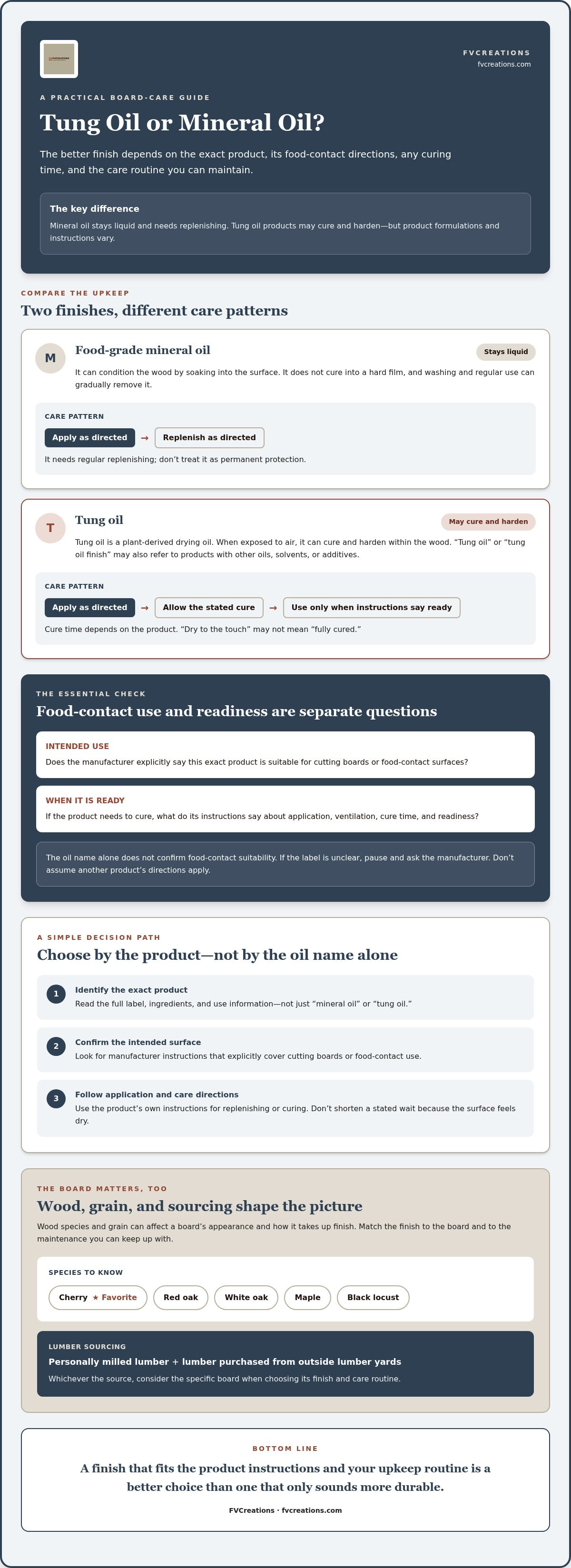
- The choice in tung oil vs mineral oil for cutting boards depends on the exact product instructions and the care routine you’re prepared to maintain.
- Mineral oil generally needs replenishing, while tung oil products may require curing. Check the label before applying either to a food-contact surface.
- Choose a finish by identifying the exact product, confirming its intended use, and following its application and care directions.
- Wood species and grain can affect a board’s appearance and how it takes up finish. Farmer Vic’s favorite is cherry, alongside red and white oak, maple, and black locust.
- Whether lumber is personally milled or purchased from an outside lumber yard, match the finish to the board and the maintenance you can keep up with.
Tung Oil vs. Mineral Oil for Cutting Boards: What Is the Difference?
The right choice in tung oil vs mineral oil for cutting boards depends on two things: whether the exact product’s instructions support use on a food-contact surface, and whether its maintenance suits you. The oil name alone doesn’t confirm suitability. Read the full label before applying a product to a board used for food.
The basic difference is that mineral oil stays liquid and needs replenishing, while tung oil can cure and harden as it reacts with air. This affects how each finish behaves, but products vary in ingredients and directions. Don’t assume every product with the same oil name works the same way.
What does mineral oil do on a cutting board?
Mineral oil is a petroleum-derived oil that can condition wood by soaking into its surface. It helps keep the board from looking and feeling dry, but it doesn’t cure into a hard film like a drying oil. Because it remains liquid, washing and regular use can gradually remove it. Replenish it according to the product’s directions rather than treating it as permanent protection.
Check that the specific mineral oil is explicitly intended for food-contact use. The words “mineral oil” alone don’t tell you whether a product is suitable for a board used to prepare food.
What does tung oil do on a cutting board?
Tung oil is a plant-derived drying oil. When exposed to air, it can cure through a chemical process that hardens the oil within the wood. The Tung oil overview describes its properties as a drying oil and its traditional use as a wood finish. On a board, curing means following the specific product’s application and wait-time instructions before putting it to use.
Read the entire label. A product marketed as “tung oil” or “tung oil finish” may contain other oils, solvents, or additives. The name doesn’t confirm that it’s pure tung oil or suitable for food contact. Don’t assume a finish is appropriate after curing unless its manufacturer confirms that intended use and provides directions for the finished surface.
Comparing these finishes starts with identifying the product, not deciding that one oil is always better. A board’s finish is part of its care, and the label guides how to use a particular product. If you’re considering a handcrafted board, browse the cutting board collection. Check the finish details separately rather than assuming a finish is included or recommended.
Food Safety and Curing: The Biggest Tung Oil vs. Mineral Oil Question
In the tung oil vs mineral oil for cutting boards decision, the oil category alone can’t confirm that a product is suitable for a food-contact surface. Even when the manufacturer says it is intended for that use, a curing finish may need to complete its cure before the board is used. Check these separately: intended use tells you where the product may be used, while cure directions tell you when the finished board is ready.
How to check a finish label before using it
Start with the exact product, not just the words “mineral oil” or “tung oil.” Look for manufacturer language that explicitly covers cutting boards or food-contact surfaces, then read the full ingredient and use information. A product containing tung oil may also include other ingredients, and a finish marketed for wood isn’t automatically suitable for a board used to prepare food.
If the label doesn’t clearly address the intended use, pause and ask the manufacturer. Don’t rely on another product’s instructions or make assumptions based on the oil’s name.
Why tung oil curing instructions matter
Curing directions apply to the specific product. The process can depend on its formulation and the conditions in which it’s applied, so there isn’t one timeline for every tung-oil product. Follow the label and manufacturer guidance for application, ventilation, and cure time, if provided.
“Dry to the touch” may not mean “fully cured.” If the manufacturer distinguishes those stages, use its definition of readiness and keep the board out of food use until the instructions say it can be used. Don’t shorten the wait because the surface feels dry.
Before treating a finished board as ready, verify the complete formulation and its stated food-contact use, then follow the product’s full curing instructions. That’s more reliable than choosing by oil type alone. For broader cleaning and care guidance, see USDA guidance on cutting board safety. Keep general board-care advice separate from approval of a particular finish.
Taking time to check the label is better than guessing about what belongs on a board. If you’re choosing a handcrafted board, browse the cutting board collection and check finish details separately for the product you plan to use.
Tung Oil vs. Mineral Oil: Compare Upkeep, Feel, and Everyday Use
For everyday care, the practical difference is how you’ll maintain the board. Mineral oil stays liquid in the wood and generally needs replenishing. A tung-oil product may cure, but its behavior and care requirements depend on its formulation and whether it has fully cured as directed. Neither choice is automatically more durable or easier for every household.
| What to compare | Mineral oil | Tung-oil product |
|---|---|---|
| Curing | Doesn’t cure into a hard film. | May cure; follow the product’s specific directions. |
| Replenishment | Generally needs topping up as it wears away. | Depends on the formulation and the manufacturer’s care instructions. |
| Label check | Confirm it’s intended for food-contact use. | Check the complete formulation, intended use, and cure directions. |
| Maintenance effort | Plan for recurring conditioning. | Be prepared to follow product-specific application and curing steps. |
Which oil is easier to maintain?
Mineral oil can fit a routine that allows for regular conditioning. A tung-oil product requires you to follow its own application and cure instructions. Don’t rely on a universal calendar. Check the board’s care guidance and appearance, and consider how often it’s washed and used. A board washed frequently may need attention differently from one used less often.
Which finish suits your board-care routine?
Consider what feels manageable: replenishing a non-curing oil as needed, or waiting until a curing product is ready for use according to its label. For either option, follow verified instructions rather than assuming all products in the category behave alike. That’s the useful answer to tung oil vs mineral oil for cutting boards: choose a routine you’ll follow and a product explicitly intended for the surface.
Finish is only one part of board care. Cleaning and proper sanitation matter too. Michigan State University Extension offers practical context on safe cutting board materials and handling. Keep those everyday habits in view as you decide which maintenance steps fit your kitchen.
How Board Wood and Your Routine Affect the Oil Choice
Wood species can influence a board’s appearance and how its grain takes up a finish, but it doesn’t replace the product-label check. For tung oil vs mineral oil for cutting boards, use this order: identify the exact oil, confirm the manufacturer says it’s intended for the board’s food-contact use, then follow its application and care directions.
Does maple, oak, black locust, or cherry change the decision?
Maple, red oak, white oak, and black locust each have their own grain and appearance. Red oak and white oak are distinct species, so don’t assume a finish will look or behave identically on both. Grain and the particular board can affect how a finish appears and is absorbed. The species name alone can’t tell you whether an oil is suitable for food contact.
Cherry deserves a special mention: it’s Farmer Vic’s favorite wood species. Its character is part of what makes working with it rewarding, but the same practical rule applies. Choose the finish based on verified product directions and a care routine you’re comfortable maintaining, not a broad claim about a species.
A practical checklist before finishing a board
Before applying anything, check these details:
- Identify the product: Read its full name and formulation rather than relying on a general oil category.
- Verify intended use: Look for explicit manufacturer instructions covering cutting boards or food-contact surfaces. If unclear, ask the manufacturer.
- Follow the directions: Use the stated application, curing, and care instructions, along with any guidance from the board’s maker.
This applies whether the lumber was personally milled or purchased from an outside lumber yard. The wood’s source doesn’t confirm that a particular finish is right for the board. Check the product label.
If you’re considering a handcrafted board, browse the cutting board collection. Match its care guidance with the verified instructions for the finish you choose.
Choosing a Cutting-Board Finish with Confidence
There’s no need to choose by reputation or a broad claim that one oil is always best. Mineral oil may suit you if the specific product is confirmed for food-contact use and you’re comfortable replenishing it as part of board care. A tung-oil product may suit you if its manufacturer confirms the intended use and you’re willing to follow its application and curing instructions before using the board.
A simple decision guide for the two oils
Use this order: confirm the exact product and formulation, check that its instructions cover your board’s intended food-contact use, then decide whether its application, curing, and upkeep fit your routine. If any directions are unclear, pause and ask the manufacturer rather than guessing. Whichever finish you choose, it doesn’t replace careful cleaning and drying after use.
Where a maker’s guidance can help
A maker can offer useful context about a board and its care, but product-specific instructions still determine how a particular finish should be used. At FVCreations, Farmer Vic’s hands-on woodworking perspective can help frame the question, not replace the manufacturer’s directions. For instance, the outdoor wood oil details are a reminder to check a product’s stated purpose. Don’t assume a finish intended for another application is suitable for a cutting board. Verify its instructions first.
That’s the practical answer to tung oil vs mineral oil for cutting boards: match the exact product to its verified intended use, then choose a care routine you can follow. A board deserves a finish chosen with care, not guesswork.
If you’re considering a board for your kitchen, explore handcrafted wood cutting boards. A finish isn’t implied, so check product details separately and ask questions about care before choosing an oil.
Choose a Finish You Can Maintain with Confidence
The best answer to tung oil vs mineral oil for cutting boards depends on the exact product and the care routine you’re willing to follow. Mineral oil may suit you if its label confirms it’s intended for food-contact use and regular conditioning feels manageable. A tung-oil product may fit if its manufacturer confirms the intended use and you’re prepared to follow its application and curing directions.
Keep those checks separate: a product’s intended use doesn’t tell you whether it has fully cured, and a dry-feeling surface isn’t a substitute for the manufacturer’s readiness instructions. Whatever you choose, thoughtful cleaning and drying remain part of caring for the board.
At FVCreations, Farmer Vic personally approves the woodworking maintenance supplies we carry, but that doesn’t establish that a particular product is right for cutting boards. Check its instructions before use. We also make handcrafted cutting and charcuterie boards. Browse our handcrafted cutting boards and check the product details before choosing a finish.
Frequently Asked Questions
Can I use tung oil on a cutting board?
Use a tung-oil product only if its manufacturer confirms it’s intended for cutting boards or food-contact surfaces and provides application and curing directions. Check the complete formulation, too: products labeled “tung oil finish” may contain ingredients beyond tung oil. Don’t put the board into food use until the product’s instructions say it’s ready. If the label is unclear, contact the manufacturer rather than guessing.
Is mineral oil better than tung oil for cutting boards?
Neither is automatically better. The right choice depends on the exact product and the care routine you’ll maintain. Verify food-contact suitability on the product’s instructions. Mineral oil generally calls for replenishment as it wears away, while a tung-oil product may require curing before use. In the tung oil vs mineral oil for cutting boards decision, compare label directions, curing requirements, and upkeep instead of relying on broad category claims.
Is tung oil food-safe after it cures?
Full curing alone doesn’t establish that every tung-oil product is suitable for a cutting board. Formulations vary, so check whether the manufacturer explicitly confirms food-contact use and follow its cure directions. If the label distinguishes “dry to the touch” from “fully cured,” wait for the stage specified for use. When the directions don’t answer your question, ask the manufacturer before preparing food on the board.
How often should I reapply mineral oil to a cutting board?
There isn’t one reapplication schedule that fits every board. Follow the specific mineral oil’s instructions and the board maker’s care guidance, then consider the board’s appearance and how often you use and wash it. Frequent washing can affect how long conditioning lasts. Choose a mineral oil explicitly intended for food-contact use, and replenish it as directed rather than following a fixed calendar that may not suit your board.
Can I apply tung oil over mineral oil on a cutting board?
Don’t layer a tung-oil product over mineral oil unless the manufacturers’ instructions confirm the products are compatible and explain how to prepare the surface. Mineral oil doesn’t cure into a hard film, and remaining oil may affect how another finish behaves. Formulations vary, so avoid relying on a general recipe. Check both product labels or contact their manufacturers, and keep the board out of food use until the finish instructions say it’s ready.
Does the wood species affect which oil I should use?
Species and grain can affect a board’s appearance and how it takes up a finish, but they don’t determine whether an oil is suitable for food contact. Maple, red oak, white oak, black locust, and cherry each have their own character. Cherry is Farmer Vic’s favorite. Whichever wood you have, identify the exact product, verify its intended use, and follow the manufacturer’s application and care directions.
What should I check before using an oil on a cutting board?
Read the full product label and confirm the exact formulation, intended use, application steps, and any curing requirements. Look for explicit manufacturer instructions covering cutting boards or food-contact surfaces. Don’t assume suitability from the words “mineral oil” or “tung oil” alone. If directions are incomplete or unclear, contact the manufacturer before applying the oil. Follow the board maker’s care guidance as well, and clean and dry the board carefully after use.