

White Oak Kitchen Counter: Style, Care, and Durability
What if the best-looking wood for your kitchen isn’t automatically the best fit for how you cook? A white oak kitchen counter has a calm, natural grain and greater natural moisture resistance than some other woods, but everyday performance depends on more than species alone. Construction, finish, and the way you use the surface all matter.
It’s reasonable to wonder whether wood can stand up to spills, dampness, and busy kitchen routines, or whether caring for it will become another chore. You can make a more practical choice by weighing the wood’s qualities against its tradeoffs and your habits.
We’ll look at white oak’s appearance and use, then compare it with red oak, maple, black locust, and cherry. Cherry is Farmer Vic’s favorite, and its warm color deserves a little extra attention. I’ll also cover decisions about construction, finish, and care. Lumber can come from personal milling as well as purchases from outside lumber yards, and material selection shapes the finished surface from the start.
Key Takeaways
- Judge a white oak kitchen counter by more than its color: natural boards vary in tone and grain, while construction and finish shape how the surface performs.
- Compare white oak with red oak, maple, black locust, and cherry by the appearance and practical considerations that matter in your kitchen.
- Plan around how you’ll use the counter, especially near sinks, seams, edges, overhangs, and supports.
- Choose a care approach that fits your preferred finish and everyday routine before settling on a surface style.
- Lumber selection influences the finished surface, whether material is personally milled or purchased from outside yards. Farmer Vic also shares why cherry is his favorite.
What Makes a White Oak Kitchen Counter Distinctive?
A white oak countertop is a kitchen work surface made from boards of white oak, a hardwood species known botanically as Quercus alba (white oak). It brings a warm, natural surface for food preparation, serving, or gathering, along with the character of real wood. Its appeal isn’t just the species name: board selection, layout, and finish all shape the finished look.
What Does White Oak Look Like as a Countertop?
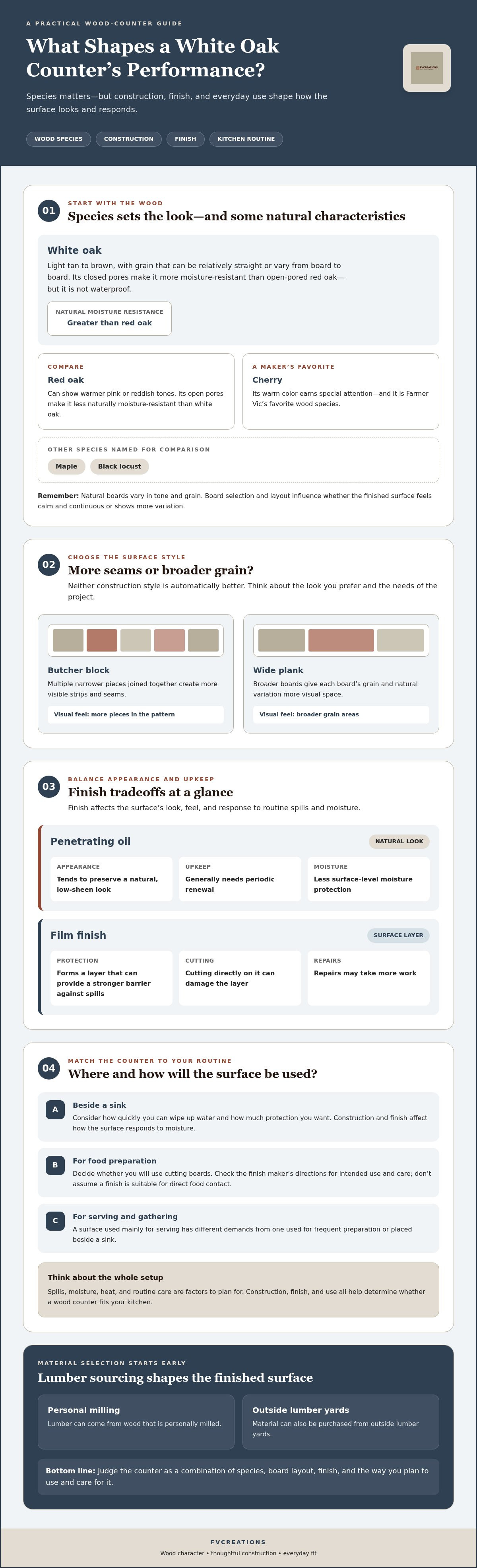
White oak ranges from light tan to brown, and its grain may appear relatively straight or vary from board to board. Natural lumber isn’t uniform, so the finished surface won’t necessarily have one consistent shade or repeating pattern. The way boards are selected and arranged can create a calm, continuous look or make the grain variation more prominent.
Room details affect how the wood reads. A pale counter against dark cabinetry creates a stronger contrast, while similar tones can give the room a quieter look. Natural and artificial lighting also change how the grain and color appear throughout the day. Consider the counter alongside cabinets, flooring, and wall colors rather than judging the wood in isolation.
Is White Oak a Good Fit for a Kitchen?
Looks are only one part of the decision. Think about how you use your kitchen: will the counter be a regular prep surface, sit beside a sink, or mostly serve as an island for serving and gathering? Spills, moisture, heat, and routine care are practical factors to plan for, not automatic reasons to rule out wood.
White oak has closed pores that make it more resistant to moisture than open-pored woods such as red oak, but it isn’t waterproof. Construction and finish also affect how the surface responds to daily use. A counter near a sink faces different demands from one used mainly for serving. A surface intended for direct cutting also has different care considerations from one used with cutting boards.
White oak brings varied, warm grain and greater natural moisture resistance than red oak, but construction, finish, and everyday use determine whether it suits your kitchen.
Start by deciding what you want the wood to look like, then match the surface and care routine to your household’s habits. A white oak kitchen counter can be a practical choice when these details are considered together, rather than relying on appearance or species alone.
How Construction and Finish Shape White Oak Countertop Performance
The wood is only part of the equation. How boards are joined, which finish is applied, and how you plan to use the surface all influence its appearance and day-to-day demands. A white oak kitchen counter used mostly for serving has different needs from one beside a sink or used for frequent food preparation. Start with your kitchen’s routines instead of looking for a one-size-fits-all rule.
Butcher Block or Wide Plank: Which Surface Style Fits?
Butcher block is made from multiple narrower pieces joined together, so the surface shows more individual strips and seams. A wide-plank style uses broader boards, giving each board’s grain and natural variation more visual space. Neither is automatically better. Consider whether you prefer a busier, patterned surface or a simpler look, how the counter relates to the cabinetry, and how you’ll use it. Seasonal wood movement also belongs in this choice: wood swells and shrinks as humidity changes, mostly across the width of a board. Because a wide plank is one broad piece, that movement builds up across a single wide board. Butcher block divides the width into narrower strips, so the movement is spread across many joints. Either style needs room to move when it is fastened to the cabinets. Beyond that, the choice depends on design and project needs, not a universal performance ranking.
What Should You Know About White Oak Countertop Finishes?
Finish changes the surface’s feel and appearance, as well as how it responds to routine spills and moisture. A penetrating oil tends to preserve a natural, low-sheen look, but generally needs periodic renewal and offers less surface-level moisture protection. A film finish forms a layer over the wood and can provide a stronger barrier against spills. Cutting directly on it can damage that layer, and repairs may take more work.
Match finish and upkeep to how you’ll use the counter. Near a sink, consider how quickly you can wipe up water and what level of protection you want. For a prep surface, don’t assume a finish is suitable for direct food contact just because it’s used on wood. Check the finish maker’s directions for its intended use and care. FVCreations’ guide, Real Milk Paint: The Artisan’s Guide to Traditional Wood Finishing, offers more background on finish choices.
Construction deserves attention, too. A counter is made from joined boards, and its layout affects the visible seams and grain. The botanical characteristics of white oak help identify the species, but the tree alone can’t tell you how a finished counter will behave. That depends on the assembled surface and how it’s protected and maintained.
Countertop performance comes from the combination of species, construction, finish, and care, matched to how the kitchen is actually used. Before choosing, picture the surface in its daily setting: where water may sit, whether you’ll use cutting boards, and how much ongoing finish care feels manageable.
White Oak vs. Red Oak, Maple, Black Locust, and Cherry
Each species brings a different mix of color, grain, and practical considerations. Natural boards vary, so treat these descriptions as a guide rather than a promise of an exact shade or pattern. When considering a white oak kitchen counter, weigh the look you want against where the surface will sit and how you’ll use it.
Seasonal wood movement is another factor to weigh when selecting wood. Wood takes on and gives up moisture as indoor humidity rises and falls, so a counter can swell and shrink slightly through the year. The amount of movement varies by wood species, and it also depends on your geographic location, since local climate and indoor humidity differ from place to place. Ask your lumber supplier or maker how a given species tends to behave in your area, and consider that alongside appearance and use.
White Oak vs. Red Oak: What Is the Difference?
White oak often has a light-to-medium brown appearance, while red oak can show warmer pink or reddish tones. Both have visible grain, though its character varies with the board and how it’s cut. Their pore structure differs: white oak has pores commonly blocked by tyloses, which contribute to greater natural resistance to moisture than red oak’s more open pores. Neither species is waterproof, so finish and care still matter. The Wood Database provides more detail on the technical properties of white oak.
How Maple, Black Locust, and Cherry Compare
Maple tends toward a light color and fine, subtle grain. Black locust can range from greenish-yellow to golden-brown and is notably hard, which may affect how it’s worked. Cherry is often warm reddish-brown, and its color deepens with age. I’m especially fond of cherry. It’s my favorite wood, thanks in part to its rich color and smooth, refined grain.
| Species | Appearance | Selection considerations | Questions to consider |
|---|---|---|---|
| White oak | Often tan to brown, with visible grain | More naturally moisture-resistant than red oak; still needs suitable construction and finish | Will its color and grain suit the room and the counter’s exposure to water? |
| Red oak | May show warmer, reddish tones and prominent grain | Open pores mean moisture protection deserves attention | Do you prefer its warmer look, and how will you manage spills? |
| Maple | Often light, with a fine, quieter grain | Can suit a brighter, more understated appearance | Would a subtle grain work with the cabinetry and other surfaces? |
| Black locust | Can range from greenish-yellow to golden-brown | Its notable hardness may influence fabrication choices | Does its distinct color fit the kitchen’s palette? |
| Cherry | Warm reddish-brown; deepens with age | Its changing color is part of its appeal | Will you enjoy how its tone develops over time? |
Species traits are starting points, not guarantees for every board or finished surface. If possible, view samples in the kitchen’s lighting and compare them with nearby cabinets and flooring. Then weigh appearance alongside intended use, construction, and finish.
How to Plan and Care for a White Oak Kitchen Counter
A little planning helps turn a wood preference into a surface that fits your kitchen’s routine. Before settling on dimensions or finish, work through these decisions in order:
- Define the use. Decide whether the counter will be a food-prep area, serving space, island, or a mix. Note where people gather and which spots are likely to see frequent water or spills, especially around a sink.
- Measure the space. Record the counter’s length and depth, along with obstacles and adjoining surfaces. Mark where seams may fall and how edges and overhangs should meet cabinets or seating areas. Consider these details together rather than leaving them for last-minute adjustments.
- Select a surface style. Choose a look that fits the room and intended use, such as the visual rhythm of butcher block or the broader grain of wide boards. Think about how the layout will look across the full counter, not just in a small sample.
- Plan for care. Choose a finish with your expected exposure and maintenance habits in mind. Keep the finish maker’s instructions handy so routine cleaning and any future renewal follow guidance for that specific finish.
What Should You Decide Before Choosing Countertop Dimensions?
Measurements are only one part of the plan. Consider how the counter meets a sink, where seams will be visible, which edges will be exposed, and whether an overhang needs support. A long stretch of counter, a corner, and a seating edge each raise different layout questions. Keep the measurements, seam placement, edge details, and support plan connected, and use project-specific guidance for installation and structural decisions.
How Do You Care for a Finished Wood Countertop?
For everyday care, wipe up spills promptly and clean the surface as recommended for its finish. Routine cleaning isn’t the same as renewing the finish. Renewal may be needed as the surface wears, but timing depends on the finish, exposure, and how heavily the counter is used. There’s no single schedule that suits every wood countertop.
Don’t assume a cleaner or oil is suitable simply because it’s commonly used on wood. Follow the finish maker’s directions, particularly for surfaces used around food. For more on evaluating finishes for kitchen use, see Best Food-Safe Finishes for Kitchen Counters as you continue planning your white oak kitchen counter.
A Maker’s Perspective on White Oak, Sourcing, and the Finished Surface
A wood surface starts taking shape long before the final sanding or finish. Lumber source, grain, and condition all influence how a finished piece looks and suits its intended use. That’s true whether you’re considering the character of a white oak kitchen counter or choosing wood for another handcrafted project.
Why Lumber Sourcing Is Part of the Finished Piece
At FVCreations, lumber comes from two places: some is personally milled, and some is purchased from outside lumber yards. These are complementary parts of sourcing, and boards can differ in character and appearance.
As a maker, I pay attention to how boards work together. Grain direction, color variation, and the character of individual pieces shape the surface’s overall appearance. Intended use matters, too. Material and layout should make sense for the finished piece, rather than treating lumber as interchangeable just because two boards share a species name.
That hands-on perspective informs the choices behind handcrafted woodwork, from selecting boards to bringing out their natural character in the finished piece. For a broader look at the maker’s approach, you can also explore Unique Handcrafted Wood Products: 2026 Artisan Guide.
Where to Go Next with Your Woodworking Plans
As you narrow your choices, bring the decision’s parts together: the look you want, how the surface will be used, its construction, the finish, and the care you’re comfortable providing. A clear plan helps you weigh those details as a whole, whether you’re considering white oak or another wood.
FVCreations makes handcrafted wooden goods and accepts custom woodworking commissions. Material selection and finish are considered as part of the work. For an example of handcrafted wooden goods, explore the handcrafted cutting boards.
Choose a Wood Surface That Fits Your Kitchen
A white oak kitchen counter can bring natural warmth and distinctive grain to a kitchen, but the species is only one part of the decision. Construction, finish, and care shape how the surface suits your routines, especially in areas exposed to water or frequent use. Comparing white oak with red oak, maple, black locust, and cherry can also help clarify which appearance and practical tradeoffs feel right for your space. Cherry remains Farmer Vic’s personal favorite for its warm character.
Define how you’ll use the surface, plan its dimensions and details, and choose a care routine that matches the finish. These steps help turn a beautiful material into a considered woodworking project.
FVCreations is an independently operated woodworking business creating handcrafted wooden goods and custom commissions shaped around customer-provided dimensions and specifications. Explore handcrafted woodwork from Farmer Vic for inspiration as you plan your project. With a clear sense of what matters in your kitchen, you can choose a wood surface with confidence and enjoy the character it brings to your home.
Frequently Asked Questions
Is white oak a good choice for a kitchen countertop?
Yes, white oak can be a good kitchen countertop choice if its construction, finish, and care suit your daily use. Its closed pores make it more naturally resistant to moisture than red oak, but it isn’t waterproof. Consider how close the counter will be to a sink, whether you’ll prepare food directly on it, and how much upkeep you’re comfortable with. Those details matter as much as the wood’s appearance.
What is the difference between white oak and red oak countertops?
White oak often has tan-to-brown tones and is more naturally resistant to moisture, while red oak may have warmer, pinkish or reddish tones and more open pores. Both have visible grain, with natural variation from board to board. Red oak can still be used for a countertop with suitable construction and finish. Choose based on the appearance you prefer and the surface’s exposure to water, not the assumption that all oak performs alike.
Does a white oak countertop need to be sealed?
A white oak countertop needs a finish suited to its intended use and exposure, but “sealed” can mean different things. A penetrating finish soaks into the wood, while a film finish forms a protective layer over it. Neither makes the surface maintenance-free or waterproof. Follow the finish manufacturer’s directions for application, cleaning, and renewal, especially near sinks. For surfaces used around food, verify the finish’s stated suitability for that use.
How do you care for a white oak kitchen counter?
Wipe up spills promptly, avoid leaving standing water on the surface, and clean it according to the finish manufacturer’s instructions. Don’t assume a household cleaner or oil is compatible with every finish. Routine cleaning is different from renewing a worn finish, and the timing depends on the finish, how often you use the counter, and its exposure to moisture. Using cutting boards and trivets can help limit direct wear and heat marks.
Is white oak better than maple for a kitchen counter?
Neither is automatically better; they offer different looks and practical qualities. White oak generally has more pronounced grain and warmer tan-to-brown tones, while hard maple often appears lighter with a tighter, subtler grain. The Janka hardness values in the supplied reference are 1,360 lbf for white oak and 1,450 lbf for hard maple, a measure of resistance to denting. Consider appearance, intended use, construction, finish, and care together.
Can you cut directly on a white oak kitchen countertop?
You can cut on a wood counter only if its finish and intended use allow it, but a cutting board is the more practical choice for most finished surfaces. Knife marks can damage a film finish, and direct cutting can leave visible marks in the wood itself. If direct chopping is important to you, choose a surface and finish specifically intended for that use, and follow the maker’s care guidance.
How does a white oak butcher-block countertop differ from a wide-plank counter?
A butcher-block surface is assembled from multiple narrower pieces, so the pattern shows more strips and seams. A wide-plank counter uses broader boards, putting more attention on each board’s grain and natural variation. The choice is mostly visual and depends on the kitchen’s design and how you want the surface to read. Neither style is universally better; consider layout, intended use, and care needs as part of the decision.