

Citrus Solvent for Wood: How Orange Oil Replacers Compare
“Citrus” on the label sounds like a clear answer, but it doesn’t tell you what a solvent will do to your wood or its finish. Citrus solvent for wood and orange oil replacer can describe similar products, yet the name alone won’t tell you whether a formula is intended for thinning an oil finish, cleaning a brush, or another task.
A plant-derived product or citrus scent isn’t automatically safe for every surface or suitable for every job. Check the product’s intended use, formulation, directions, and precautions. Then test it on a small, inconspicuous area before treating the full piece.
In this guide, we compare citrus solvents and orange oil replacers by what they’re made to do, then cover careful use on wood. We’ll consider red and white oak, maple, and black locust, with extra attention to cherry, one of Farmer Vic’s favorite woods. Our lumber comes from both personal milling and purchases from outside lumber yards, so we know each board deserves attention to its own character and finish.
Key Takeaways
- The name “orange oil replacer” doesn’t guarantee the same ingredients or uses as another citrus solvent. Compare each product’s label and Safety Data Sheet.
- Choose citrus solvent for wood by the task, such as cleaning or thinning, and use it for that task only when the product instructions support it.
- Keep solvents separate from the oils or waxes that protect and finish wood. They play different roles in the process.
- Before applying a product broadly, test it on a small, inconspicuous area and assess the result.
- Follow the product’s directions for ventilation, protective equipment, storage, and disposal. Farmer Vic personally approves FVCreations’ woodworking supplies.
What Is Citrus Solvent for Wood, and What Does “Orange Oil Replacer” Mean?
Citrus solvent for wood is a solvent sold for particular woodworking or finishing tasks. Its composition and proper use depend on the product’s own documentation. The name describes a category, not a guarantee about ingredients, compatibility, or results. Some products use d-limonene, a compound found in citrus oils and used as a solvent. Limonene offers background on its chemistry and sources.
A solvent is a workshop aid, not a protective wood finish. A product may be intended to thin a particular finish, clean tools, or assist with another stated task, but it doesn’t automatically leave a lasting protective layer on wood. Oil, wax, or another finish is a separate product with its own purpose and directions.
Does “orange oil replacer” mean the same thing as citrus solvent?
Not necessarily. Manufacturers may use “orange oil replacer” and “citrus solvent” differently. The names alone don’t establish that two products have identical ingredients or intended uses. Treat each product as its own formulation instead of assuming the label tells the whole story.
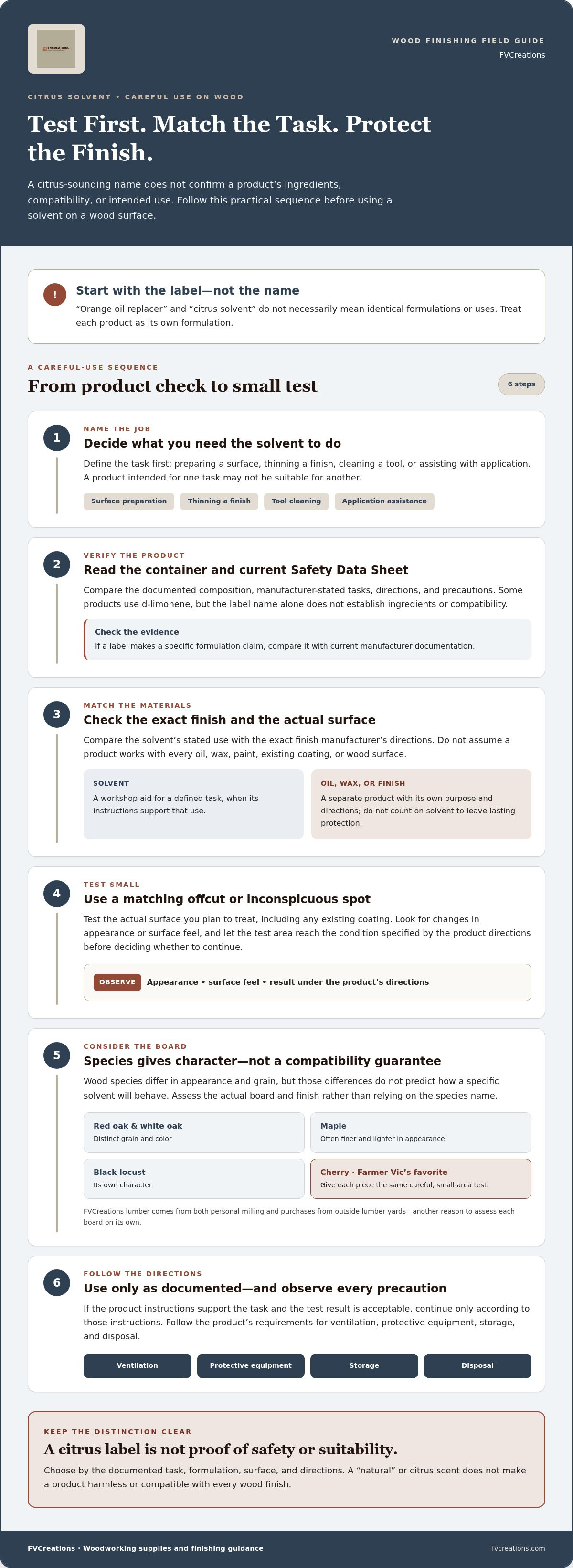
Read the container and, when available, the current Safety Data Sheet. Compare the stated composition, tasks identified by the manufacturer, and directions for use. If a label makes a specific formulation claim, check it against current manufacturer documentation. This gives you a more reliable basis for comparison than a citrus-sounding name.
What does a woodworker use a citrus solvent for?
That depends on the specific product. A manufacturer may say its solvent is suitable for thinning a named type of finish, cleaning certain tools, or another finishing task. Don’t assume those uses apply to every citrus solvent. Follow the product’s instructions, including any limits on the finishes or surfaces it can be used with.
The same care applies to the wood itself. Suitability depends on the solvent, the existing or planned finish, the surface, and the application directions. A product intended for one step in a finishing process may not be appropriate for another. Test a small area before wider use, and don’t treat “natural” or “citrus” as proof that a product is harmless or compatible.
At FVCreations, Farmer Vic personally approves woodworking supplies, including products in our solvents collection. Match the documented product to the task, then follow its directions.
How Citrus Solvent Interacts with Wood Finishes and Workshop Tasks
A solvent’s role depends on its formulation and directions. One product may be labeled for thinning a particular finish, while another may be intended for cleaning or a different workshop task. Don’t assume that a solvent suitable for one step will work for every finish, surface, or cleanup job.
Check the solvent’s stated use against the exact finish you’re using. This helps prevent a common mix-up: a solvent may be used alongside a finish, but it isn’t automatically the finish itself. Oils and waxes are applied to leave a finish on the wood. A solvent’s role, when supported by the product instructions, is to help with a defined task in the process. Don’t count on it to provide lasting protection.
Some solvents, including d-limonene, are discussed for their ability to dissolve materials. Cleanfax’s overview of d-limonene as an original green solvent provides broader context, but it doesn’t establish that a particular citrus product is compatible with a wood finish. The product’s own instructions remain the guide.
Match the solvent to the task, not just the finish category
Start by defining the job: preparing a surface, thinning a finish, cleaning a tool, or assisting with application. Then compare that task with the product’s stated uses and the finish manufacturer’s directions. Don’t assume a solvent works with all oils, waxes, paints, or existing coatings just because it’s marketed for woodworking.
For example, if you’re pairing a solvent with an oil finish, use the combination only as directed for those specific products. FVCreations’ outdoor wood finishing oil is a separate finishing product, not a solvent. The two have different roles. For more context on finishing choices, see the Real Milk Paint finishing guide.
Why wood species and existing surfaces deserve a small test
Even when the instructions indicate a use is suitable, test on a matching offcut or an inconspicuous spot first. Look for changes in appearance or surface feel, and let the test area reach the condition specified by the product directions before deciding whether to continue. An existing coating can respond differently from bare wood, so test the actual surface you plan to treat.
Species also differ in appearance and grain. Red oak and white oak have distinct grain and color, while maple often has a finer, lighter appearance. Black locust is another wood with its own character. These differences don’t predict how a specific solvent will behave, so test the actual board and finish rather than relying on the species name. Cherry deserves extra attention in Farmer Vic’s shop because it’s his favorite species. Our lumber comes from both personal milling and purchases from outside lumber yards, which is another reason to assess each piece instead of assuming every board will respond alike.
Citrus Solvent vs. Orange Oil Replacer: Compare These Details Before Choosing
Two containers can sound alike and still have different formulations, uses, or handling directions. When choosing citrus solvent for wood, compare what the manufacturer documents instead of trying to decode the name. The right product is the one whose stated use matches your task and the finish or surface involved, not necessarily the one with the most appealing label.
Which comparison criteria matter most for wood finishing?
Use the label and current Safety Data Sheet as your reference points. Check the stated composition, tasks the manufacturer supports, any compatible products named, and product-specific cautions and storage directions. If information is missing or unclear, don’t fill in the blanks based on “citrus” or “orange oil replacer.”
Use this comparison to narrow down a product before testing it:
| What to compare | Citrus solvent | Orange oil replacer |
|---|---|---|
| Product identity | Verify on label | Verify on label |
| Stated composition | Check the label and Safety Data Sheet | Check the label and Safety Data Sheet |
| Intended use | Follow the manufacturer’s stated uses | Follow the manufacturer’s stated uses |
| Handling instructions | Follow product-specific cautions and storage directions | Follow product-specific cautions and storage directions |
This comparison doesn’t assume the two names refer to identical products. It gives you a consistent way to evaluate each one for the job, whether that’s a stated cleaning task or a finish application the manufacturer specifically describes.
Is a citrus-sounding solvent automatically safer or better?
No. A citrus-derived name alone can’t establish a product’s safety, environmental impact, or performance. It also can’t show that the solvent suits a particular finish, wood surface, or application. Those details depend on the specific formulation and its documented directions.
Read the label and Safety Data Sheet before use, including guidance on ventilation, protective equipment, storage, and disposal. Don’t rely on broad marketing language or assume that “natural” means harmless. Compare the documentation, then use a small test to see how that exact product behaves on your workpiece.
How to Test and Use Citrus Solvent on Wood with Care
A careful test can help you avoid an unwanted change to a finished piece. Before using citrus solvent for wood, define the task, read the product directions, test a small area, and assess the result. Don’t skip those steps because a product sounds familiar or the wood looks sturdy.
- Identify the task. Decide whether you’re preparing a surface, cleaning, or applying a finish. Confirm that the product instructions support that use.
- Read the label and Safety Data Sheet. Check the application directions and product-specific precautions before opening or using the container.
- Test a small area. Use a discreet spot or a matching offcut with the same wood and existing finish.
- Assess before proceeding. Look for changes in color, sheen, tackiness, or the condition of the finish.
A small-area test before treating the whole piece
Choose a test spot that represents the surface you plan to treat. Bare wood and an existing coating may respond differently, so a scrap with the same finish is more useful than an unrelated offcut. Follow the product’s directions for application and how long to wait before assessing the area. Don’t substitute a guessed schedule.
A small test shows how this product interacts with this particular surface before you commit to treating the whole piece. Check for changes in color or sheen, a tacky feel, or signs that the existing finish has softened or changed. If you see an unwanted result, stop. Don’t apply more solvent or leave it on longer to try to correct the result.
Read product-specific precautions before opening the container
Use the product label and Safety Data Sheet for handling and storage directions. Follow their guidance on ventilation and protective equipment. Pay attention to ignition precautions if the product documentation specifies them, and use the stated storage and disposal instructions rather than making assumptions about citrus-derived ingredients.
Keep the product’s directions close at hand as you work. If the test changes the surface in an unwanted way, don’t continue across the board. That’s especially important on a valued piece. Cherry is a favorite in Farmer Vic’s shop, and careful testing helps preserve the wood’s appearance without assuming a solvent will behave the same on every surface.
For a product-specific starting point, read the directions for FVCreations’ woodworking solvents before choosing a task or testing a piece.
Choosing a Citrus Solvent for Wood: A Practical Next Step
Choose a product in three steps: define the task, compare its documented composition and intended use, then test it on the surface you plan to treat. With citrus solvent for wood, the name is only a starting point. The label and Safety Data Sheet provide details to help you decide whether the product fits your work.
At FVCreations, Farmer Vic personally approves woodworking supplies with a maker’s eye for how products fit real shop tasks. Keep the solvent’s role clear: it’s a workshop aid for uses supported by its directions, not a wood finish in itself.
When a named orange oil replacer is the better fit
An orange oil replacer may be a good fit when its manufacturer documents the task you have in mind and its instructions suit the finish and surface involved. Compare its stated composition, intended use, precautions, and storage guidance with the alternative. Don’t assume the product contains a particular ingredient or will produce a certain result because of its name.
If the label doesn’t support your intended task, choose a product whose documented use does. This helps prevent a solvent from becoming a catch-all for unrelated finishing jobs.
When a general citrus-solvent product deserves a closer look
A general citrus-solvent product is worth considering when its documented use matches your task and its directions suit the finish and surface. For broader context on natural finishing choices, read the Real Milk Paint natural-finishes guide. Then compare the solvent’s own documentation and test it on a discreet spot before applying it more broadly.
You can also browse the Real Milk Paint Co. solvent collection as a product-discovery step. Let the documented task, formulation, and test result guide your choice, not the label wording alone.
For more maker-approved woodworking supplies, explore the FVCreations shop.
Make Your Next Finishing Step a Thoughtful One
The name on a container is only a starting point. Choose citrus solvent for wood by matching its documented composition and intended use to your task and finish, then test the exact product on a small, representative area. Read the label and Safety Data Sheet for product-specific directions and precautions.
A solvent and a protective finish do different jobs. Keep that distinction clear, and take time to see how a product behaves on your surface before using it more broadly.
Farmer Vic personally approves FVCreations’ woodworking maintenance supplies. We offer Real Milk Paint Co. finishing products and a dedicated solvents collection for shop projects. Explore woodworking supplies for your next piece. Follow the product directions and approach each finishing step with care.
Frequently Asked Questions
Is citrus solvent the same as an orange oil replacer?
Not necessarily. Manufacturers may use these names differently, and a citrus-sounding label doesn’t prove two products have the same ingredients or purpose. Compare the stated composition, intended uses, directions, and precautions on each product’s label and Safety Data Sheet. For a specific woodworking task, rely on the manufacturer’s documentation rather than assuming the names are interchangeable.
Can citrus solvent be used on finished wood?
Only when the product’s instructions support that use on the particular finish and surface. A solvent may affect an existing coating, so don’t assume it’s suitable for every finished table, board, or furniture piece. Check the label and Safety Data Sheet, then test a discreet area or matching offcut. Stop if you notice an unwanted change in color, sheen, tackiness, or finish condition.
What is orange oil replacer used for in woodworking?
Its use depends on the product. A manufacturer may describe a particular orange oil replacer for a task such as thinning a specified finish or cleaning tools, but the name alone doesn’t establish what it can do. Read the product directions and use it only for the stated purpose. A solvent is a workshop aid, not a protective wood finish, unless the product documentation specifically describes a finishing role.
Is a citrus-based wood solvent safe to use indoors?
Don’t assume indoor use is safe just because a product is citrus-based or plant-derived. Check the product’s label and Safety Data Sheet for ventilation, protective equipment, storage, and ignition precautions. Follow the manufacturer’s guidance for the space and task, and don’t substitute another product’s instructions. If the documentation doesn’t support the way you plan to use it, don’t proceed on assumption alone.
How do I test citrus solvent on wood before using it?
Choose a discreet spot or an offcut matching the wood and existing finish. Follow the product’s application directions and stated waiting time, then inspect for changes in color, sheen, tackiness, or finish condition. A small test shows how that specific product responds on that particular surface. If the result is unwanted, stop rather than applying more solvent or extending the application.
Can citrus solvent be mixed with tung oil or another wood finish?
Only mix them if the solvent and finish manufacturers’ instructions support that exact combination. Don’t assume citrus solvent is compatible with every tung oil, wax, paint, or other finish, and don’t guess at a mixing ratio. Check both products’ directions and test the mixture as instructed before using it on the project. The solvent and the finished oil serve different purposes in the woodworking process.