

Handcrafted Wood Desks: The Artisan’s Guide to Quality and Sourcing (2026)
Yesterday morning, I stood in my workshop running my hand over a fresh slab of cherry wood, thinking about why so many people settle for furniture that wobbles or peels after just a year. It's frustrating to spend your day at a generic desk that lacks character and eventually ends up in a landfill. You shouldn't have to guess which wood species will hold up under pressure or wonder if your furniture is truly built to last. I believe your workspace should be anchored by a handcrafted wood desk that feels like an heirloom from the very first day you sit down at it.
In this guide, I'll show you how to choose the right materials and finishes to transform your office into a place of quality. We'll dive into the traits of maple and black locust, and I'll explain the differences between red oak and white oak. I'll also share why cherry remains my absolute favorite wood to work with. You'll see how I source lumber, whether I'm milling it myself on the property or visiting local yards for the perfect piece. By the time we're done, you'll have the confidence to commission a bespoke piece that stands the test of time.
Key Takeaways
- Understand why traditional wood-to-wood joinery makes a handcrafted wood desk a lifetime investment compared to wobbly, mass-produced office furniture.
- Learn to identify the unique personalities of different species, from the incredible durability of black locust to the warm, deepening patina of my personal favorite, cherry.
- Get a behind-the-scenes look at my sourcing process, which blends timber milled right here on the property with premium stock from trusted local lumber yards.
- Discover why non-toxic options like Real Milk Paint are the best choice for a breathable, durable finish that protects your workspace and your health.
- Master the essential steps for commissioning a bespoke piece, including how to measure your home office for a perfect ergonomic fit.
The Value of Investing in a Handcrafted Wood Desk
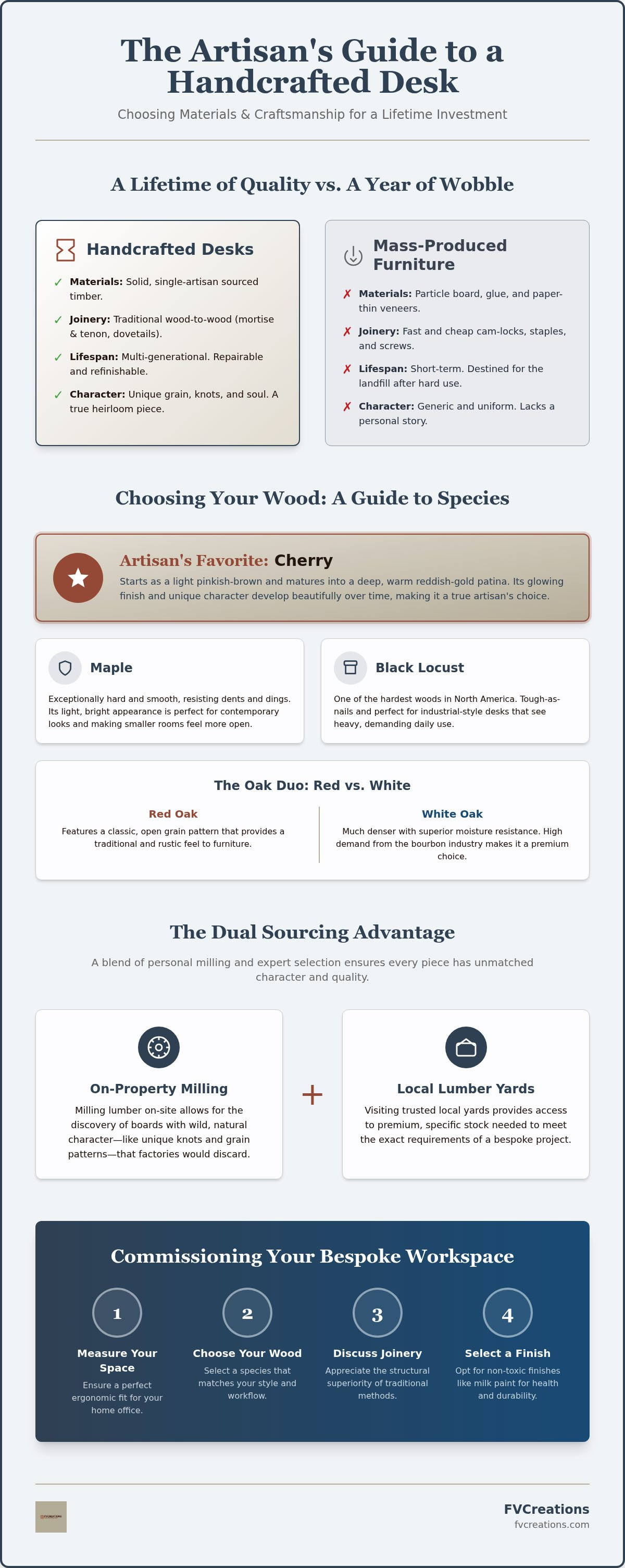
When I talk about a handcrafted wood desk, I'm not just describing a piece of furniture. I'm talking about a workspace built by a single artisan using techniques that have survived for centuries. Most of the "fast furniture" you find today relies on particle board, glue, and paper-thin veneers. It looks fine in a photo, but the moment you try to move it or spill a glass of water, the flaws start to show. A desk made from solid timber is a multi-generational investment. It can be repaired, refinished, and passed down to your kids, whereas factory pieces are usually destined for a landfill after a year of hard use.
I take a lot of pride in the raw materials I use. I source lumber through a mix of personal milling on my property and careful selection from local lumber yards. This dual approach lets me find boards with unique character marks, like small knots or interesting grain patterns, that industrial factory lines usually smooth away. These marks aren't defects. They're the fingerprint of the tree, and they give your desk a soul that mass-produced items can't replicate.
Artisan Joinery vs. Factory Fasteners
The secret to a desk that lasts a lifetime is in how it's put together. Factories love cam-locks, staples, and cheap screws because they're fast. I prefer traditional joinery like mortise and tenon or hand-cut dovetails. These wood-to-wood connections are structurally superior because they allow the piece to breathe and move with the seasons. If you have a heavy setup with multiple monitors and gear, you need that structural integrity. I personally vet every single board for strength before it ever touches a saw. Whether it's a sturdy piece of white oak or a slab of my favorite cherry wood, the joinery is what ensures it won't wobble when you're typing.
The Emotional Connection to Your Workspace
There is a real, tactile difference when you work on a natural wood surface. It feels warmer and more inviting than a sterile laminate top. It actually helps you focus. When you know your desk started as a tree on an artisan's property, it changes your relationship with your work. You aren't just sitting at a station; you're part of a story. By choosing small-batch furniture, you're also supporting the local craft economy and keeping traditional skills alive. It's about bringing a bit of the outdoors inside. It creates an environment where you actually want to spend your time.
Choosing Your Wood Species: From Cherry to Black Locust
Selecting the right timber for a handcrafted wood desk is a personal decision that goes far beyond aesthetics. It's about finding a material that matches how you work and how you want your office to feel. Every wood species has a distinct personality. Some are steady and reliable, while others are bold and change significantly as they age. When you sit down at a desk, you're interacting with the history of that tree, so it's vital to pick a species that resonates with your daily routine.
The Warmth of Cherry and the Strength of Maple
Cherry is my absolute favorite species to work with in the shop. It's the artisan’s choice because it has an incredible, glowing finish that gets deeper and richer every single year. Cherry's grain develops a unique character that veneers simply cannot replicate. It starts as a light pinkish-brown and matures into a warm, reddish-gold patina. If you prefer a cleaner, more contemporary look, Maple is the ultimate choice. It is exceptionally hard and provides a perfectly smooth writing surface that resists the dents and dings of a high-traffic workspace. It stays light and bright, making it perfect for smaller rooms that need to feel more open.
Oak and Black Locust: Durability for the Decades
If you need something with a bit more grit, I often suggest Oak or Black Locust. When we talk about Oak, I make a clear distinction between Red Oak and White Oak. Red Oak has a classic, open grain that feels very traditional and rustic. White Oak is much denser and has superior moisture resistance. It is actually in high demand right now because the Kentucky bourbon industry uses so much of it for barrels, which makes finding high-quality furniture grade stock a real hunt. For those who want a desk that is truly tough-as-nails, Black Locust is the way to go. It is one of the hardest woods in North America and is perfect for industrial-style desks that see heavy daily use.
I use a dual approach to sourcing these materials to ensure the best quality for your project. I mill quite a bit of lumber right here on my property, which lets me find boards with wild, natural character marks that a factory would usually discard. When a project requires something very specific, I visit local lumber yards to hand-select premium stock. Once we've picked the perfect boards, I like to use Real Milk Paint to give the wood a breathable, non-toxic finish. Matching the species to your home’s aesthetic, whether it's rustic Red Oak or modern Maple, is a conversation we'll have to make sure your desk fits your life perfectly.
Sourcing the Soul: Property-Harvested Timber vs. Outside Yards
I don't just order wood from a catalog and wait for a truck to drop it off. My process for building a handcrafted wood desk starts much earlier, often with a chainsaw or a trip to a local lumber yard. I use a dual-sourcing model because it gives me the best of both worlds. On one hand, I have timber I mill myself right here on the property. I get especially excited when I find a fallen cherry tree. It's my favorite species to work with, and milling it myself feels like uncovering a hidden treasure. On the other hand, for species like White Oak, I often head to outside yards. White Oak is in high demand right now, especially with the Kentucky bourbon industry needing so much of it for barrels. By sourcing it from specialist yards, I can ensure I'm getting the highest furniture-grade quality for a desk surface that needs to stay flat and true for decades.
The Journey from Log to Workshop
The milling process is where the stability of your future desk is actually decided. Once a log is cut into boards, the drying process is everything. I pay close attention to whether a board is air-dried or kiln-dried because improper moisture levels lead to warping once the piece is in your home. While the wood dries, I'm already looking for "character boards." These are the pieces with natural defects or wild grain patterns that I personally vet for structural integrity. When I'm ready to build, I spend hours grain matching. I want the boards to flow together so the finished desk looks like a single, cohesive piece of art rather than just a bunch of planks glued together.
Sustainability Beyond the Buzzword
Most big furniture companies talk about sustainability, but they rarely show you what that looks like on the ground. For me, it's about small-batch sourcing that reduces waste. When I manage timber resources on my own land, I'm making decisions that affect the health of the forest for years to come. I don't have the massive overhead or the "throwaway" culture of an industrial plant. Every scrap has a purpose, from the main desk build down to the firestarters I make from the leftovers. Knowing your maker means you aren't just buying a product; you're supporting a responsible way of using natural materials. It’s a transparent loop from the forest floor to your office floor.
Protecting Your Investment: Natural Finishes and Maintenance
The finish you choose is the most critical factor in how your desk ages. It is the only barrier standing between your morning coffee mug and those beautiful cherry or oak fibers. I don't believe in slathering a handcrafted wood desk in thick, plastic-like polyurethane. That stuff eventually cracks and peels, and once it does, you are looking at a massive sanding job to fix it. I prefer a breathable approach. I use Real Milk Paint because it is non-toxic and lets the wood's natural personality show through. For surfaces that see a lot of heavy use, like the area where your keyboard and mouse sit, I often apply a layer of Outdoor Defense Oil. It provides extra moisture resistance without losing the tactile feel of the grain.
You can tell exactly when it is time for a refresh with a simple "water bead test." Just put a tiny drop of water on the surface of the desk. If it beads up like a fresh wax job on a truck, your protection is still strong. If the water soaks in and leaves a dark spot, it is time for a light coat of oil. This simple check takes ten seconds but can prevent permanent staining.
The Beauty of Tung Oil and Traditional Finishes
Most factory furniture uses a spray-on plastic finish that feels cold and synthetic. I use Tung oil blends because they soak "in-the-wood" rather than just sitting on top. This keeps the surface feeling like actual timber. A skin-safe finish means the surface is free from harsh chemicals and metallic driers, making it safe for your skin to rest against for an eight-hour workday. Since cherry is my favorite wood to work with, I always recommend a finish that highlights its natural darkening over time. Using Real Milk Paint allows us to add subtle color while still letting the grain of your maple or black locust shine through.
A Simple Maintenance Schedule
Keeping your desk in heirloom condition isn't hard work. It just takes a little bit of consistency. First, for daily care, just use a soft, dry cloth to wipe away dust. This prevents those tiny micro-scratches that dull a finish over time. Second, aim for an annual oiling. Once a year, give the wood a light coat of oil to keep the fibers hydrated. This prevents the wood from drying out and cracking when the air gets dry in the winter. Finally, for minor repairs, don't panic if a small crack appears or a knot starts to loosen. You can use Starbond adhesives to stabilize these spots quickly and keep the desk solid.
If you want to see the colors we can achieve with these non-toxic finishes, take a look at our Real Milk Paint collection to find the perfect shade for your workspace.
Commissioning Your Bespoke Workspace
Setting up your workspace shouldn't feel like you're trying to fit a square peg in a round hole. If you've been searching for a handcrafted wood desk that actually fits your room, starting a custom woodworking commission is the best way to solve those awkward space problems. Maybe you have a corner that's just a few inches too narrow for a standard desk, or perhaps you need a specific height for your ergonomic setup. When you work with an artisan, we build the piece to fit your life, not the other way around.
Before we start, you'll need to measure your office carefully. I always tell folks to measure twice and think about their chair clearance. You don't want a beautiful desk that doesn't leave room for your legs. Since I run a small-batch shop, lead times can vary depending on what's currently on the workbench. It isn't a fast process, but that's because every joint is cut with care and every surface is finished by hand. Taking the time to get it right ensures the piece lasts for generations.
Small Batch vs. One-of-a-Kind
There's a big difference between picking a desk from my current inventory and starting a new build from scratch. When we start a custom project, we get to collaborate. We'll talk about whether you want a rustic live edge or a clean straight edge to match your decor. This is also when we pick the wood. While I work with maple and black locust, nothing beats the feeling of selecting a prime slab of cherry. It's my favorite species because of how it matures. We'll look at the grain patterns together to make sure the soul of the wood matches the vibe of your home. For those who want to take this level of customization further, you can learn more about incorporating bespoke furniture into a comprehensive interior design plan for premium homes.
If you're ready to move forward, the first step is to reach out for a personalized quote. Just send over your dimensions and a rough idea of the style you're after. I'm always happy to chat about what's possible with the lumber I have on hand, whether it's property-harvested or sourced from the local yard. I also recommend signing up for my email list. That's where I notify people about new property-harvested lumber drops, so you can get first dibs on a special piece of timber for your handcrafted wood desk.
Browse our current collection of handcrafted wood desks and furniture to see what I've been working on lately.
Building Your Legacy Workspace
Your workspace is more than just a place to answer emails; it's the foundation of your daily grind. By now, you know that a true handcrafted wood desk isn't just about the surface. It's about the joinery, the sourcing, and the story behind every board. Whether we use a piece of my favorite cherry wood milled right here on the property or a sturdy slab of white oak from a local yard, the goal is always durability. You've seen how hand-applied natural oil finishes protect the timber while letting you feel the real grain under your fingertips.
I'm here to help you move past the world of wobbly, disposable furniture. We can work together through direct collaboration to design a piece that fits your specific needs and solves those awkward office layout problems. It's a slow, methodical process, but the result is a desk that stays in the family for decades. I'd love to help you get started on this journey.
Explore our current inventory of handcrafted wood furniture to find a piece that speaks to you, or reach out to start your own custom build today.
Frequently Asked Questions
Is a handcrafted wood desk worth the higher price tag?
Yes, a handcrafted wood desk is worth the investment because it is built to last several lifetimes. I use traditional wood-to-wood joinery that stays solid long after factory fasteners have failed. You aren't just buying a place to put your computer. You're getting a piece of furniture that can be repaired and refinished rather than thrown away. It is a one-time purchase that saves you money and frustration over the long haul.
How do I know if the wood for my desk was sustainably sourced?
You can be certain about the origin of your timber because I handle much of the sourcing myself. I mill many logs right here on my property, which ensures hyper-local sustainability. When I need specific species like White Oak or Maple from outside yards, I hand-select every board from trusted local suppliers. This transparency means you know your desk didn't come from a massive, wasteful industrial loop.
Can I choose a specific wood species like Black Locust for my desk?
Can I choose a specific wood species like Black Locust for my desk?
Yes, I can certainly build your desk using Black Locust if you need an incredibly dense and durable surface. While Cherry is my favorite species for its glowing patina, I enjoy working with the unique strengths of Maple and Oak as well. Each wood has a different personality. Black Locust is a great choice for an industrial look that can handle heavy daily use without breaking a sweat. For those who want to take that industrial precision even further with specialized materials or complex designs, you can learn more about CNC Cut to Size to see how professional CNC services can assist with your project.
Lead times for a custom commission depend on my current project queue and the specific design you're looking for. Since I'm a small-batch artisan, I don't rush the process of milling, drying, and building. Quality work takes time. I'll provide you with a realistic timeline during our initial conversation so you know exactly when to expect your new workspace. It's always worth the wait for a piece done right.
What is the best way to clean my solid wood desk daily?
The best way to keep your desk clean is to use a soft, dry cloth for daily dusting. This prevents micro-scratches from building up on the surface. You should avoid using generic furniture polishes or harsh chemicals because they can damage the natural oil finish. If you have a stubborn spot, a slightly damp cloth followed by a quick dry is all it takes to keep the wood looking its best.
Do you offer international shipping for large furniture pieces?
I primarily ship within the country to ensure these heavy furniture pieces arrive in perfect condition. International shipping for a large desk is often complicated and carries a high risk of damage during transit. If you're outside my usual service area, it is best to reach out directly. We can discuss the logistics and see what the current possibilities are for your specific location and the size of the piece.
What should I do if my handcrafted desk gets a scratch or a dent?
One of the best things about solid wood is that most minor scratches and dents can be repaired at home. You can often refresh the area with a light application of oil or a very fine sanding. For stabilizing small cracks or knots, I suggest using Starbond adhesives to keep the surface solid. Unlike factory furniture with thin veneers, a solid wood desk can always be brought back to its original beauty.
Is Real Milk Paint safe for a desk used in a home with children or pets?
Real Milk Paint is absolutely safe for homes with children and pets because it's a non-toxic, organic finish. It doesn't contain the harsh chemicals or volatile organic compounds found in many industrial paints and lacquers. This makes it a skin-safe choice for a surface where you'll be resting your arms for hours every day. It is a breathable finish that protects the wood without compromising the air quality in your home.