

Natural Wood Fire Starters: How to Choose and Use Them
A “natural” label doesn’t tell you whether a fire starter suits your fireplace, stove, or outdoor fire. Natural wood fire starters vary in materials and format, so compare the product details with your fire setup and the fuel you have ready.
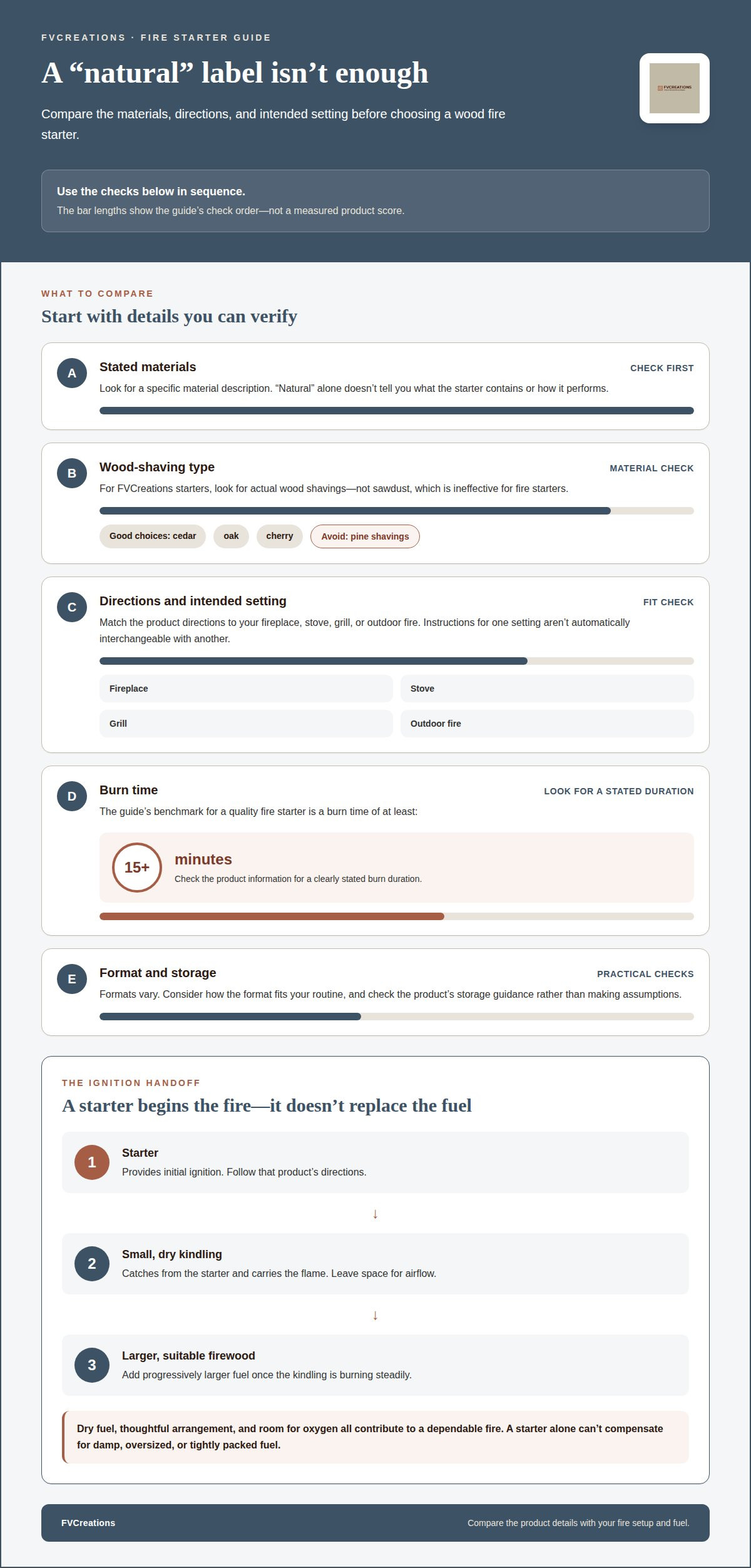
A starter helps ignite the first small, dry fuel, but it doesn’t replace kindling. The starter catches the kindling, which then helps larger firewood catch. At FVCreations, our fire starters are made from actual wood shavings and wax. Use wood shavings rather than sawdust, which is ineffective for fire starters. Cedar, oak, and cherry shavings are good choices; avoid pine shavings. I’m Farmer Vic, and I want to make the differences clear so you can choose with confidence.
This guide explains what to look for, how common options differ, and how to match a starter to your setup. It also covers a practical starting routine: follow the product directions, use suitable dry fuel, and keep basic fire precautions in mind. A dependable fire starts with the right combination of starter, fuel, and airflow.
Key Takeaways
- Compare natural wood fire starters by their stated materials, format, directions, storage guidance, and intended setting, not by broad labels alone.
- Match a starter to your fire setup. Directions for a fireplace, stove, grill, and outdoor fire aren’t automatically interchangeable.
- Build a dependable ignition sequence with dry fuel in progressively larger sizes and enough space for airflow.
- Prepare the fire area, arrange fuel thoughtfully, and use the starter only as directed.
- Farmer Vic’s wider woodworking practice draws on both personal milling and lumber purchased from outside lumber yards. Those sources are separate from claims about the fire starters.
What Are Natural Wood Fire Starters and How Do They Work?
A natural wood fire starter is an ignition aid that helps small fuel catch before larger firewood is added. It provides the initial heat, but it doesn’t replace kindling or the main fuel. Think of the process as a handoff: the starter ignites kindling, the kindling helps the fire grow, and larger pieces of seasoned firewood sustain it.
This sequence matters in a campfire, stove, or fireplace because each part has a different job. Fire also needs heat, fuel, and oxygen, the three elements described by the Fire Triangle. A starter supplies initial heat; the condition and arrangement of the fuel determine whether the flame can spread. Large logs are harder to ignite at the beginning, so start with smaller fuel and build up as the fire catches.
How Is a Fire Starter Different from Kindling?
A starter is the ignition aid at the beginning of the sequence. Depending on the product, it may be a prepared item or a material used to establish the first flame. Follow the product directions rather than assuming all starters are used the same way.
Kindling is small, combustible fuel arranged so it can catch from the starter. Once it is burning steadily, add larger firewood in a measured way. Seasoned firewood is the main fuel, not a substitute for the first step. Dry, appropriately sized pieces help the fire grow from a small flame toward larger logs. The starter begins the process, but the rest of the setup still matters.
For a product example, Farmer Vic’s fire starters can be used as part of a setup with suitable kindling and firewood.
What Does “Natural” Tell You About a Fire Starter?
“Natural” is a broad description, not a complete ingredient list or a promise about performance. Look for specific material descriptions on the packaging or product page. Those details help you understand what the starter is made from and whether its directions fit your fire setup.
Keep material descriptions separate from claims about smoke, safety, or environmental impact. A natural material description alone doesn’t establish those qualities. Products described as natural can differ in composition, form, and intended use, so don’t assume a starter meant for one setting is suitable for another. Read the instructions for the particular product and use it only as directed.
In practice, the label is a starting point, not the whole story. Compare the stated materials and directions with your setup, then prepare suitable kindling and seasoned wood to complete the sequence.
How Fire Starters, Kindling, and Firewood Work Together
A fire builds in stages. The starter provides initial ignition, small kindling catches and carries the flame, and larger firewood becomes the main fuel once the fire is established. A starter can’t make damp, oversized, or poorly arranged fuel behave like well-prepared firewood.
Airflow matters, too. A fire needs oxygen, and tightly packed fuel can restrict the air moving between pieces. Arrange kindling with space around it, but keep it close enough to the starter to catch. Follow the instructions for your appliance or outdoor fire as well as the starter’s directions.
What Helps Kindling Catch?
Begin with dry kindling that’s smaller than the firewood you’ll add later. Small pieces are easier for a new flame to catch than large logs. Arrange them so air can move through the stack instead of pressing everything together. If the fuel is damp, too large, or packed too tightly, even a suitable starter may struggle to establish the fire.
Use the directions for the particular starter and the rules for your fireplace, stove, or outdoor fire. Instructions aren’t interchangeable across settings, and no starter should be assumed to work in every condition. A steady fire depends on the whole setup, not just the ignition aid.
How Do Wood Species Affect Firewood Choices?
Species can be one factor in choosing firewood, but a wood name alone won’t tell you how a particular load will perform. Condition, size, and suitability for your appliance or fire setting matter, too. Red oak and white oak are distinct species; maple and black locust are other woods you may encounter as firewood. Choose properly seasoned wood that suits your setup rather than relying on an unsupported ranking of species.
Cherry deserves a personal mention: it’s Farmer Vic’s favorite wood species. That’s a favorite, not a claim that cherry is the best firewood for every situation. Keep species comparisons separate from starter ingredients. A wood species mentioned here describes possible firewood, not what a fire starter contains.
The practical relationship is simple: a starter helps kindling catch, kindling carries the flame, and suitable firewood sustains the established fire. To compare the starter itself, view FVCreations fire starters and match the product directions to your fuel and fire setting.
How to Compare Natural Wood Fire Starters Without Guessing
Start with details you can verify, not the biggest promise on the label. Check that the starter uses actual wood shavings rather than ineffective sawdust, and look for cedar, oak, or cherry shavings instead of pine. Check the starter’s format, the directions, and whether those directions suit the fire you plan to build. Quality fire starters should burn for at least 15 minutes. Consider how the format fits your routine and how the product should be stored.
Use the table as a checklist. Formats and instructions vary, so treat each row as a prompt to look for clear information rather than an assumption about every product in a category.
| Option | Stated materials | Format | Directions and intended setting | Storage |
|---|---|---|---|---|
| Packaged wood-based starter | Look for specific material descriptions, such as wood shavings and wax, rather than “natural” alone. | It may be sold as a prepared piece or another defined form. Consider how it fits your fire-building routine. | Read the product directions and intended setting. Don’t assume instructions for one type of fire apply to another. | Follow the package guidance and keep the product in suitable conditions. |
| Resin-rich wood starter | Look for a clear description of the wood material rather than relying on a broad environmental claim. | Often presented as pieces of wood. Check the maker’s directions for use. | Compare the stated directions with your fire setup and available kindling. | Use the product’s storage guidance. |
| Homemade approach | You choose the materials, so identify each one and consider how it behaves when used as directed. | Prepared at home, with the effort and format depending on the method. | Use a method suitable for your fire setting and don’t assume it’s appropriate everywhere. | Plan how to keep prepared materials in suitable condition. |
Which Product Details Are Worth Comparing?
Start with material descriptions and specific use instructions. Then consider format and storage in relation to your usual setup. A starter that’s easy to handle at home may be less convenient to pack. Treat performance statements as claims about that particular product, not guarantees for every fire or condition. Words such as “clean” or “eco-friendly” are broad, so look for details explaining what the claim refers to.
Natural, Commercial, or Homemade: What Are the Trade-Offs?
A packaged starter can offer a ready-to-use format and written directions. A homemade approach gives you control over the materials, but requires preparation and storage. Neither is automatically better. Compare the effort involved, how clearly the materials are described, and how well the option fits your fire routine. Then follow the directions for the one you choose.
If you’re weighing a packaged option against those criteria, Farmer Vic’s Famous Fire Starters are available through the shop. Read the product details and directions, then compare them with the fuel and setting you have in mind.
How to Prepare and Use a Wood Fire Starter Safely
A careful start begins before you light anything. Identify the fire setting, then match your fuel and starter to its instructions. A fireplace, wood stove, grill, and outdoor fire each have different operating guidance. Don’t assume a starter’s directions for one setting apply to another. The steps below are a general preparation sequence, not a substitute for appliance instructions or local fire-safety guidance.
What Should You Prepare Before Lighting a Fire?
Check the operating instructions for your fireplace, stove, grill, or outdoor-fire setup. Gather suitable kindling and firewood, arrange them as directed, clear nearby flammable items, and have appropriate safety equipment at hand. If you’re outside, check for local fire restrictions before you begin. Preparing in advance helps avoid rushed decisions once the starter is lit.
- Confirm the setting. Read the appliance or site guidance and make sure conditions allow a fire. For a fireplace, follow its operating instructions; for a stove or grill, use the manufacturer’s directions; for an outdoor fire, follow applicable site guidance and local restrictions.
- Prepare the area. Keep the immediate space clear of items that could catch fire. Set out safety equipment appropriate to the setting before lighting, so it’s within reach if needed.
- Choose suitable fuel. Arrange dry kindling and firewood as recommended for your appliance or fire setting. Don’t crowd the fuel so tightly that it blocks airflow, and don’t use wood or other fuel that the setting’s instructions rule out.
- Read the starter directions. Check how the particular product is meant to be used and whether its instructions match your setting. Natural wood fire starters aren’t automatically interchangeable across fireplaces, stoves, grills, and outdoor fires.
- Light and monitor the fire. Use the starter only as directed, then stay present and follow the setting’s guidance as the fire catches. Don’t leave an active fire unattended. Follow instructions for managing and fully extinguishing it when you’re done.
What Should You Avoid While Starting a Fire?
Never use gasoline or other flammable liquids to start or boost a fire. Don’t add accelerants or use a starter in a way its directions don’t describe. If the fire doesn’t catch, pause and reassess the fuel and setup instead of improvising. Continue to follow appliance guidance and local restrictions. Safe use depends on the place and equipment, not just the product label.
To see a starter option and its product directions, view FVCreations fire starters.
A Maker's Perspective on Choosing FVCreations Fire Starters
As a maker, I believe useful product information should help you decide whether an item fits your setup. A broad label may catch your eye, but practical details make it easier to compare options: the stated materials, how the item is meant to be used, and whether its directions suit the fire you’re preparing. Natural wood fire starters aren’t all alike, so consider each product on its own terms.
That approach reflects how I think about making and choosing things in the shop. A product’s story can add context, but it shouldn’t replace the information you need to make a sound choice. Read the description and directions, consider your fuel and fire setting, and don’t assume that a claim about one starter applies to another.
What Can a Maker’s Material Story Add?
At FVCreations, our wider woodworking practice draws on more than one lumber source: I mill some lumber myself, and I also purchase lumber from outside lumber yards. That’s context for the shop’s woodworking, not a statement about the materials used in our fire starters. Keeping those details distinct helps you understand what a maker’s sourcing story does and doesn’t tell you about a particular product.
For wooden goods, details about material and craft can help you understand an item beyond a short product label. Explore unique handcrafted wood products to see the broader woodworking side of the shop. For a fire starter, rely on the details given specifically for that offering rather than drawing conclusions from how other goods are made.
Where Can Readers Find FVCreations Fire Starters?
Farmer Vic’s Famous Fire Starters are available through the shop. I’m Farmer Vic, and I want readers to have clear information to compare products and choose what makes sense for their fire setup. Read the product description and follow the directions for the starter you select. The name alone isn’t a substitute for those details.
To see the specific offering, view Farmer Vic’s Famous Fire Starters. You can also explore FVCreations and the wider maker’s shop. Compare the product information with your setup, and let the stated details guide your choice.
Choose a Fire-Starting Routine That Fits Your Setup
Before your next fire, match the starter and fuel to your setting. Follow the product directions and the guidance for your appliance or fire area. That pause helps you prepare rather than make decisions in a rush.
When comparing natural wood fire starters, look for clear material details and practical instructions, not broad labels or promises. Choose an option that fits how you build a fire and the fuel you have on hand.
At FVCreations, Farmer Vic brings a maker’s care to a shop that includes fire starters, handcrafted wooden goods, and woodworking supplies. Explore FVCreations and shop Farmer Vic’s fire starters for your next fire.
Frequently Asked Questions
Are natural wood fire starters better than homemade fire starters?
There’s no universal winner. Consider how much preparation you want to do and whether you prefer making the starter yourself. Compare the steps involved before each fire and, for a homemade option, keep a record of the materials and method you used. That makes it easier to choose a routine that suits you without assuming one approach performs better.
Can natural wood fire starters be used in a fireplace or wood stove?
Use one only when the product directions suit the appliance instructions. Check the manual for your particular stove or fireplace, not just general advice for that type of appliance. Pay attention to directions about where to place a starter and what fuel the appliance accepts. This model-specific check helps you avoid relying on instructions meant for a different setup.
Do natural wood fire starters work with damp firewood?
Don’t count on a starter to make damp logs ready to burn. If firewood fails to ignite using a long-burning fire starter, the wood is likely too wet. Before lighting, sort your fuel and keep damp logs out of the initial arrangement. Use firewood that meets your appliance guidance.
Are natural wood fire starters safe for cooking over a fire?
Use a starter for a cooking fire only when its directions specifically allow that use and the cooking appliance guidance is compatible. Don’t infer cooking suitability from a product’s name, appearance, or material description. If the instructions don’t address cooking, choose an approach whose directions cover your cooking setup. Keep the starter’s role separate from the food and cooking surface.
How should you store wood fire starters?
Follow the product’s storage directions and keep it away from heat, ignition sources, and children. Keep the instructions or label with the starter so you can identify it and review its handling guidance later. Avoid mixing loose starters with kindling or other materials in a way that makes the product hard to identify. Don’t assume a shelf life unless the manufacturer provides one.
Can one fire starter light a campfire, fireplace, and grill?
Use one starter for all three settings only if its directions name each use. Before packing for a trip, read the product information and compare the stated uses with the fire you expect to build. Outdoor conditions can also affect whether a fire is allowed, so check applicable restrictions before relying on a campfire plan. Choose a different option if the directions don’t fit your setup.