

Natural Wood Firestarters: The Artisan’s Guide to Clean, Easy Fires (2026)
You just sat down with a glass of wine, ready to watch the flames dance, but instead, your living room smells like a gas station and your "easy-light" block is just fizzling out. It is frustrating when a relaxing evening turns into a battle with damp logs and acrid chemical smoke. Most of us have been there, staring at a cold hearth while store-bought starters leave a nasty residue on your fireplace glass. I believe your home deserves better. I make my natural wood firestarters because I wanted a clean, effortless way to start a fire without the laboratory smells.
In this guide, I'll show you why handcrafted, chemical-free options are the superior choice. You'll learn how my process of personal milling and sourcing scraps from outside lumber yards creates a starter that actually works. We will explore how different species impact your fire, from the steady burn of Red Oak and Black Locust to the reliable heat of Maple. I'll also share why Cherry is my absolute favorite species to work with. By the end, you will know how to achieve a clean-burning hearth while supporting sustainable, small-batch craftsmanship.
Key Takeaways
- Learn how the density of different wood species, including Red Oak and White Oak, dictates the speed and heat of your fire.
- Discover why handcrafted natural wood firestarters are the superior, chemical-free choice for a clean hearth and better-tasting grilled food.
- Master the "Top-Down" lighting technique to reduce smoke and improve airflow for a more efficient burn every time.
- Understand how a blend of personal milling offcuts and lumber yard scraps ensures that high-quality wood never goes to waste.
- See why Cherry wood stands out as the top choice for its unique scent and reliable ignition properties.
What Are Natural Wood Firestarters and Why Do They Matter?
A natural wood firestarter is exactly what it sounds like: a chemical-free tool designed to get your hearth roaring without any nasty additives. Instead of using petroleum-based gels or paraffin wax, these starters rely on the natural chemistry of wood fibers and resins. It is all about surface area. When I take fine shavings from my workshop floor, they catch the smallest spark because there is so much surface for the flame to grab onto. It is a simple, honest way to start a fire that respects the wood I work with every day.
There is a massive difference between an artisan product and the mass-produced pellets you find at big-box stores. Most commercial options are compressed sawdust held together with artificial binders. My starters are different because they are a direct byproduct of high-end woodworking. When you use furniture-grade scraps, you get a cleaner burn and a more reliable flame. It is the difference between a quick, cheap fix and a tool that was made with care and intention.
The Dangers of Chemical Accelerants in Your Home
Most people reach for those white chemical cubes because they are convenient, but they come with a hidden cost. They release toxic fumes into your living room, which is not great for your indoor air quality. These accelerants also leave behind a heavy, lingering scent of kerosene that can ruin the atmosphere of a cozy evening. If you use a ceramic grill or a pizza oven, these chemicals are a major problem. The porous ceramic walls can soak up those chemical smells, and nobody wants their dinner tasting like charcoal lighter fluid.
Beyond the smell, chemical starters can contribute to faster creosote buildup in your chimney. This sticky residue is a primary cause of chimney fires, so keeping things natural is a smart safety choice. Switching to natural wood firestarters means you are protecting your home and your health while enjoying a much more pleasant, woody aroma as the fire catches.
Sustainability: From the Milling Table to Your Hearth
My approach to making these is rooted in a philosophy where nothing goes to waste. I get my lumber through a dual process: personal milling from my own property and purchasing specific species from trusted outside lumber yards. This gives me a steady supply of incredible wood like Red Oak, White Oak, Maple, and Black Locust. When I am crafting a charcuterie board or a cedar planter, I am left with shavings and small pieces that are just too good to throw away.
I have a real passion for Cherry wood; it is my favorite species to work with. There is something special about the way it smells when it catches fire, and it adds a wonderful character to the blend. By combining property-harvested wood with vetted pieces from the yard, I create a sustainable loop. This process ensures that every bit of the tree is used for something productive, turning what would be workshop waste into a premium solution for your fireplace.
From Cherry to Oak: The Science of Wood Species
Not all wood burns the same way. If you have ever tried to light a dense piece of oak with a single match, you know that density is both a blessing and a curse. In my workshop, I see how different species behave under a blade and under a flame, which is why I am so picky about the materials in my natural wood firestarters. For a truly effective starter, you need a balance. You want something that catches quickly but has enough substance to stay lit until your larger logs take over.
Softwoods like cedar are great for that initial flash, but they can burn out before the fire really takes hold. Hardwoods are the heavy lifters. When I source wood through personal milling on my property or by picking up select pieces from outside lumber yards, I am looking for that perfect mix. The scraps from my furniture projects are ideal because they have been kiln-dried or air-seasoned in the shop. This makes them far superior to kindling you might find on a damp forest floor, which often carries too much moisture to be helpful.
Farmer Vic’s Favorite: The Magic of Cherry Wood
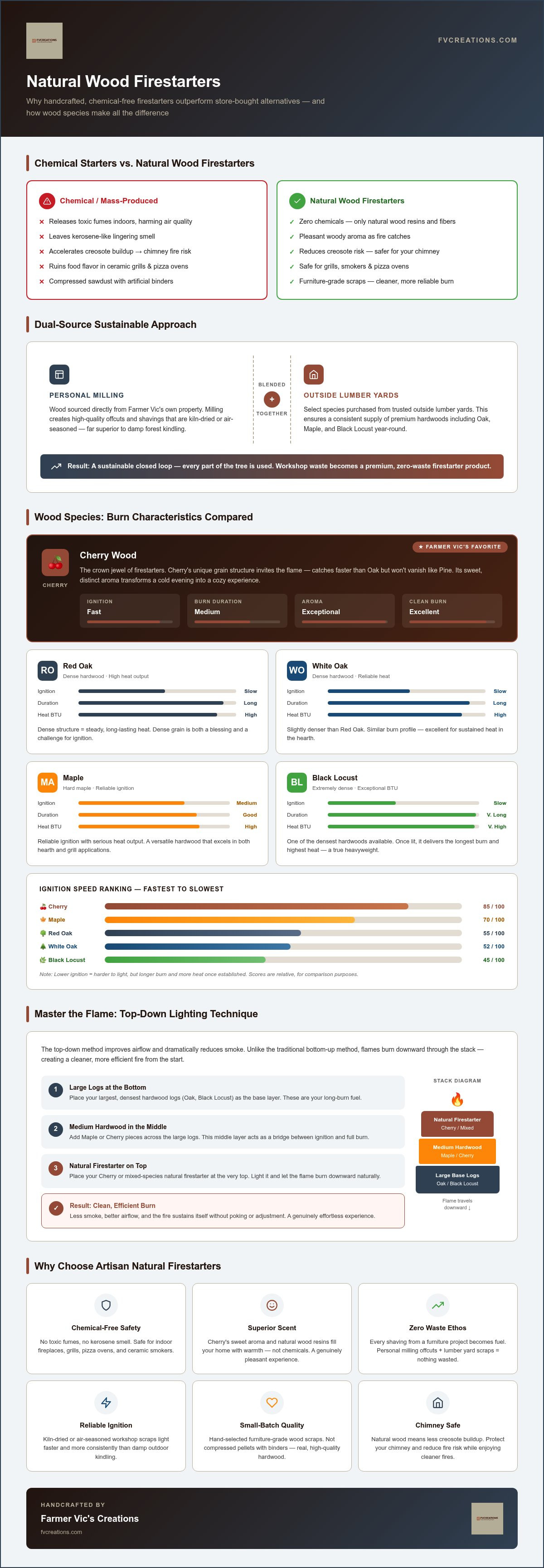
If you ask me which wood I love most, the answer is always Cherry. It is my favorite species to work with, whether I am making a charcuterie board or a batch of natural wood firestarters. Cherry has a unique grain structure that seems to invite the flame. It catches much faster than Oak but does not vanish in a puff of smoke like Pine. It is a reliable middle ground that makes lighting a fire feel easy rather than like a chore.
The real magic, though, is the smell. There is a sweet, distinct aroma that fills the room when Cherry hits the heat. It is one of those small details that turns a cold evening into a cozy experience. Because I use hand-selected scraps from my own production, you get that pure Cherry scent every time you light your hearth. It is a clean, natural smell that beats a chemical starter every day of the week.
The Strength of Oak and Maple
Just as a natural wood fire creates a premium atmosphere in your home, you can learn more about Flava Car Scents to discover how high-quality fragrances can redefine your time spent in the car.
Oak is the backbone of many fires, but not all Oak is the same. Red Oak is porous, which helps it catch a bit easier than its cousin. White Oak is incredibly dense and rot-resistant, making it a powerhouse for building a long-lasting coal bed. I use both in my blends to ensure your fire has a strong foundation. Maple is another staple in my shop. It burns clean and consistent, providing a steady heat that helps bridge the gap between your starter and your main fuel.
Then there is Black Locust. It is one of the densest woods in North America and has a massive energy output. This variety ensures that no matter what kind of wood you are trying to light, you have the right science on your side. If you are ready to see the difference for yourself, you can try a batch of Farmer Vic’s Famous Fire Starters next time you are prepping the hearth.
Artisan vs. Mass-Produced: How to Choose Quality
When you walk into a big-box store, you often see massive boxes of firestarters for what looks like a bargain. It is tempting to grab the biggest pack for the lowest price. But if you have to use four or five of those compressed sawdust blocks just to get a single log to catch, you aren't really saving anything. High-quality natural wood firestarters should catch in seconds, not minutes. I look for ignition speed and burn duration when I test my own batches. An artisan starter made from real wood shavings—like the Red Oak and White Oak I use—often replaces several mass-market alternatives because it burns hotter and stays lit longer.
You can tell the difference just by looking at them. Mass-produced starters are often just industrial sawdust held together with paraffin wax. They feel greasy and leave a waxy residue on your hearth or your hands. My starters are hand-bundled shavings. You can see the curls of the wood and the texture of the grain. Because they aren't packed with chemicals, they don't produce that thick, black smoke. You get a clean flame and the natural scent of the wood, which is much better for your home. This is especially true when my favorite Cherry wood is in the blend, as it adds a wonderful aroma to the room.
Why Handcrafted Starters Save You Money
It sounds odd, but buying a smaller bag of handcrafted starters usually ends up being cheaper in the long run. I call it the one-light approach. When you have a starter made from seasoned hardwoods like Black Locust or Maple, you only need one to get the job done. Chemical fuels have a habit of losing their punch if the box sits in your garage for a season. Natural wood resins and fibers are shelf-stable. They will be just as effective two years from now as they are today. You're paying for reliability and performance, not just a high piece count in a box.
The Story Behind the Starter
There is a level of transparency you only get when you support a small-batch maker. I know exactly where my wood comes from. I am either milling it myself from trees on my property or hand-picking specific species from outside lumber yards. I am a woodworker first. Every shaving in my firestarters has been hand-selected by someone who spends all day looking at grain patterns and moisture levels. I wouldn't use a piece of wood in my fireplace that I wouldn't trust for one of my charcuterie boards. When you buy from an artisan, you get a product that has been vetted in a real workshop, not just a factory lab.
Mastering the Flame: Best Practices for Natural Ignition
Lighting a fire is a skill that takes a bit of patience and the right tools. I have spent a lot of time in front of both my shop stove and my home fireplace, and I have learned that how you build the pile matters just as much as what you are burning. If you use natural wood firestarters, you are already ahead of the game because you aren't fighting chemical smells or oily residues. The goal is to create a steady heat that coaxes the larger logs into a self-sustaining burn.
I always recommend the "Top-Down" method for the cleanest results. Most people are used to putting the starter at the bottom, but that often leads to a smoky start. Instead, try placing your largest logs—like a heavy piece of White Oak or Black Locust—at the very bottom. Layer smaller logs on top, followed by kindling, and place your starter at the very peak. As it burns, it pre-heats the air in the chimney, which creates a stronger draft and pulls smoke up and out immediately. It is a game changer for indoor fireplaces.
This technique is just as effective for outdoor fire pits, though you have to be more mindful of the wind. If you are using a ceramic grill or a pizza oven, these starters are essential. Since they are made from the same high-quality scraps I use for furniture, like my favorite Cherry wood, they don't leave any weird flavors on your food. You get the pure, smoky taste you want without any hint of kerosene.
Step-by-Step: The Perfect Fire Every Time
Building a "Log Cabin" stack is my preferred way to ensure success. You lay two logs parallel, then two more across them at a right angle. This creates a hollow center where air can flow freely. Place one of my starters right in that center or on the top layer if you're using the top-down method. Once you light it, follow the most important rule: don't poke it. It is tempting to move things around, but natural wood firestarters need a moment to let their fibers catch and create a steady flame. Let the wood do its job.
Winter Fireplace Safety and Maintenance
A clean fire is a safe fire. Using natural materials helps prevent the heavy creosote buildup that chemical accelerants often cause. This keeps your chimney safer over the long winter months. You also need to keep your starters dry. I keep mine in a tin near the hearth so they stay crisp. If they get damp, they won't perform like they should. While you are thinking about hearth care, you might also consider maintaining your hearth with natural oils to keep everything looking sharp and protected.
Ready to stop struggling with your fireplace? You can pick up a bag of Farmer Vic’s Famous Fire Starters and see how easy a well-built fire can be.
Farmer Vic’s Famous Fire Starters: The Artisan Solution
I did not set out to build a brand around firestarters. It happened because I hate seeing good material go to waste. In my workshop, I am constantly surrounded by the best wood nature has to offer. Whether I am milling timber from my own property or working with premium boards from outside lumber yards, my floor ends up covered in shavings. I started bagging these up for my own hearth because I knew they were too good to throw away. Before long, neighbors and friends were asking for them, and that is how the "Famous" recipe truly began.
Every bag is a carefully curated blend. I don't just sweep up whatever is on the floor. I hand-select shavings from Cherry, Oak, and Maple to ensure you get a reliable burn every time. I have mentioned before that Cherry is my favorite species to work with, and I make sure it is a star player in these natural wood firestarters. It provides that sweet, nostalgic aroma that makes a fire feel like home. I also mix in Red Oak and White Oak for their density, ensuring the flame has enough heat to bridge the gap to your larger logs.
Because I am a woodworker first, I treat these with the same respect I give a custom piece of furniture. I vet every batch to make sure the moisture content is low and the fiber size is just right. It is a sustainable loop that keeps my shop clean and your fireplace roaring. This isn't a factory product; it is a workshop solution born from a "nothing goes to waste" philosophy.
Why They’re 'Famous' Among Fire Lovers
The reason people call them "Famous" is simple: they work. I have perfected a combination of very fine, quick-light fibers and slightly larger hardwood chunks, including bits of Black Locust when I have it. This means you get an immediate ignition that actually stays lit long enough to do its job. I hear from customers constantly who have finally achieved a "one-match" fire after years of fighting with chemical blocks. If you are ready for a better experience, you can Shop Farmer Vic's Famous Fire Starters and see the artisan difference for yourself.
Complete Your Hearth and Home
A great fire is often the centerpiece of a relaxing evening, but it is just one part of a handcrafted life. I love seeing my firestarters used in outdoor spaces alongside my cedar planters or near a gathering spot. When the fire is crackling, it is the perfect time to bring out some snacks on one of my Artisan Charcuterie Boards. Everything I make comes from the same hands and the same commitment to quality. I invite you to join our community and bring a little more of the natural world into your home.
Elevate Your Hearth Experience
Starting a fire should be the easiest part of your evening, not a battle that leaves your living room smelling like a chemical plant. We have explored how the right wood science, from the quick light of my favorite Cherry wood to the steady heat of Red Oak and White Oak, makes all the difference. By choosing natural wood firestarters, you are opting for a cleaner burn and supporting a process where nothing goes to waste. My blend of property-milled timber and hand-selected lumber yard scraps ensures that every fire you light is rooted in sustainable, handcrafted quality.
You don't have to settle for greasy, mass-produced blocks that often fizzle out. Instead, you can enjoy a 100% chemical-free experience that is handcrafted right here in the USA from sustainable hardwoods. It is about bringing that authentic workshop quality into your own home. If you are ready to stop fighting with damp wood and toxic fumes, it is time to upgrade your hearth. Grab a box of Farmer Vic's Famous Fire Starters for your next fire and experience the "one-match" difference yourself. I hope you enjoy the warmth.
Frequently Asked Questions
Are natural wood firestarters safe for cooking and BBQ?
How many firestarters do I need to light a standard fireplace?
You typically only need one firestarter to light a standard fireplace if your wood is properly seasoned. I design these to have a high surface area so they catch quickly and burn long enough to ignite larger logs. If you are dealing with particularly large logs or a cold chimney, you might use two, but the "one-match" fire is my goal for every batch I hand-pack in the workshop. Proper stacking helps keep usage low.
Do natural firestarters expire or lose their effectiveness over time?
Natural wood firestarters do not expire or lose their effectiveness over time because they don't rely on volatile chemicals that can evaporate. As long as you keep them dry, the natural resins and wood fibers will remain shelf-stable for years. This is a big advantage over store-bought blocks that often dry out and become useless after sitting in a garage for a single season. They are always ready when you are.
Can I use these in a wood-burning stove or a pizza oven?
These are perfect for wood-burning stoves and pizza ovens because they produce very little smoke and leave no chemical residue. In a pizza oven, the porous stone can absorb smells, so using a natural option is essential for the best-tasting crust. Whether I am using scraps of Black Locust or White Oak, the high-energy output helps get your stove up to temperature quickly and efficiently without gunking up your glass door.
What makes Farmer Vic's firestarters different from store-bought fatwood?
The main difference is the wood species and the burn profile. Store-bought fatwood is usually just resin-heavy pine, which can be very smoky and leave a lot of soot. My starters are a curated blend of hardwoods like Cherry, Maple, and Oak. This combination provides a more pleasant aroma and a cleaner burn. I source the material through personal milling and selecting specific yard scraps, ensuring a higher quality than mass-harvested pine sticks.
Do I still need kindling if I use a natural wood firestarter?
You generally don't need traditional kindling if you use these starters, though a few small sticks can help a fire grow faster. The fine wood shavings in my blend act as their own kindling by catching the flame immediately. By the time the starter has burned through, it has usually generated enough sustained heat to light your medium-sized logs. It simplifies the whole process and saves you the time of splitting tiny pieces of wood.
Are these firestarters waterproof or do they work when wet?
They are not waterproof and will not work if they become truly soaked. Because they are made from natural wood fibers, they will absorb moisture just like any other lumber. If they get a little damp, you can usually dry them out by a warm hearth, but for the best results, they should be kept bone-dry. If you are camping, I recommend keeping them in a sealed container or a dry bag to maintain their quick-lighting properties.
What is the best way to store firestarters for the winter?
The best way to store your firestarters for the winter is in a dry, cool place away from direct moisture. A lidded tin or a wooden box near your fireplace works perfectly. This keeps them handy and ensures they stay crisp for easy lighting. Since I use kiln-dried scraps from my furniture projects, they are already at a very low moisture content, and keeping them that way is the secret to a successful "one-match" fire every time.