

Solid Wood Furniture vs Veneer: Which Material Should You Choose
The piece that looks most like solid wood may not be solid wood at all. The solid wood furniture vs veneer pros and cons start with construction: veneer is a thin layer of real wood bonded to a core, while solid wood is made from wood throughout. Solid wood is generally heavier and easier to repair and refinish; veneer often costs less, uses less natural wood, and moves less as humidity changes.
That makes the choice less obvious than appearance alone suggests. Grain, edges, and the underside can offer clues, while how you’ll use, move, and care for a piece may point to one material over the other. We’ll compare construction, cost, weight, natural variation, and sourcing, then cover practical ways to distinguish veneer from solid wood. You’ll be better equipped to weigh the trade-offs for your home and account for seasonal wood movement.
Key Takeaways
- Inspect edges and the underside to look for a layered core or grain that repeats across a surface.
- Factor moisture and seasonal movement into your choice; solid wood responds to humidity, while veneer is less prone to movement.
- Think about how often the piece will be used, moved, and repaired before weighing upfront affordability against long-term upkeep.
- Veneer can make efficient use of distinctive or less common wood, while solid wood offers the same wood throughout the piece.
- Use the furniture’s purpose, the wood species, and the room’s conditions to decide which trade-offs suit your home.
What is Wood Veneer?
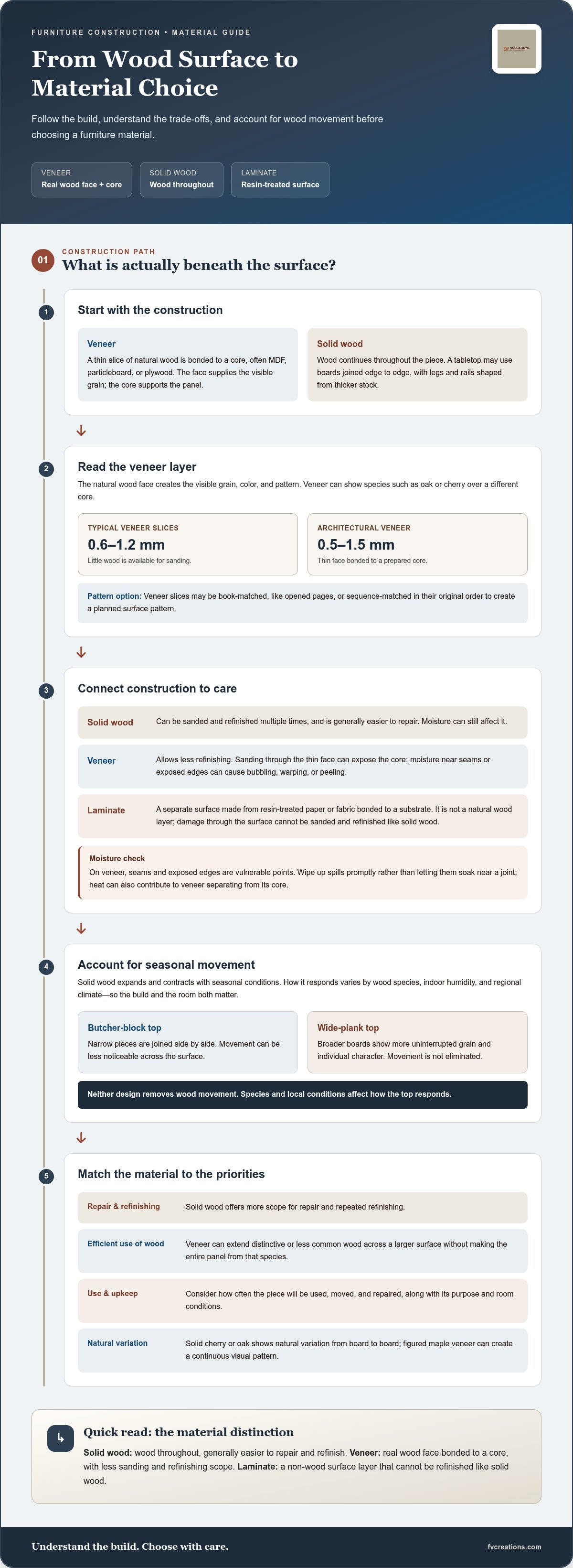
Veneer is a thin slice of natural wood bonded to a core, often MDF, particleboard, or plywood. Veneer furniture can be a practical choice for some settings, while the right material depends on how the piece will be used and maintained. The difference becomes clearer when the surface is damaged or exposed to moisture.
The visible layer gives veneer its natural grain, color, and patterns; the core provides the panel’s structure. Veneer slices are typically 0.6 to 1.2 millimeters thick, leaving little wood for sanding. A table may show oak or cherry on top while its underside reveals a layered core. That construction can create a consistent surface without making the entire piece from the visible species.
Water is a particular concern around seams and exposed edges. Prolonged moisture can reach the core and cause bubbling, warping, or peeling, especially if edges aren’t properly sealed. Wipe up a spill on a veneer dining table promptly rather than letting it soak near a joint. Heat can also contribute to veneer separating from its core. The risk partly depends on the core material and the condition of the bond.
Stains and scratches need careful attention because the veneer layer is thin. Before staining, find out whether the existing surface has a finish: stain won’t behave as intended over a sealed coating. Sanding through the veneer can expose the core and permanently change the appearance. Veneer may be lightly sanded and refinished, but it generally allows less scope for refinishing than solid wood. Solid wood, by comparison, can be sanded and refinished multiple times.
Small surface damage may be repairable, but chips or peeling need a repair that addresses both the wood layer and its bond. Matching the grain and color can be difficult, especially if damage is in the middle of a tabletop. Solid wood is often easier to repair because the material continues through the piece. For furniture used heavily every day, that difference matters as much as initial strength.
Laminate is a separate surface material, not a natural wood layer. It uses resin-treated paper or fabric bonded to a substrate such as MDF or particleboard. It’s easy to clean, but a scratch through the top layer can’t be sanded and refinished like solid wood. Significant damage usually means replacing the panel; exposed edges can also chip or separate.
| Material | Water and surface damage | Repair and refinishing |
|---|---|---|
| Solid wood | Can be affected by moisture | Can be repaired, sanded, and refinished multiple times |
| Veneer | Moisture can cause bubbling or peeling | Limited sanding; core may show through |
| Laminate | Surface and edges can be damaged | Cannot be sanded and refinished; damaged panels may need replacement |
Choose solid wood for repairability and repeated refinishing. Choose veneer when its appearance and efficient use of natural wood suit the piece, and take care to keep moisture away from vulnerable edges.
Wood veneer construction and thickness
A veneer panel combines a real wood face with a core made from plywood, MDF, or particleboard. The face provides the visible wood grain; the core supports the panel and helps it hold its shape. This construction lets makers use attractive wood species across broad surfaces without making the entire panel from that wood.
Architectural wood veneer typically uses real wood slices from 0.5mm to 1.5mm thick. The slice is bonded to its core, then trimmed to fit the panel. Veneer sheets may be book-matched, with adjacent slices opened like pages, or sequence-matched, keeping slices in their original order. Both approaches create planned patterns across cabinet doors or a tabletop.
In a small shop, veneer can be pressed against a prepared core using cauls and clamps or a vacuum press. A caul spreads pressure across the surface; a vacuum press holds veneer evenly against curved or flat shapes. Once the adhesive sets, the maker trims the edges and lightly sands the face. Heavy sanding can cut through the thin layer, so veneer offers less opportunity to reshape a surface than solid wood.
Solid wood construction starts with boards rather than a veneered panel. A tabletop, for example, may be made by joining boards edge to edge, while legs and rails are shaped from thicker stock. The wood’s growth rings and grain continue through the piece, leaving material that can be sanded and repaired more deeply. Proper joinery must also allow for seasonal expansion and contraction, which varies by species and local conditions.
Wood movement affects panel design. A butcher-block top uses narrow pieces joined side by side; a wide-plank top shows broader boards and more uninterrupted grain. Narrow pieces can make movement less noticeable across the surface, while wide boards display more individual character. Neither choice eliminates movement. The species, indoor humidity, and regional climate all affect how wood responds.
High-pressure laminate differs from both materials. It uses resin-treated paper or fabric bonded to a substrate such as MDF or particleboard. Its printed or textured face can imitate wood grain, but it isn’t a real wood surface. That distinction is useful when comparing natural veneer, laminate, and solid boards for a desk or dining table.
Veneer can extend distinctive wood across a larger area, while solid wood uses the chosen species throughout its components. For instance, figured maple veneer can create a continuous visual pattern without using thick figured stock for the entire panel. Solid cherry or oak, by contrast, shows natural variation from board to board and can last for generations with proper care.
Solid wood cost, weight, and natural variation
The pros and cons of solid wood furniture versus veneer involve more than appearance. Solid wood generally costs more, but it can be repaired and refinished over time. Its advantages include natural variation and material throughout the piece; its weight and response to humidity are trade-offs. Veneer is generally more affordable, while laminate is usually the least expensive of these materials.
Consider weight before deciding where a table will go. Solid oak or maple furniture is heavier than a comparable veneer piece, which can make it harder to move through a doorway or up stairs. A veneer panel over particleboard or MDF has a lighter core, though the whole piece’s weight depends on its dimensions and construction. Plan for moving the furniture as well as placing it.
Natural wood brings variation that a printed or uniform surface can’t reproduce exactly. Cherry is my favorite species, with distinctive grain and color that can deepen with light exposure. Walnut, butternut, elm, and oak each have their own character, too. Red oak, white oak, maple, black locust, tiger maple, pine, and hickory offer still more choices in grain and appearance.
Veneer gives designers flexibility with these appearances. Book-matched slices can create a balanced pattern across cabinet fronts, and a thin face of figured wood can cover a broad panel without using thick stock throughout. That can make veneer appealing when a particular grain is the priority. It also uses less natural wood than a solid panel, though the furniture still depends on its core and construction.
Laminate offers a different value proposition. Its face can imitate wood or stone, and the surface is designed to resist scratches, impact, abrasion, heat, and moisture. It’s easy to maintain with mild soap and water. However, damage that cuts through the top layer can’t be sanded away, and significant damage usually means replacing the panel. The edges remain vulnerable.
For long-term value, match the furniture’s intended use with its upkeep. A solid-wood dining table used daily can be sanded and refinished as wear builds up, while a veneer desk may suit a room where lower weight and cost matter more. Solid wood also needs care to limit humidity-related movement. Species and local conditions influence that movement, so a wide-plank pine top and a butcher-block maple top may behave differently.
Choose solid wood for repairability and visible natural variation. Choose veneer or laminate when lower cost, lighter weight, or a consistent surface better suits the room and its use.
Sustainability and responsible sourcing
Veneer can use less natural wood than a solid panel, but material efficiency alone doesn’t settle the sustainability question. The core, construction, sourcing, and useful life matter, too.
Veneer can be more sustainable when efficient use of a valued species is paired with durable construction and a long service life. Solid wood can also be a responsible choice when sourced thoughtfully and kept useful over time.
Veneer Cost and Sustainability
A veneer face uses a thin layer of wood over a core such as plywood, MDF, or particleboard. This can make a distinctive or less common species more affordable across a broad surface, since the decorative wood doesn’t need to run through the whole panel.
Consider a 1-1/2-inch-thick slab of curly maple used for a door: it consumes a substantial amount of figured wood. Veneer can show a similar striking figure while using less of that scarce material. The core and construction still matter, though. A panel that fails early may need replacement, reducing the benefit of using less face wood.
Sustainability and Wood Use
Responsible wood use starts with choosing material for the job. I use self-milled lumber mostly for smaller projects. For most furniture and outdoor items, I buy much of my lumber from lumberyards. The source and selection of boards are part of planning a piece, alongside its intended use and design.
Veneer makes efficient use of figured wood across decorative panels; solid wood uses the chosen species through its components. A maker can reserve distinctive grain for visible parts and use other suitable materials where appearance matters less. For solid furniture, boards can be selected for each part, such as the legs, rails, or top.
Service life also belongs in the sustainability calculation. A well-cared-for solid cherry table may be repaired and kept in use, while veneer furniture can serve well when its core and edges stay protected from moisture. Changing humidity can affect solid wood, with movement varying by species and location. Good design accounts for the room where the piece will be used.
Compare the source and amount of visible wood, the panel or board construction, and the furniture’s expected use. The better choice is the one that uses materials thoughtfully and stays useful in your home.
How to identify veneer versus solid wood
Start with the edges and underside, not just the broad, finished surface. A dining table can have a convincing oak veneer on top while its underside reveals a layered core. Solid wood generally shows the same wood throughout the piece. Check several areas, since edge treatments and applied trim can hide the construction.
Use these practical clues together:
- Inspect an unfinished edge. Look for thin layers or a core beneath the surface. Veneer may show a separate face layer; solid wood continues through the board.
- Compare grain at corners. Grain patterns that repeat or appear to wrap unnaturally across an edge can indicate veneer. Solid boards usually show individual grain details that continue across adjoining faces.
- Look underneath. Check the bottom of a tabletop, drawer front, or cabinet shelf. A layered edge or different material beneath a wood face suggests veneer or another panel construction.
- Notice the edge treatment. Veneered furniture may have narrow edge banding that covers the core. A visible seam or a change in grain direction can offer a clue, especially around a tabletop corner.
- Lift one end carefully. Solid wood is generally heavier than veneer furniture. Weight is only one clue, since a large particleboard core can also make a piece heavy.
Touch can add context, but it can’t prove what lies beneath a finish. A smooth, uniform surface without noticeable natural grain ridges may be veneer, while visible grain variation can occur in both veneer and solid wood. A well-made veneer face is real wood, so it can look and feel natural. Judge the edges and underside alongside the top.
Don’t use scratches as a test. A scratch can damage either material, and sanding thin veneer can expose its core. Instead, look for existing chips or worn areas. A damaged veneer edge may reveal the panel beneath; wear on solid wood usually shows wood continuing through the surface. That difference matters when assessing repair options and likely durability.
Craftsmanship can make identification less obvious. Carefully matched veneer may show smooth, consistent grain across cabinet doors, while solid wood often varies from board to board. Matching grain alone doesn’t prove the material. On a dining table, inspect the apron, underside, and corners as well as the top before deciding.
For a useful conclusion, combine three checks: inspect an edge, compare the underside, and look for repeated grain. No single clue is as reliable as considering those details together.
FVCreations: Custom Furniture
FVCreations makes custom indoor furniture, including tables designed around your space and how you’ll use them. A made-to-fit table can make an awkward alcove or oddly sized empty corner useful when standard furniture doesn’t fit.
Custom furniture can also make a thoughtful housewarming, birthday, or special-occasion gift. The recipient gets a useful piece chosen for their home, rather than something that has to be squeezed into whatever space is available.
If you have a table or furniture idea in mind, contact FVCreations to discuss your project and the details that matter to you.
Choose a Piece That Fits Your Home and How You Live
Understanding the solid wood furniture vs veneer pros and cons is a useful start. Next, picture the piece in daily use. Consider the room, the shape and size that would serve you well, and whether you want furniture made to fit an unusual space. A custom table can also mark a housewarming, birthday, or another occasion with something chosen for the person and their home.
FVCreations makes custom furniture and offers Real Milk Paint Co. Finishes. If you’re considering a table, countertop, or built-in, bring your ideas together with the practical details that matter in your home. Contact FVCreations to discuss your furniture, and take the next step toward a piece that feels right in its space.
Frequently Asked Questions
What is Solid Wood?
Solid wood furniture is built from wood boards or parts made of wood throughout, rather than a thin wood face over a manufactured core. A chair leg cut from maple and a tabletop assembled from oak boards are examples. The species affects color, grain, and how the piece responds to its surroundings. For a specific room, consider both the look you want and the care the furniture will need.
So, is Veneer Ever Worth It?
Yes, veneer can be a sensible choice when you want a particular wood appearance across a broad panel without using that species throughout the piece. A cabinet with figured maple fronts, for example, can show a coordinated grain pattern. Veneer also tends to cost less than solid wood and may be lighter to move. It suits buyers who value appearance and efficient material use over repeated refinishing.
Which Wood Option Is Best For Me?
Choose based on the furniture’s job, where it will sit, and how long you expect to keep it. A family dining table that may need refinishing points toward solid wood, while a bedroom cabinet moved occasionally may suit veneer. If a piece must fit an awkward alcove, prioritize its dimensions and layout, then choose the material that supports your preferred appearance and maintenance routine.
What is the difference between solid wood furniture and wood veneer?
The key difference is what lies beneath the visible surface. Solid wood uses the same wood material throughout its boards or components; veneer places a thin layer of real wood over a core panel. For example, a dresser front may look like walnut in either construction. Inspecting a drawer edge or the underside can reveal whether walnut continues through the part or covers another material.
What are the pros and cons of veneer furniture?
Veneer can provide real wood grain, coordinated patterns, lower weight, and generally lower cost than solid wood. Its limitations become clear with damage: moisture may affect edges or the core, and sanding can expose the layer beneath. For a low-wear bookcase, veneer may be practical. For a heavily used tabletop where scratches are likely, limited refinishing is a meaningful drawback.
Can solid wood and veneer furniture be repaired or refinished?
Both materials can sometimes be repaired, but the method depends on the damage and construction. A small dent in solid wood may be sanded as part of refinishing; a veneer chip requires careful work to match the thin face. Before attempting either repair, identify the existing finish and test any treatment in an inconspicuous spot. Avoid aggressive sanding on veneer, which can expose its core.
How do solid wood and veneer furniture compare in price?
Solid wood furniture generally costs more than veneer furniture, while veneer usually costs more than synthetic laminate. The difference depends on the species, design, construction, and finishing work, so two pieces of similar size may vary substantially in price. Compare more than the purchase price: a solid wood table may be refinished later, while damaged veneer can be harder to restore without patching or replacing its surface.
How can you tell whether furniture is solid wood or veneer?
Look at an exposed edge, the underside, and the back of a drawer rather than relying on the tabletop alone. A visible layered core or edge banding suggests panel construction; wood continuing through the part suggests solid stock. Repeated grain can be a clue, but carefully matched veneer may look natural. Don’t scratch or sand the furniture to test it, since either action can leave permanent damage.