

Sustainable Wood Furniture for Eco-Friendly Homes
What makes sustainable wood furniture for eco-friendly homes a thoughtful choice isn’t a broad green claim, but whether you can understand the materials, construction, and care behind a piece. If you’re comparing furniture, specific details help you judge how well it fits your home and priorities.
I work with wood from more than one source. I mill some lumber from my own property, mostly for smaller projects. For most furniture and outdoor pieces, I buy lumber from lumberyards. The wood’s source is one useful consideration, but species, construction, seasonal movement, and finish also affect how a piece performs.
This guide covers practical questions to consider before choosing wood furniture, from sourcing and species to movement and maintenance. You’ll find ways to compare oak, cherry, maple, and black locust, understand the differences between a wide-plank top and butcher block, and choose a finish that suits the surface. The goal is a piece that works well in your home and makes sense to live with over time.
Key Takeaways
- Assess sourcing, design, durability, and repairability together. A single label or material can’t tell the whole story of sustainable wood furniture for eco-friendly homes.
- Match a piece’s dimensions, placement, surface use, and construction to the room and the work it needs to do.
- Choose a finish for the way you’ll use and care for the surface. Oil-based finishes penetrate and impart water tightness, but need renewing.
- For a counter meant for cutting, choose a food-safe finish such as tung oil or a suitable hard oil finish, not a film-forming coating.
- Custom dimensions can help a table or other furniture fit an awkward space, a specific use, or a meaningful occasion.
What Makes Wood Furniture a More Thoughtful Choice for an Eco-Friendly Home?
A thoughtful furniture choice involves more than a broad sustainability label. Consider where the wood came from, whether its species and construction suit the intended use, and what care will help keep the piece useful. No single material or claim establishes a piece’s full environmental impact, so specific information is more useful than a label on its own. That gives you a practical way to assess sustainable wood furniture for eco-friendly homes without relying on assumptions.
Specific sourcing details tell you more than broad sustainability language. Knowing what wood was used and how the piece was built gives you concrete details to weigh against your needs and values.
What should a buyer ask about wood sourcing?
Start with the wood’s origin and how it was obtained. Was it milled by the maker, purchased from a lumberyard, reclaimed, or sourced another way? Each describes a different path from material to finished piece, but none alone tells the whole environmental story. Look for details that identify the source and explain what applies to the specific furniture you’re considering. Handmade describes how a piece is made, not where its lumber came from.
Use this checklist to build a clearer picture of an individual piece:
- Origin: Find out whether the wood is self-milled, purchased, reclaimed, or otherwise sourced.
- Species: Identify the wood, since its appearance and behavior affect whether it suits your plans.
- Construction: Look at how the parts are joined and whether the design makes sense for the way you’ll use the furniture.
- Care: Understand what the finish needs and how you’ll maintain the surface. Background on wood finishing techniques can help explain different approaches to protecting wood.
Clear answers are more useful than assuming that a handmade piece must be local or reclaimed. Weigh the material information alongside construction and care details, then decide how well they fit your priorities. If a description makes a broad claim without explaining what it means for that particular piece, there is little concrete information to compare.
Why does furniture lifespan matter to a thoughtful purchase?
A piece is more likely to stay useful when its design fits its job and its care is manageable for the household. Think through the daily use: a desk needs to suit the tasks performed at it, while a bench needs to fit its place and purpose. Construction matters, too. Well-considered joinery and a finish suited to the surface make routine care more straightforward and give the piece a practical path for maintenance.
Repairability and fit count. A piece that can be maintained or repaired may remain useful as your needs change, while a custom size can make a table work in an awkward corner or fill a specific gap. Before choosing, measure the space, picture how the furniture will be used, and consider whether you can care for its surface. These questions won’t calculate a product’s full environmental impact, but they can help you choose a piece that makes sense for your home and is designed around its intended use.
How Do Wood Species and Seasonal Movement Shape Furniture Design?
Species affects more than a piece’s color and grain. Wood responds to changes in moisture, so a maker needs to consider how boards will move as indoor conditions shift through the year. That response differs by species and location. Wood species and local conditions belong in the same conversation because a sound design must suit both the material and the room where it will live.
How can buyers compare oak, cherry, maple, and other woods?
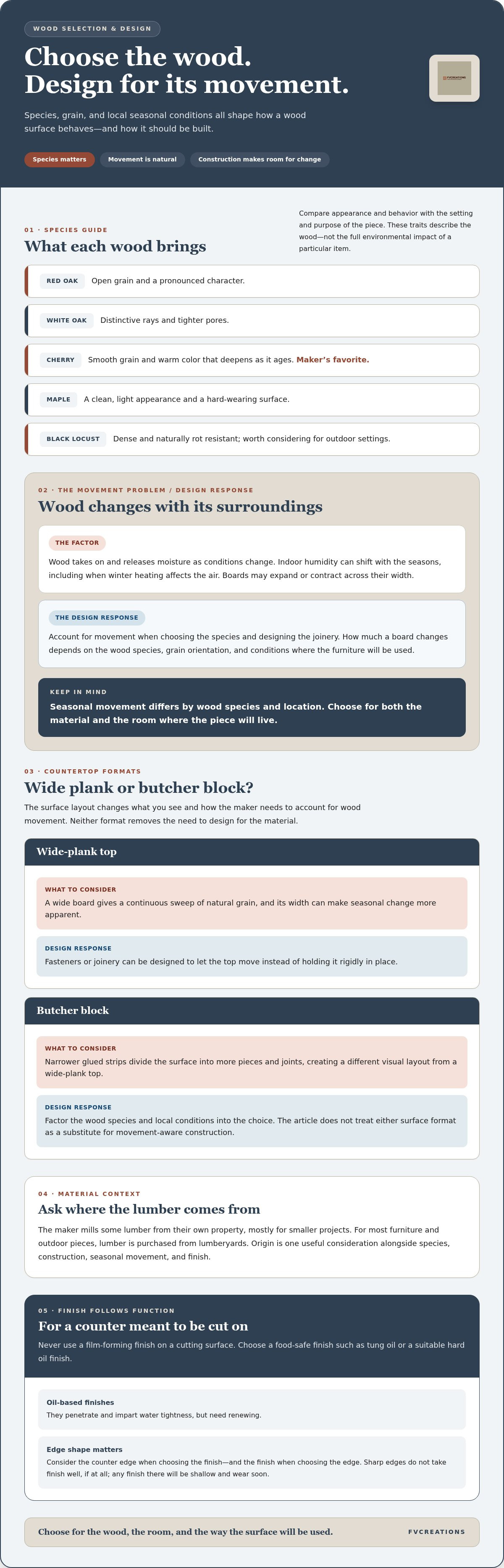
Think of each species as a different material choice, not a rung on a sustainability ladder. Red oak has open grain and a pronounced character; white oak has distinctive rays and tighter pores. Cherry is my favorite, with a smooth grain and a warm color that deepens as it ages. Maple has a clean, light appearance and a hard-wearing surface. Black locust is dense and naturally rot resistant, which can make it worth considering for outdoor settings. These qualities describe the woods, but they don’t establish the full environmental impact of a particular piece.
The useful question is how a species fits the design and the conditions around it. Grain and movement can influence how a maker lays out boards and joins components. I account for those details when working with the material rather than treating species as interchangeable. For your own comparison, note the look you want, where the piece will sit, and how its construction accommodates the wood’s behavior.
What does seasonal wood movement mean for furniture?
Wood takes on and releases moisture as its surroundings change. Indoor humidity can shift with the seasons, including when heating affects the air in winter. Boards may expand or contract across their width; the amount depends on species, grain orientation, and the conditions where the furniture will be used. The USDA Forest Products Laboratory guide on moisture relations explains the relationship between moisture and dimensional change in wood.
Good design makes room for that movement. A wide-plank top shows a continuous sweep of natural grain, but its width can make seasonal change more apparent. Fasteners or joinery can be designed to let the top move instead of holding it rigidly in place. Butcher block, made from narrower glued strips, divides the surface into more pieces and joints, changing how movement is distributed. Neither format is automatically right for every room or species. Location matters, too: the indoor humidity pattern where the piece will live should inform the design.
These are practical design choices, not reasons to avoid solid wood. If you’re considering wood in another format, FVCreations’ wooden cutting boards offer another example of how grain and joined pieces shape a finished surface.
How Can You Compare Sustainable Wood Furniture for Different Rooms?
Start by identifying the job each piece needs to do. A dining table, desk, and outdoor bench may all be made of wood, but they have different requirements for dimensions, placement, surface use, construction, and care. When comparing sustainable wood furniture for eco-friendly homes, focus on details you can observe or learn about rather than assuming a natural appearance or broad marketing phrase tells the whole story.
Which questions help compare furniture construction?
Measure the space, including the route the piece must take to reach it. Then consider what will happen on the surface, how much support the piece needs, and whether its construction suits that use. Look at visible joints and overall stability. Made-to-measure furniture can address an unusually sized room, an awkward corner, or a gap that standard dimensions don’t fill.
| Furniture | Intended use and placement | What to compare |
|---|---|---|
| Tables | Dining, gathering, or everyday household use | Measure the footprint and space around it. Consider the surface’s daily use, how the top is joined to its base, and what care the finish requires. |
| Desks | Work or study in a dedicated spot or shared room | Check that the dimensions suit the room and your work setup. Look for a stable base, practical access around the desk, and a surface finish that fits its routine. |
| Benches | Seating where people will regularly sit | Consider placement, seat dimensions, support, and how the legs or base connect. Think about whether the surface will need regular cleaning or finish care. |
| Built-ins | Storage or work surfaces fitted to a particular area | Measure the available space carefully. Compare how the components are joined, whether the layout suits the room, and how accessible surfaces will be maintained. |
| Outdoor furniture | Decks, patios, and other exposed settings | Consider weather exposure, placement, construction, and the upkeep the finish or wood will need. No wood choice should be treated as maintenance-free. |
Use the table as a starting point, then separate observable details from assumptions. You can measure a piece, inspect accessible joints, and understand how its surface will be used. A rustic look, handmade label, or sustainability phrase alone doesn’t establish where the wood came from or how well the construction suits your home. If you’re considering outdoor seating or tables, browse FVCreations’ outdoor furniture and items as examples of furniture made for exterior settings.
How should indoor and outdoor furniture choices differ?
Indoor pieces are generally sheltered from direct weather, while outdoor furniture faces greater exposure and may call for more regular attention. Think about where rain, sun, and everyday use will reach the wood, then factor the expected care into your choice. Cedar can be used for outdoor items, but Cedar is rot resistant but that does not make it rot proof.
For indoor purchases, finishes and adhesives may also matter to readers concerned about indoor air. The EPA indoor air quality guidance on volatile organic compounds explains how VOCs relate to indoor air quality. Use that context alongside the actual materials and construction details of the furniture, not as a substitute for them.
Which Finishes and Care Choices Suit Wood Furniture?
A finish should suit what a surface will do and the care you’re comfortable providing. A dining table, cabinet, and counter used for chopping don’t all call for the same approach. When choosing sustainable wood furniture for eco-friendly homes, consider the surface’s daily use, whether food will touch it, and how you’ll maintain it over time.
Oil-based finishes penetrate the wood and impart water tightness, but they need renewing. That upkeep is part of the choice, not a sign that a finish lasts forever. Before settling on a piece, understand what its finish is intended to do and what maintenance it calls for. A realistic care routine is easier to follow than one that doesn’t suit your household.
What finish is appropriate for a counter used for cutting?
If you plan to cut directly on a counter, don’t use a film-forming finish. A knife can break the surface film, damaging the coating and exposing the wood. Instead, choose a food-safe, non-film-forming finish such as tung oil or a suitable hard oil finish. These finishes penetrate the wood rather than forming a surface film, and they can be renewed as the counter sees use.
Renewal still matters. Oil-based finishes can help make the wood water tight, but that protection needs attention over time. Consider the counter’s real routine: frequent cutting and food preparation call for a finish suited to those uses, along with a willingness to maintain it. Don’t choose a coating simply because it sounds durable if it isn’t appropriate for direct knife work.
Why do edge shape and finish need to be considered together?
The edge is easy to overlook, but it affects how well a finish holds. A sharp corner takes finish poorly, if at all. Any finish there is shallow and can wear soon, leaving the edge more exposed. A softened profile, such as an eased edge or roundover, can be a better fit for a surface that will be handled and wiped regularly.
Choose the edge and finish as a pair. A crisp profile may suit the look you want, while a softened edge can support more reliable finish coverage along the corner. The counter’s intended use matters, too: a food-prep surface needs a food-safe finish, and its shape should be practical for the way you work at it. Choose a finish for the job the surface does and the care you’ll give it afterward.
For other wood furniture, match the finish to the surface and expected wear, then keep its care needs in mind as seasons and use take their toll. If an outdoor wood finish is part of your care plan, explore FVCreations’ Outdoor Defense Oil.
How Does FVCreations Approach Thoughtful, Custom Wood Furniture?
FVCreations is an independently operated woodworking business led by Farmer Vic. I’m a hands-on tradesman who makes practical wood pieces for everyday use. My approach starts with understanding what the furniture needs to do and where it will go. The room’s dimensions and the habits of the people using a piece help guide its size and design.
What makes the sourcing story specific and transparent?
Transparency means describing the materials and construction of the particular piece, rather than relying on a broad claim that could mean different things to different people. Wood choice varies with the project. I mill some lumber from my own property, mainly for smaller projects, and buy lumber from lumberyards for most furniture and outdoor items. I don’t treat one species or source as the answer for every job. The goal is to give each piece a clear purpose and make design decisions that suit how it will be used.
My work includes custom tables, countertops, built-ins, desks, benches, and outdoor furniture. Each has its own practical considerations, from the available space to the work a surface needs to handle. As you consider handcrafted wood furniture, start with those everyday needs and the details that make a particular piece right for your home.
When can custom dimensions help a home?
Standard furniture dimensions don’t always suit a room. A narrow passage, empty corner, or space between existing fixtures may call for a different size. FVCreations makes custom furniture to customer-provided dimensions and specifications, helping a table fit a particular spot or a built-in suit the space it’s meant to occupy. Measurements make a useful starting point: consider the available width, depth, and height, as well as room to move around the piece.
A custom countertop can be planned around its intended use, while a desk or bench can be sized for its place in the home. Custom-built furniture can also make a personal housewarming or birthday gift, mark another special occasion, or fill that one odd, empty space with a table that fits perfectly. If you’re considering a piece for your space, Explore FVCreations woodworking to see examples and begin planning your project.
Choose a Piece That Feels Right at Home
Start by thinking about what would make your home work better, whether that’s a more useful surface, a better-fitting table, or a spot that feels finished. The right piece should suit your routines and the space around it, not just look good in a picture. That’s a practical place to begin choosing sustainable wood furniture for eco-friendly homes.
A custom piece made to your dimensions and specifications can address a tricky corner or an empty space that standard furniture doesn’t quite fit. It can also make a thoughtful housewarming or birthday gift, designed around the home it’s meant for.
Start with the space and use you have in mind, then explore FVCreations woodworking to plan a custom piece that fits your home.
Frequently Asked Questions
Is wood furniture more sustainable than furniture made from other materials?
Not automatically. A material comparison depends on details such as where the materials came from, how the piece is made, how it’s used, and whether it can be maintained or repaired. A wood label alone can’t tell you the full story, and the same is true of furniture made from other materials. For a careful comparison, look at the specific piece and its materials rather than assuming one category is always the better choice.
How can I tell whether wood furniture is sustainably sourced?
Look for a specific explanation of the lumber’s origin and the materials that make up the piece. For sustainable wood furniture for eco-friendly homes, broad phrases such as “green” or “responsibly made” are less useful than details about the wood itself. Find out whether the description refers to solid wood, veneer, or a combination, and whether adhesives or finishes are part of the construction. Specifics make comparisons more grounded.
Does solid wood furniture move with the seasons?
Yes. Solid wood can respond to seasonal changes in indoor moisture, so a tabletop may shift slightly in width over time. This is a natural behavior, not necessarily a sign that the piece is failing. For everyday care, avoid placing furniture directly beside a heat source or in a spot with pronounced changes in conditions. A well-designed piece accounts for movement while allowing its parts to do their job.
Which wood species are commonly considered for furniture?
Oak, red oak, white oak, cherry, maple, and black locust are all woods to consider. Each has its own grain and color, so viewing a sample in the room’s light can help you picture how it will look alongside floors, walls, and existing furniture. Think about appearance and the piece’s intended setting, rather than treating a species name as a sustainability rating or assuming one wood is best for every project.
Can I use an oil-based finish on a wood countertop?
Yes, an oil-based finish can suit a countertop, depending on how you’ll use the surface. These finishes penetrate the wood and impart water tightness, but they need renewing as part of ongoing care. A counter used mainly for serving has different needs from one used for chopping. Consider the surface’s routine, the finish’s intended use, and whether you’re comfortable maintaining it over time.
What finish should I use on a countertop that I plan to cut on?
Choose a food-safe, non-film-forming finish, such as tung oil or a suitable hard oil finish. Don’t use a film-forming coating on a counter intended for cutting, because knife work can damage the coating. Oil finishes need renewal, so factor that care into your decision. The finish should suit direct food preparation, not just the counter’s appearance when it’s new.
Can custom wood furniture be made to fit an unusual space?
Yes. FVCreations makes custom furniture to customer-provided dimensions and specifications, which can help with a narrow alcove, an awkward corner, or a gap that standard furniture won’t fill. Measure the available height, width, and depth, and account for nearby doors, walkways, and fixtures. Share how you plan to use the piece, too, so its proportions can suit both the space and its purpose.