

The Ultimate Elevated Cedar Planter Box Checklist: Gardening Without the Backache
An elevated cedar planter box isn't just a container for dirt; it's a piece of outdoor furniture that has to survive a brutal cycle of soaking wet soil and scorching sun. I've spent years milling timber right here on my property and sourcing the best boards from local yards, and I've seen too many folks get burned by cheap store-bought kits that fall apart before the first frost. You deserve a garden that's easy on your joints and built to last long enough for your grandkids to help with the harvest.
I know the frustration of waking up with a sore back after a day of kneeling in the mud, and it's exactly why waist-high gardening is such a game changer. You probably want the confidence that your wood is safe for vegetables and won't rot out on your deck in two seasons. I'm sharing my personal checklist for choosing a high-quality planter so you don't have to guess. We'll look at why wood species like the cherry I'm so fond of or rot-resistant cedar matter, how to ensure proper drainage, and the construction details that help a planter last for ten years or more.
Key Takeaways
- Learn how gardening at waist height eliminates the physical strain on your back and knees, making your daily hobby enjoyable again.
- Understand why an elevated cedar planter box made from hand-selected, rot-resistant wood is a better long-term investment than mass-produced kits.
- Get a behind-the-scenes look at how I source lumber from my own property and local yards, including why species like cherry or black locust make a difference.
- Discover the critical structural features to look for, like proper wall thickness and artisan joinery, to prevent bowing and soil leaks.
- Find out the simple seasonal maintenance steps and non-toxic finish choices that'll keep your garden bed thriving for over a decade.
Why Choose an Elevated Cedar Planter Box for Your Garden?
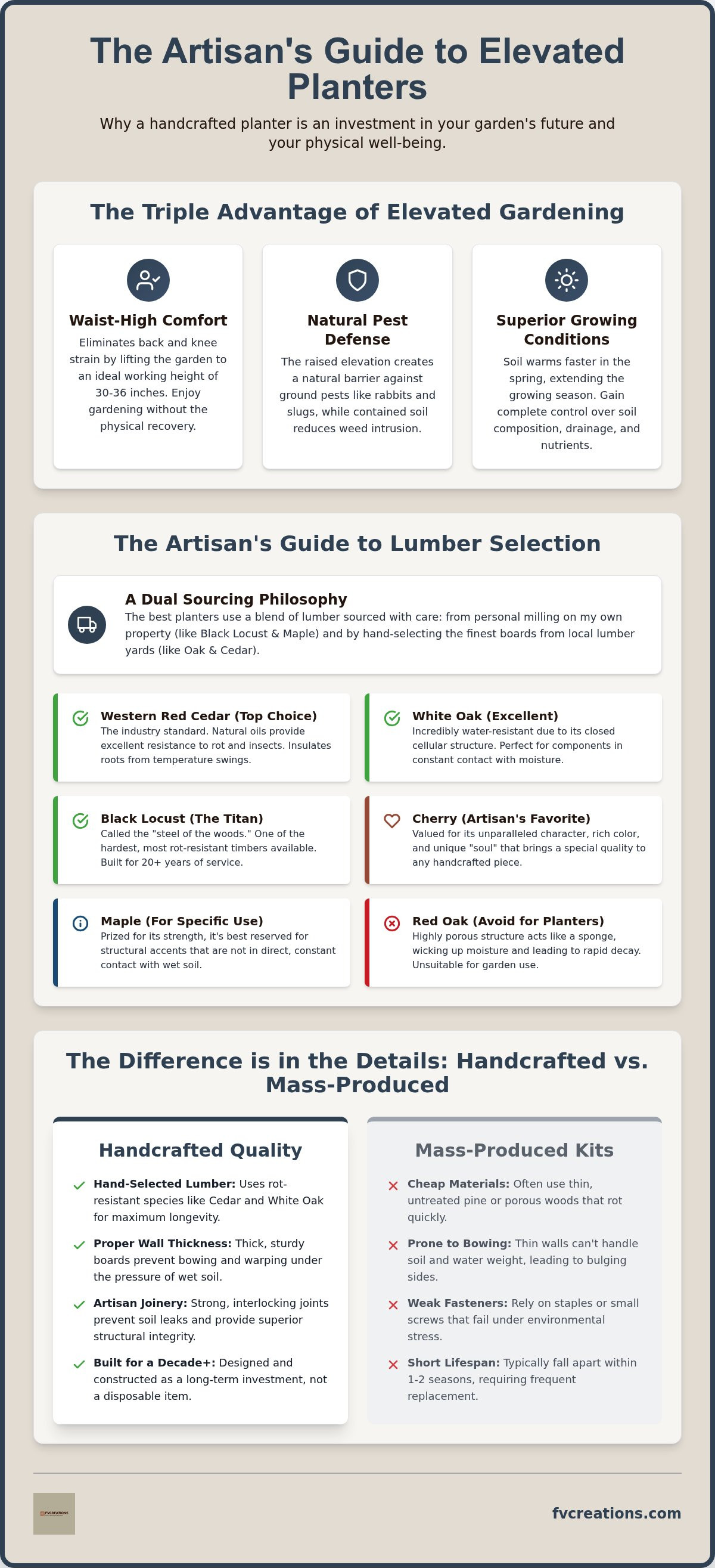
An elevated planter is essentially a sturdy raised garden bed supported by legs, lifting your plants up to a comfortable working height. Unlike traditional beds that sit flush with the ground, a high-quality elevated cedar planter box acts like a specialized piece of furniture for your patio or deck. I've spent plenty of hours in my workshop and out on my property milling timber, and I can tell you that the right height makes all the difference. I source my lumber with a dual approach. I mill logs like black locust or maple right here on my property, but I also visit local yards for specific cuts of oak. I'm careful to distinguish between red oak and white oak, as white oak handles the moisture much better. And while I love the strength of these woods, my absolute favorite is cherry wood. It has a character you just can't find in a big-box store. I've seen folks give up on their tomatoes because their knees just wouldn't cooperate anymore. That breaks my heart, especially when a well-made box can solve that problem instantly.
Lifting the garden off the ground isn't just about looks. It gives you total control over the soil environment. Because the box is raised, the soil catches the sun from the sides as well as the top. This means it warms up much faster in the early spring than the frozen ground does. You'll likely find yourself harvesting lettuce or radishes weeks before your neighbors who are still waiting for their garden patches to thaw. It's an efficient way to extend your growing season without needing a greenhouse.
The Ergonomic Advantage of Planters with Legs
Natural Pest and Weed Suppression
When your garden is two feet in the air, you've won half the battle against pests. Rabbits and groundhogs aren't going to jump into an elevated cedar planter box for a snack. It's also much harder for slugs and ground-dwelling insects to climb the legs. Since the soil is contained and elevated, you won't deal with many weed seeds blowing in from the lawn. Elevated gardening is a proactive pest management strategy that keeps your vegetables safe without the need for heavy fencing or chemicals.
The Artisan’s Guide to Materials: Why Cedar (and Others) Matter
I don't just order a pallet of wood and call it a day. Building a long-lasting elevated cedar planter box requires a much more personal touch. I use a dual approach to sourcing my materials. I spend a good deal of time milling logs like maple and black locust right here on my property; it's hard work, but it keeps me connected to the land. For other specific needs, I head over to local lumber yards to hand-pick the best cuts of oak and cedar. This mix of home-milled and carefully vetted outside lumber ensures that every piece I build has a foundation that won't quit on you after a couple of seasons.
Western Red Cedar is the industry standard for a reason. It's naturally packed with oils that act as a built-in defense against rot and hungry insects. Beyond its durability, cedar provides excellent thermal insulation. This means the soil inside stays at a more consistent temperature, protecting your plants' delicate root systems from the midday heat or a sudden evening chill. While cedar keeps your plants cool, you can find out more about keeping yourself comfortable during those hot garden days. It's a reliable choice that looks just as good as it performs.
Comparing Wood Species for Longevity
- White Oak vs. Red Oak: I'm very particular about this. White oak has a closed cellular structure that makes it incredibly resistant to water. Red oak is porous and acts like a bundle of tiny straws, which is a recipe for rot in a garden setting. I only use white oak for components that need to withstand heavy moisture.
- Black Locust: I often call this the "steel of the woods." It's one of the hardest and most rot-resistant timbers in North America. If you want a planter that's still standing in twenty years, black locust is the way to go.
- Maple: I typically reserve maple for specific structural accents where its strength can shine without being in direct, constant contact with wet soil.
The Beauty of Cherry and Artisan Sourcing
While cedar is the workhorse, cherry wood is my absolute favorite species. There is a soul to cherry that you just don't get with other woods. It starts with a warm, pinkish hue and develops a deep, rich patina as it sits under the sun. When I harvest wood from my own property, it significantly reduces the carbon footprint of your garden bed. It's a closed loop that feels right. I avoid cheaper softwoods entirely; you can read more about why I choose these over the alternatives in my guide on the cedar vs pine planter box. If you're curious about how these different woods look once they're finished, you might enjoy viewing my current outdoor builds to see the grain patterns for yourself.
The Ultimate Elevated Planter Checklist: 7 Features You Can’t Skip
Building a garden bed that sits on legs is a different beast than building one that sits on the ground. When you lift that soil into the air, gravity becomes your biggest critic. I've spent years refining my designs, using a mix of lumber I mill on my property and high-quality boards I find at local yards. Whether I'm working with my favorite cherry wood or a sturdy piece of white oak, the construction rules stay the same. If you're shopping for an elevated cedar planter box, don't let a pretty photo fool you. You need to look at the bones of the piece. Soil is heavy. Water is heavier. Your planter needs to handle both without bowing or rotting out from the inside.
- Wall Thickness: Never settle for anything less than 3/4 inch thick boards. Thinner wood will eventually bow outward under the immense pressure of wet soil, especially after a heavy rain.
- Artisan Joinery: Simple butt joints held together by a few screws will pull apart over time as the wood expands and contracts. I prefer fitted joints that distribute the weight across the wood itself, not just the hardware.
- Advanced Drainage: Water needs a clear path out. If it pools at the bottom, it'll rot the floorboards and drown your plants. A good system ensures the deck underneath stays dry and the roots stay healthy.
- Leg Stability: A standard 2x4 foot planter can hold over 200 lbs of wet soil. The legs need to be heavy-duty and properly braced to prevent the whole thing from wobbling or collapsing.
Construction Standards for Heavy Duty Use
I always use rust-resistant hardware, like stainless steel or high-quality coated screws. Standard nails will rust and streak your beautiful wood within a single season. Another detail I swear by is a "cleat" system. Instead of just screwing the floorboards into the sides, I install thick support cleats that the floor sits on. This transfers the weight directly to the frame. You can see how I apply these heavy-duty principles across all my outdoor items. It's the difference between a product that lasts two years and one that lasts ten.
Safety and Non-Toxic Considerations
If you're growing food, what you put on the wood is just as important as the wood itself. I strictly avoid "treated" lumber because of the chemicals that can leach into your lettuce and herbs. A food-safe wood finish is a coating made from natural, non-toxic ingredients that won't contaminate your harvest or harm the environment. I personally vet every finish I use, often reaching for Real Milk Paint or natural oils. It gives me peace of mind knowing my family and yours are eating clean vegetables from a safe environment.
Maintaining Your Cedar Planter for Decades of Use
I've heard folks say that cedar is a "set it and forget it" wood. That's a bit of a stretch. While it's true that the oils in the lumber I mill on my property or pick up from local yards provide a natural defense, any elevated cedar planter box exposed to the sun and rain needs a little love to reach its full potential. I've spent years working with different species, from the rugged black locust to my personal favorite, cherry wood. I've learned that a small amount of effort each season ensures your investment doesn't just survive, but actually gets better with age. Soil stays wet. Wood moves. It's a natural cycle that you can manage with just a few simple steps.
Every spring, I recommend a quick seasonal cleaning. Empty out the old soil if it's become compacted and check the bottom boards for any debris blocking the drainage holes. If you leave wet leaves or sludge sitting in the corners, you're just asking for trouble. If you prefer the natural silver-gray look that cedar takes on over time, you can let it be. But if you want to keep that warm, golden glow, you'll need to refresh the finish occasionally. Winter prep is just as important. If you live in a climate with heavy snow, either empty the bed or cover it to prevent the weight of the ice from stressing the joinery.
Finishing with Outdoor Defense Oil
I'm a big believer in using non-toxic barriers to protect your garden. Applying Outdoor Defense Oil provides a vital layer of UV protection that keeps the wood fibers from breaking down under the sun's rays. These products from the Real Milk Paint Co. are safe for your vegetables and easy to apply. They penetrate deep into the grain, whether you're working with white oak or maple, creating a breathable shield against the elements. It's the same process I use on all my custom builds to ensure they handle the moisture of a busy growing season.
Repairing and Refreshing Your Planter
Wood is a living material, and sometimes small checks or cracks can appear as it seasons. Don't panic. I keep Starbond adhesives in my shop for exactly these moments. A little bit of glue can seal a crack before it becomes a problem. If the surface starts to feel a bit rough after a few years, a quick pass with some sandpaper will get it ready for a fresh coat of oil. It doesn't take much to keep things looking sharp. If you're ready to add a long-lasting piece to your backyard, you can browse my handcrafted elevated planters to find the right fit for your space.
The FVCreations Difference: Handcrafted vs. Mass-Produced
When you buy an elevated cedar planter box from a big-box store, you're usually getting a kit designed for shipping efficiency, not garden longevity. These mass-produced units are often flimsy and lack the soul of a handmade piece. I do things differently in my workshop. I use a dual approach to sourcing my materials. I personally mill much of the lumber right here on my property, including tough black locust and maple. For other specific needs, I hand-select boards from local lumber yards. This allows me to pick out the best white oak for its water-shedding properties or a beautiful piece of cherry. Cherry wood is easily my favorite species because of the warm character it brings to a project. This process ensures I know exactly where every board comes from before it ever touches my saw.
Choosing a handcrafted garden bed means you have a direct line to the maker. There's real accountability when you know the person who planed the wood and joined the corners. You aren't just a number in a database; you're a fellow gardener. I take pride in the fact that my planters don't need to be replaced every three seasons. They're built as heavy-duty furniture that happens to hold soil. Whether you need a specific height to save your back or a custom length for a narrow balcony, "one size fits all" just doesn't cut it in a real garden. I focus on sustainable practices by using property-harvested timber and natural, non-toxic finishes that keep your soil and your family safe.
The Value of Artisan Woodworking
Artisan work is about the details that machines miss. I spend time grain matching and selecting specific species like white oak over red oak to ensure the best moisture resistance for your plants. It’s about the long-term return on your investment. While a cheap kit might save a few dollars today, a well-built elevated cedar planter box saves you money and labor for a decade. If you want a specific look, I often use milk paint to add a pop of color while keeping everything non-toxic and breathable. It's about combining traditional methods with your personal style.
Starting Your Garden with Farmer Vic
I'm always happy to talk shop with folks who care about quality. If you have a specific spot on your deck that needs a custom size, or if you're looking for a specific wood species like black locust for its incredible durability, just reach out. Supporting a local craftsman means you're getting a piece of work that was built with intention and care. It’s a connection between my workshop, the trees on my property, and your backyard harvest. When you're ready to stop kneeling in the dirt and start gardening with ease, explore our handcrafted cedar planters and outdoor items to find a piece that's built to last.
Ready to Transform Your Gardening Experience?
You've seen the difference that proper height and artisan construction make for your body and your plants. Investing in a high-quality elevated cedar planter box isn't just about avoiding a sore back; it's about building a sustainable garden that stays productive for years. I take the time to hand-mill lumber like black locust and maple on my property and vet every board I buy from local yards because I want you to have the same durability I demand for my own harvest. Whether we're talking about the incredible strength of white oak or the warm, soulful grain of my favorite cherry wood, the quality of the material is what carries your garden through the seasons.
I've personally vetted every finish and joint to ensure your soil stays safe and your frame stays sturdy. When you choose a piece made by a dedicated maker, you're getting a product that’s been tested in a real workshop and a real backyard. Browse Farmer Vic’s Handcrafted Outdoor Collection to find a planter that fits your lifestyle. I'm here in the workshop if you need a hand getting started. Let's make this the year you finally enjoy gardening without the physical strain.
Frequently Asked Questions
Do elevated cedar planter boxes need a liner?
A liner isn't strictly necessary for the wood's sake if you're using rot-resistant species like cedar or the black locust I mill on my property. However, a landscape fabric liner helps keep the soil in place and prevents fine particles from washing through the drainage gaps. I don't recommend plastic liners because they trap moisture directly against the wood, which can lead to premature rot. A breathable fabric is always the better choice for the health of your plants and the planter.
How deep should an elevated planter be for vegetables?
Most common vegetables thrive in 8 to 12 inches of soil depth. Leafy greens and herbs can get by with about 6 inches, but if you're growing tomatoes or peppers, you'll want at least 10 inches for their root systems to spread out. I build my standard boxes to handle these depths while ensuring the legs are strong enough to support the massive weight of the wet soil without wobbling.
Will an elevated cedar planter rot if left out in the rain?
Cedar is naturally rot-resistant, but it isn't invincible. While the natural oils in the lumber I source from local yards protect it, constant moisture without proper drainage will eventually cause issues. That's why I use white oak for structural parts and finish everything with natural oils. If you follow the maintenance steps I've shared, an elevated cedar planter box can easily last 10 to 15 years even in rainy climates.
Can I put an elevated planter box on a wooden deck?
Yes, you can, but you must ensure proper drainage to protect your deck boards. I design my planters with specific drainage points so water doesn't just pool underneath the box. It's a smart move to use a tray if you're worried about water marks. Since the planter is raised on legs, it allows air to circulate under it, which is actually much better for your deck than sitting a flat-bottomed pot directly on the wood.
How do I stop my elevated planter from tipping over in high winds?
The sheer weight of the soil usually keeps these units very stable, but you can add extra security if you live in a particularly windy area. I build my planters with heavy-duty legs and a wide footprint to lower the center of gravity. You can also place a few heavier stones or "drainage logs" at the very bottom of the box before adding your soil to keep the weight concentrated near the base.
Is cherry wood safe to use for edible garden planters?
Cherry is safe and non-toxic, but it's best used for the exterior or as a decorative accent rather than direct soil contact. It's my favorite species to work with because of its rich color, but it doesn't have the same rot-resistance as cedar. For the parts touching wet dirt, I stick to cedar or the black locust I harvest from my woods. Using cherry on the outside gives you that beautiful artisan look without compromising the planter's lifespan.
What is the best way to fill an elevated planter to save on soil costs?
You can use a modified "hugelkultur" method by placing small branches or wood scraps at the bottom. I often use offcuts from my milling process, like maple or oak scraps, to fill the bottom third of the box. This fills space and eventually breaks down into nutrients. Just make sure the top 8 to 10 inches is a high-quality potting mix so your vegetables have a clean environment to grow their roots.
How often should I re-apply oil to my cedar planter?
I recommend refreshing the finish once a year, usually in the spring before you start your planting. If the wood starts to look "thirsty" or lose its vibrant color, it's time for a quick coat of Outdoor Defense Oil. It only takes a few minutes and keeps the wood from silvering or developing small cracks. This simple bit of annual maintenance is what helps your elevated cedar planter box survive and look great for decades.