

Live Edge Wood Slab Table Care: Artisan Guide (2026)
That spray bottle of commercial furniture polish sitting under your sink might be the biggest threat to your dining room. Caring for a live edge wood slab table often feels intimidating, especially if you are terrified of stripping a hand-rubbed oil finish or watching dry winter air crack an exposed sapwood edge. You brought a living piece of timber into your home to gather around and enjoy, not to babysit behind velvet ropes.
You can easily keep that slab silky, stable, and protected for generations of daily use without relying on harsh chemicals. In my workshop, where I work with timber sourced both from personal milling and reputable outside lumber yards, long-lasting care comes down to respecting natural wood movement. Whether your table is dense white oak, open-pored red oak, maple, black locust, or my absolute favorite, rich cherry, the right habits make all the difference. We will walk through safe daily wipe-downs, indoor humidity targets that stop checking, and simple techniques to refresh dried grain right at home.
Key Takeaways
- Master gentle, soap-and-water cleaning routines that keep natural finishes protected without harsh chemicals when caring for a live edge wood slab table.
- Discover how maintaining stable indoor humidity protects wide solid timber from seasonal movement, cupping, and dry winter checks.
- Learn species-specific grain behaviors, from the tight, water-resistant pores of white oak to the light-sensitive patina of cherry.
- Follow a straightforward workshop routine to safely buff out micro-scratches and re-oil dry timber to restore its warm, silky luster.
- Gain the confidence to stabilize seasonal hairline checks and preserve delicate sapwood edges using time-tested artisan repair methods.
Understanding Live Edge Slab Care: Why Natural Wood Behaves Differently
A live edge slab is not ordinary factory lumber. Standard dimensional boards are ripped, squared, and stripped of their natural growth rings, but a solid slab keeps the full cross-section of the tree. That means it breathes, shifts, and reacts to your home environment in ways mass-produced furniture never does. Caring for a live edge wood slab table requires understanding this living dynamic instead of fighting it.
Every wide board constantly trades moisture with the surrounding indoor air. Equilibrium moisture content represents the point where wood fibers neither gain nor lose moisture from the surrounding air, dictating whether a wide slab stays flat or begins to cup and check. Locking timber beneath thick plastic coats often traps moisture inside; practical care focuses on balancing that humidity exchange so the wood breathes naturally without warping.
The Anatomy of a Live Edge Slab: Heartwood vs. Sapwood
A single cut of timber houses two distinct zones with different needs:
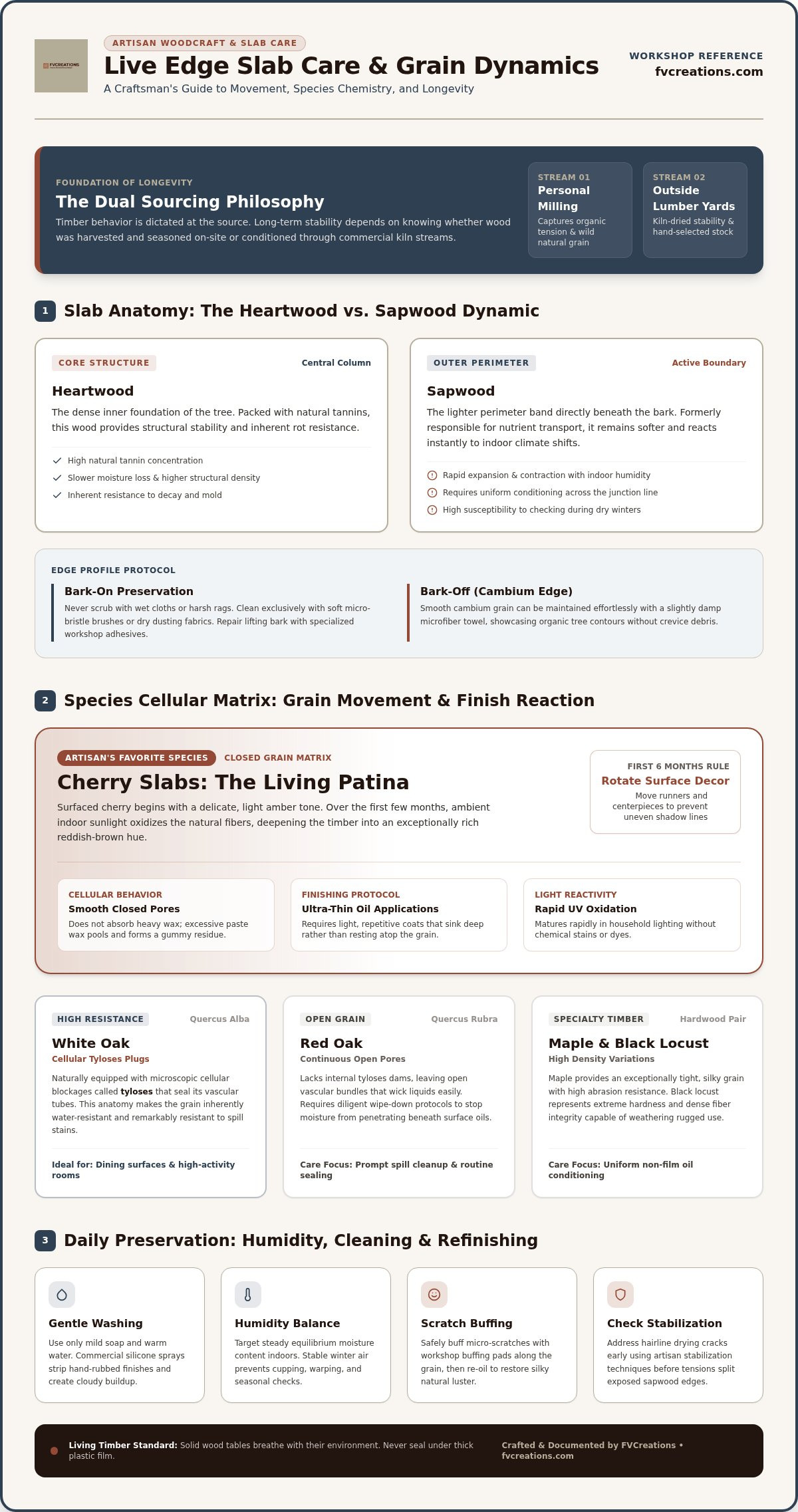
- Heartwood: The darker, central column of the tree. It is dense, packed with natural tannins, and inherently rot-resistant.
- Sapwood: The lighter perimeter band just beneath the bark. It carried water and nutrients during the tree's life, so it is softer and responds much faster to household humidity swings.
Because sapwood expands and contracts quicker than dense heartwood, the boundary where they meet experiences internal tension. Routine conditioning must cover both zones evenly to prevent uneven moisture loss across the surface.
Bark On vs. Bark Off: Edge Preservation Rules
The natural border defines the piece. In traditional live edge furniture design and construction, makers either retain the wild outer bark or peel it away to highlight the sculpted cambium underneath. Caring for a live edge wood slab table means adapting your cleaning technique to whichever style sits in your room.
If your slab retains its original bark, avoid wet scrubbing and harsh rags entirely. Soft micro-bristle brushes or dry dusting cloths remove dust without dislodging natural crevices. If a loose piece begins to lift, stabilizing it with specialized workshop adhesives keeps the rustic edge intact and prevents caught sleeves. De-barked edges, on the other hand, reveal smooth cambium grain that wipes clean easily with a damp cloth, giving you rugged visual character with minimal fuss.
Hardwood Species Care: Managing Grain, Movement, and Finish Needs
In our shop, we work with timber that comes from two distinct paths: logs we mill ourselves on-site and hand-selected slabs from reputable outside lumber yards. While kiln-dried stock from a yard behaves reliably, personally milled lumber often carries wild grain and unique tensions. No two trees share the exact same cellular makeup. As documented in the USDA Forest Service Wood Handbook, grain orientation and pore anatomy directly dictate how moisture travels through solid wood. Understanding these cellular differences is the secret to caring for a live edge wood slab table without watching the finish turn dull, blotchy, or sticky.
Farmer Vic Favorite: The Warm Character of Cherry Slabs
Cherry holds a special place in my heart; it is easily my favorite wood species to build with. Freshly surfaced cherry starts with a delicate amber tone, but ambient indoor light naturally oxidizes the wood fibers, deepening the timber into an astonishingly rich, reddish-brown patina over the first few months. Because cherry has a smooth, closed grain, heavy paste waxes or thick oils can pool and create a gummy film. I always recommend applying very light, thin coats of finishing oil that sink deep without sitting on the surface. If you want to see how we pair this wood with modern spaces, take a look at our handcrafted wood desks guide. Just be sure to rotate table runners and centerpieces regularly during the first six months so the wood matures evenly under sunlight.
White Oak vs. Red Oak: Open Pores and Moisture Resistance
Oak may look similar at a glance, but red and white oak behave like two entirely different materials under a finish:
- White Oak: Packed with microscopic cellular blockages called tyloses. These natural dams seal the vascular tubes, making the grain naturally water-resistant and far less prone to accidental spill stains.
- Red Oak: Features wide, open vascular tubes running like tiny straws straight down the slab. Standing moisture wicks rapidly into red oak pores, reacting with natural tannins to form stubborn dark rings.
Wiping up liquids immediately on red oak is critical to prevent deep staining, whereas white oak offers a bit more grace when life happens around the dinner table.
Caring for Dense Hardwoods: Maple and Resilient Black Locust
Dense hardwoods demand a measured approach. Hard maple has a tight, fine grain that shrugs off everyday dings and dents with ease, though uneven oil application can create blotchy patches if you skip careful surface preparation. Black locust goes a step further. It is exceptionally dense, naturally immune to rot, and sports a distinct yellowish-olive hue that warms into golden russet with age. When caring for a live edge wood slab table made from these heavyweight species, stick with lightweight penetrating oils. Thick products cannot absorb into their rock-hard cell walls, so thin application is essential to preserve their natural glow. If you appreciate heirloom longevity built around authentic timber traits, explore our handcrafted work at FVCreations.
Daily Cleaning and Climate Control: Protecting Your Table Naturally
Dust is surprisingly abrasive. Airborne grit settles into open wood pores, acting like ultra-fine sandpaper every time a dinner plate or laptop slides across the top. Many homeowners instinctively reach for commercial spray polishes, but aerosol cans loaded with silicone and synthetic solvents choke the grain. Silicone forms a slick barrier that makes caring for a live edge wood slab table nearly impossible down the road, preventing natural maintenance oils from soaking into dried wood fibers.
The Safe Daily Cleaning Routine for Natural Wood Finishes
Daily cleaning requires nothing more complicated than warm water, a drop of mild dish soap, and two microfiber towels. Dampen the first cloth so it is barely moist, not dripping, and wipe strictly in the direction of the grain to prevent micro-swirls. Follow immediately with the dry towel to lift away any lingering dampness. If you want a practical look at gentle, food-safe surface upkeep, take a look at our handmade charcuterie boards guide.
Managing Indoor Humidity to Stop Seasonal Warping and Cupping
Massive slabs never stop breathing. In their published guidelines for preserving wooden furniture, conservators emphasize that steady environmental conditions prevent irreversible dimensional movement. Wide solid boards need an indoor relative humidity range between 35% and 55% to remain flat and calm. During dry winter heating periods, running an evaporative room humidifier keeps boards from shrinking rapidly. Keep the table away from active heating registers, wood-burning stoves, and south-facing windows, as concentrated heat draws moisture from one side and causes cupping.
Sunlight Protection and Coaster Etiquette for Dining Slabs
Natural timber ages gracefully when shielded from extreme temperature shifts and direct ultraviolet exposure. Sensible day-to-day habits keep your table protected:
- Breathable Coasters: Keep felt or cork-backed coasters under icy glassware to catch condensation rings before water settles into open sapwood pores.
- Heat Trivets: Set hot cast-iron skillets and baking dishes on thick trivets to avoid scorching oil finishes.
- Light Management: Draw sheer blinds during the sunniest hours of the day to protect natural wood pigments from bleaching out.
With these everyday rhythms in place, caring for a live edge wood slab table feels like second nature rather than a chore.
Maintaining and Re-Oiling Your Slab: A Step-by-Step Refinishing Routine
Penetrating plant oils nourish raw timber fibers from within, highlighting curly figure and natural grain variations without suffocating the board under plastic. Unlike factory film finishes that eventually peel or turn cloudy, an oil finish is delightfully forgiving. A dining table subjected to daily family dinners and dry indoor air naturally sheds its protective luster over several months. Caring for a live edge wood slab table simply means listening to what the timber tells you and refreshing those fibers before moisture evaporates completely, using reliable treatments from specialists like Masters in Wood to keep the grain protected and nourished.
Testing Finish Integrity: The Water Droplet Method
You never need to guess when your slab is thirsty. The seasonal water droplet absorption test involves placing a single bead of clean water onto high-traffic zones to observe whether it holds a tight, rounded dome or quickly flattens and soaks into the wood fibers. Tight beads mean your barrier remains resilient. If that droplet spreads out or darkens the wood within three to five minutes, your table needs a fresh coat of conditioning oil.
Step-by-Step Slab Conditioning with Natural Workshop Oils
Re-oiling a slab is a quiet, satisfying weekend ritual that takes less than an hour of hands-on effort:
- Prep the Surface: Clean the table thoroughly with mild soapy water and let the timber dry out completely for several hours.
- Apply the Oil: Pour a small pool of penetrating finish or a trusted outdoor defense oil directly onto the wood, working it across the entire surface and down the live edges with a clean cotton rag.
- Let It Soak: Allow the conditioning oil to penetrate wood grain for twenty minutes so the dried pores absorb everything they need.
- Buff Bone-Dry: Take clean, dry rags and vigorously buff away every trace of wet surface oil until the tabletop feels smooth and silky under your bare palm.
Addressing Light Scuffs with Fine Woodworking Abrasives
Everyday silverware scrapes or sliding ceramic bowls occasionally leave shallow surface scuffs. You do not need an electric sander to make them vanish. Take a 320-grit or 400-grit sheet from our curated workshop sandpaper collection and gently feather the scratch by hand, rubbing strictly parallel to the grain lines. Once the mark blends into the surrounding area, wipe away the fine wood dust and buff in a few drops of oil. To keep your heirloom looking its absolute best between meals, shop hand-vetted workshop care supplies at FVCreations.
Repairing Cracks, Checking, and Bark Edges Like a Craftsman
Seeing a tiny hairline split open along a natural slab can trigger instant panic, but wood is organic. Hairline fissures and minor surface checks are completely normal responses to seasonal humidity swings as wide boards release internal tension. When you are caring for a live edge wood slab table, catching these small movements early stops them from traveling deeper into the core timber. With a few proven bench techniques and the right workshop supplies, you can stabilize these character marks cleanly right at home.
Stabilizing Hairline Checks with Clear Cyanoacrylate Adhesives
Hairline surface checks do not require heavy machinery or messy casting resins. Thin cyanoacrylate glue flows like water, wicking deep into microscopic grain separations through natural capillary action. In our shop, we turn to professional fast-setting formulas from our Starbond adhesives collection to bond separated fibers instantly. Run a thin bead along the split, allow it to penetrate fully, and let it cure completely. Once rock-hard, carefully shave the excess adhesive level with a sharp cabinet scraper or fine abrasive block, leaving an invisible, permanent structural repair.
Securing Fragile Bark and Cambium Edges
Tables retaining their natural bark edge require occasional physical checkups. Over seasonal dry spells, the delicate cambium bond beneath the bark can loosen, creating small pockets that snag knit sweaters or tablecloths. Check your table perimeters using these simple steps:
- Inspect: Run your fingertips gently along the natural edge to locate any loose or lifting fiber pockets.
- Inject: Slip a fine micro-applicator tip beneath the lifted bark segment and inject a few drops of medium-viscosity adhesive.
- Clamp: Press the bark firmly back against the sapwood using a cork-lined hand clamp or padded scrap block until the bond cures solid.
Knowing When to Call a Professional Woodworker
Minor surface movement is an easy home fix, but severe structural movement calls for professional intervention. If a check widens into a deep through-split pulling across the width of the board, it requires hand-cut hardwood butterfly bowties to mechanically lock the opposing sides together. Likewise, severe cupping that lifts table legs off the floor indicates an underlying moisture imbalance that demands specialized workshop flattening. When caring for a live edge wood slab table, understanding these artisan boundaries ensures your heirloom stays stable for generations. If you appreciate the exacting craft behind heirloom furniture standards, explore our unique handcrafted wood guide.
Keep Your Living Timber Thriving for Generations
Caring for a live edge wood slab table doesn't require harsh chemicals or constant worry. When you understand how solid timber breathes, simple indoor humidity control and prompt wipe-downs keep the grain balanced. In my workshop, whether I am shaping logs from personal sawmilling or working with slabs hand-picked from outside lumber yards, every piece is crafted to age gracefully. From resilient white oak and dense black locust to my absolute favorite, warm darkening cherry, natural wood tells an honest story that deepens with every meal shared around it.
With routine damp-cloth dusting, seasonal droplet checks, and fresh oil when the surface feels thirsty, your tabletop will remain silky for decades. Every finishing supply we curate has been personally vetted by me, Farmer Vic, so you can nurture your own timber with complete confidence. Explore our workshop-tested finishing supplies and handcrafted timber goods to keep your wood heirloom-ready. Give your slab a little thoughtful care, and it will anchor your home for generations to come.
Frequently Asked Questions
How often should I oil my live edge wood slab table?
Most tables thrive with a fresh coat of conditioning oil every six to twelve months, depending on daily household use and indoor humidity levels. Whether caring for a raw-milled slab or a handcrafted piece from The Mensa Table Company, high-traffic dining tables exposed to dry winter air lose surface moisture faster. Rely on the water droplet test rather than a rigid calendar date. If water soaks in quickly instead of beading up, rub in a thin coat of oil.
Can I use vinegar or commercial glass cleaner on a live edge table?
No, you should never use vinegar, ammonia, or commercial glass cleaners on naturally finished timber. Acidic solutions like vinegar eat away at protective plant-oil coats, while harsh chemicals strip wood fibers and leave cloudy, dull patches. Caring for a live edge wood slab table requires gentle care; stick with warm water and a tiny drop of mild dish soap for routine mess cleanups.
What should I do if water leaves a white ring on my slab table?
A white ring means moisture is trapped inside the surface finish layer, which you can usually lift with gentle heat or fresh oil. Place a clean, dry cotton cloth over the spot and press lightly with a warm clothes iron set to low dry heat for a few seconds. If cloudiness persists, buff the ring gently with fine sandpaper along the grain and re-oil.
Is it normal for a live edge table to develop small cracks over time?
Yes, minor hairline fissures and checks are a completely natural part of living timber adjusting to seasonal humidity shifts. Solid slabs expand during humid summers and contract when winter heating dries your indoor air. These hairline checks show the wood is breathing naturally. You can stabilize them early with thin cyanoacrylate adhesive before they widen into structural splits that require bowties.
How do I prevent my live edge wood slab from warping in winter?
Keep your home's relative humidity between 35% and 55% by running a room humidifier during cold, dry heating months. Massive timber warps when rapid moisture loss pulls unevenly across the width of the board. Proper climate control is essential when caring for a live edge wood slab table. Position your table away from forced-air vents, woodstoves, and radiators to prevent localized drying.
Can I keep the natural bark on my live edge table forever?
Bark can be preserved for years with careful maintenance, but keeping it attached indefinitely on a daily dining table is challenging. Natural bark shrinks and dries at a different rate than the underlying sapwood, eventually loosening along the cambium layer. Regular dusting with soft brushes and stabilizing lifting edges with specialized adhesive will protect the rustic look, though many owners eventually prefer de-barked edges.
What is the best daily cleaning cloth for natural oil finishes?
High-density, lint-free microfiber cloths are the safest and most effective choice for daily slab maintenance. Microfiber picks up abrasive grit and dust without scratching soft sapwood or delicate hand-rubbed oil sheens. Avoid coarse paper towels or scouring pads, which leave fine swirl marks in the grain. Keep one barely damp cloth for wiping messes and a second dry cloth for buffing moisture away.