

Unique Handcrafted Wood Products: 2026 Artisan Guide
Most of the "wood" furniture sitting in big-box stores today is little more than sawdust and glue held together by a thin, printed sticker. It's frustrating to spend hard-earned money on a piece that starts peeling or wobbling before the year is out. You probably want something that feels real under your hands, something that actually tells a story and carries the weight of a living tree into your home. I've seen too many folks settle for mass-produced decor that lacks soul, and I think it's time we get back to basics.
I'm here to show you how unique handcrafted wood products bridge the gap between raw, natural character and the professional durability your home deserves. Whether I'm milling a log right here on the property or hand-selecting a prime slab of White Oak or Red Oak from a local yard, the goal is always the same. In this 2026 guide, we'll explore the beauty of different species, from the rugged strength of Black Locust to my absolute favorite, Cherry. I'll also share how I use shop staples like Real Milk Paint and Starbond to ensure every piece, from cedar planters to charcuterie boards, is as tough as it is beautiful.
Key Takeaways
- Learn why "perfect" factory furniture lacks the soul of unique handcrafted wood products and how an artisan's eye for grain patterns creates a true statement piece.
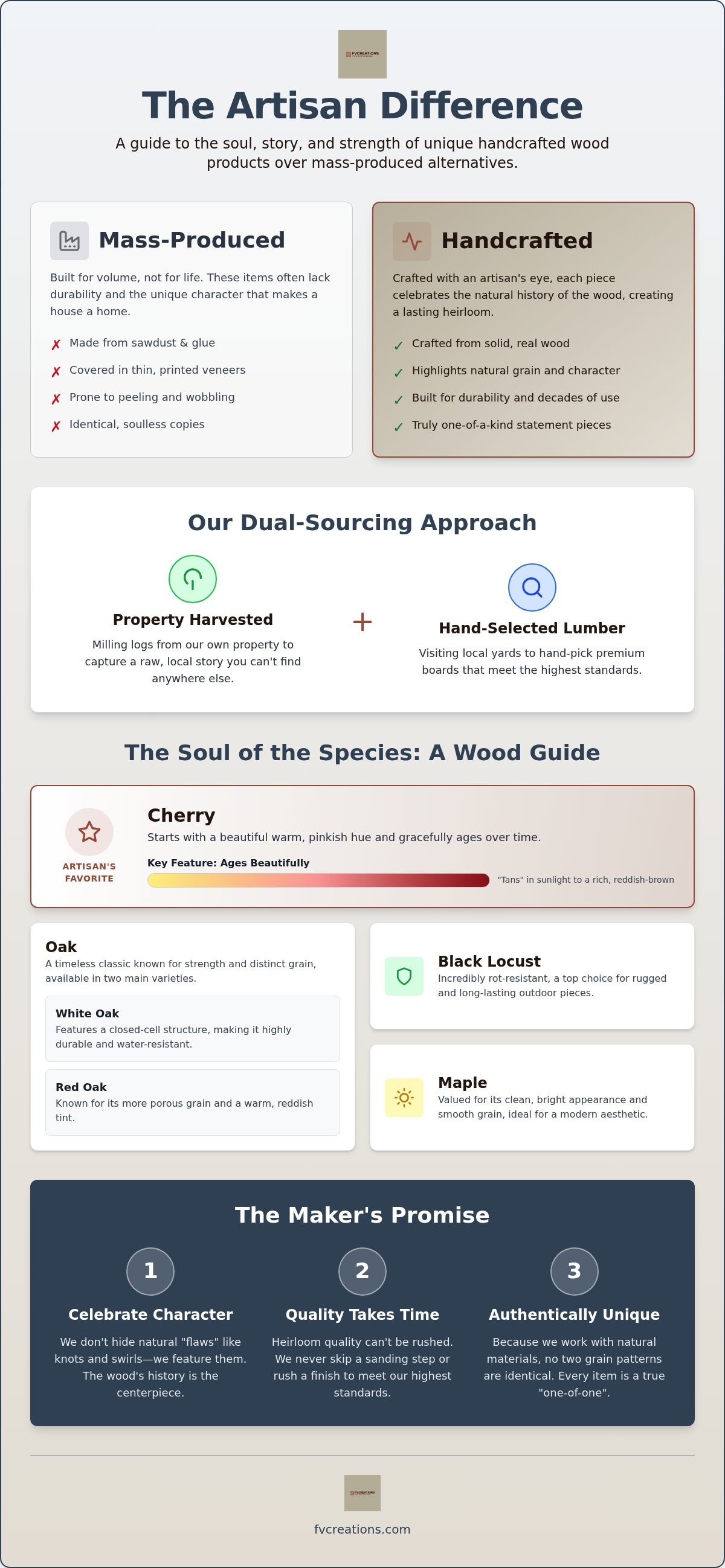
- Understand our dual-sourcing approach, where we mill logs on-site and hand-select premium lumber like Red Oak, White Oak, and my personal favorite, Cherry.
- Discover how to choose the right wood species for your needs, from the incredible rot-resistance of Black Locust to the timeless beauty of Maple.
- See how professional-grade shop staples like Starbond adhesives and Real Milk Paint finishes ensure your cedar planters and charcuterie boards last for decades.
Defining Unique Handcrafted Wood Products: The Artisan Difference
Most folks think "perfect" means smooth, uniform, and clinical. That's what machines do. But when I look at a piece of wood, I'm not looking for a blank canvas. I'm looking for the history of the tree itself. Truly unique handcrafted wood products aren't about hiding natural flaws; they're about celebrating the character that only nature can provide. A factory churns out thousands of identical items that look the same in every house. They're fine, I guess, but they often feel hollow and temporary. In my shop, the process is personal.
I spend a lot of time with each board before a tool ever touches it. I'm looking at how the grain swirls around a knot or how the light catches the fibers. This maker's eye is what separates an heirloom from a disposable piece of furniture. Because I work in small batches, the reality is that quality takes time. Lead times are part of the deal here. I won't rush a finish or skip a sanding step just to clear a shelf. If you want something that lasts decades, you have to be patient with the process.
The Story Behind the Grain
I take a dual approach to where my lumber comes from to ensure every piece has a solid foundation. Sometimes, I'm out there milling a log that fell right here on the property. There's something special about property-harvested wood; it carries a local story you just can't buy at a big-box store. Other times, I'm heading to the local lumber yard to hand-pick the best stock they've got. Whether it's the rugged, rot-resistant Black Locust or the distinct difference between the porous grain of Red Oak and the closed-cell structure of White Oak, every species has a specific job to do. I also work with plenty of Maple for its clean, bright look.
I have a real soft spot for Cherry, though. It's my absolute favorite species because of how it deepens in color over time, turning a rich, warm reddish-brown that looks better every year. Bringing these materials into the craft of woodworking allows me to tell a story that starts in the forest and ends in your home. I believe in being transparent about where my wood comes from because that honesty builds a better bond between me and you.
Authenticity You Can Feel
When you run your hand across one of my charcuterie boards, you aren't feeling a plastic coating or a rushed factory spray. You're feeling wood that's been sanded through multiple grits until it's buttery smooth to the touch. Because I work with natural variations, every single piece is a "one-of-one." No two grain patterns are ever exactly the same, even if they came from the same tree.
My philosophy is pretty simple: if I wouldn't use it in my own shop or put it on my own family's table, I won't sell it to you. That's the promise of a small-batch maker. It's about accountability and a personal connection to the work. When you choose unique handcrafted wood products, you're not just buying an object. You're supporting a way of working that values durability and natural beauty over quick, cheap transactions.
The Soul of the Species: Choosing Your Ideal Wood Type
Picking the right wood isn't just about what looks good on a shelf. It's about how that piece is going to live in your home or garden for the next thirty years. When I'm creating unique handcrafted wood products, the first thing I consider is the "job" the wood has to do. I use a dual-sourcing approach to make sure I always have the right tool for that job. Sometimes that means milling a fallen log right here on the property to capture its raw history. Other times, I head to the lumber yard to hand-select premium boards that meet my strict standards for stability and grain pattern.
Every tree has a different personality. Some are stubborn and tough, while others are elegant and refine themselves over time. Understanding these traits helps me guide you toward a piece that fits your lifestyle. Whether you need something for a high-traffic kitchen or a rugged backyard setup, the species makes all the difference in the world. When you learn the tools of the trade, you start to see that the wood itself does half the work if you treat it right.
Cherry Wood: The Artisan’s Favorite
I'll be honest with you; Cherry is my absolute favorite species to work with. There is just something special about the way it feels under a hand plane. It starts out with a soft, warm pinkish hue that's beautiful on its own, but the real magic happens later. Cherry is one of the few woods that actually "tans" as it ages. As it's exposed to light in your home, it deepens into a rich, dark reddish-brown that you just can't replicate with stains. It's the gold standard for heirloom decor because it literally gets better every single year you own it.
Hardwood Heavyweights: Oak, Maple, and Black Locust
When durability is the top priority, I reach for the heavy hitters. It's important to distinguish between Red Oak and White Oak because they behave very differently. Red Oak has a classic, porous grain that looks beautiful in traditional furniture. White Oak, however, has a closed-cell structure. This makes it naturally resistant to rot and water, which is why it's my go-to for pieces that need to stand up to a bit more moisture.
For a cleaner, more modern look, Maple is hard to beat. It's incredibly dense and bright, making it perfect for kitchen items that take a lot of abuse. If we're talking about pure outdoor toughness, though, Black Locust is the king. It's one of the hardest woods in North America and resists decay better than almost anything else. If you're curious to see how these different grains look once they're finished, you might enjoy browsing my latest charcuterie boards to see the contrast for yourself.
Artisan Kitchenware and Indoor Decor for the Modern Home
Your kitchen is the heart of your home, so why fill it with plastic and mass-produced clutter? When I'm in the workshop, I think about how unique handcrafted wood products can change the whole feel of a room. A handmade charcuterie board isn't just a plate; it's a conversation piece. When you set it down on the table, people notice the grain, the weight, and the smooth finish. It's about bringing a bit of the workshop into your living space and giving your guests something real to look at while they're enjoying a meal.
The Centerpiece: Handmade Charcuterie Boards
I love selecting boards that have a bit of "soul" in them. Sometimes that means a live-edge design that keeps the natural, rugged curve of the tree. Other times, I'll go with a traditional straight-cut piece that shows off a perfectly linear grain. If you're looking for something special for your next gathering, you can explore our handcrafted cutting boards to see what I've been working on lately. I find that property-harvested wood adds a layer of history that makes these boards the ultimate host gift. You aren't just giving a tray; you're giving a piece of a real tree that was milled and dried right here in the shop.
Practical Beauty: Cutting Boards and Kitchen Tools
While decor is nice, I'm a firm believer that tools should be used. A custom wood cutting board needs to handle real work in a busy kitchen. I often get asked why one-size-fits-all boards from the store don't last. It's usually because the wood wasn't selected for its specific cell structure or density. If you look at the Inside Wood database, you can see how different species vary at a microscopic level. For a chef who's always prepping, a dense Maple board or a rich Cherry piece is ideal. I've written more about this in The Artisan Guide to Charcuterie Boards if you want to dive deeper into the care side of things.
Transitioning from a decorative accent to a functional kitchen staple is all about the finish. I use shop-vetted supplies to make sure every surface is safe for food and family. Whether it's a sturdy Maple board for daily prep or a Cherry accent piece that darkens beautifully on your counter, these items are built to handle the heat of a modern kitchen while keeping their artisan character intact.
Heavy-Duty Outdoor Living: Handcrafted Cedar and Hardwood
Outdoor furniture has it tough. It isn't like a dining table that sits in a climate-controlled room; it has to fight the sun, rain, and snow every single day. I focus on building pieces that can take a beating from the weather without falling apart after just one season. When you look for unique handcrafted wood products for your backyard, you're looking for a balance of natural rot-resistance and solid, heavy-duty joinery. I use a lot of Western Red Cedar for this because it's naturally infused with oils that keep bugs and decay at bay. This focus on durability is also essential for other exterior features; for example, Boxed In Designs LLC creates luxury custom mailboxes using premium wood and stone designed to endure the same harsh conditions.
My approach to sourcing is the same for outdoor gear as it is for indoor decor. I mill some of the lumber right here from trees that have fallen on the property, but for large-scale projects like deck tables or heavy benches, I'll often hand-pick structural-grade stock from a local lumber yard. This dual-sourcing ensures that every leg and brace is straight and strong enough to support the weight of wet soil or a full family gathering. You don't want to guess when it's holding up a hundred pounds of dirt or a heavy hardwood bench.
Most store-bought planters are made of thin slats that warp or rot within months. I build my Cedar Planters with Legs and Cedar Inground Raised Planting Beds to be much more substantial. Elevating a planter on legs isn't just about saving your back; it's about airflow and keeping the wood away from constant ground moisture. You can shop our durable outdoor collection to see the difference that thick-cut cedar makes. For more details on why this species is the best choice for your garden, check out The Ultimate Guide to Handcrafted Cedar Planters. I personally vet every joint, using Starbond or BOSSDOG adhesives to make sure they stay tight through the freeze and thaw cycles.
Artisan Benches and Outdoor Seating
If you want a bench that stays in the family for a generation, you need hardwoods that don't mind getting wet. I often reach for White Oak because its closed-cell structure is essentially waterproof; that's why they used it for old ship hulls. Red Oak is beautiful, but it's too porous for direct rain. For the most extreme conditions, Black Locust is my secret weapon. It's one of the hardest woods in North America and resists rot better than almost anything else. While Cherry is my absolute favorite species for its beauty and how it deepens in color, I usually reserve it for covered porches where it can age gracefully out of the direct rain. Every piece is finished with Outdoor Defense Oil to keep the wood hydrated and protected.
I also take on custom commissions for outdoor spaces. If you have a specific corner on your patio that needs a bench or a desk of a certain size, I can work with you to get the dimensions exactly right. This isn't mass production; it's about making a piece of unique handcrafted wood products that fits your life perfectly. Check out our heavy-duty cedar planters to get started on your garden transformation.
The Maker’s Secret: Professional Maintenance and Supplies
I'll tell you a secret: the best piece of wood in the world won't look like much if you don't treat the finish with respect. In my shop, I spend just as much time sanding and sealing as I do at the saw. Truly unique handcrafted wood products require a professional touch that goes beyond just "good enough." It all starts with the grit of your sandpaper. If you skip steps here, you'll feel it the moment you touch the wood. I only use high-quality sandpaper to ensure every surface is ready for a finish that actually protects the fibers rather than just sitting on top of them.
The finish is what brings out the "soul" I mentioned earlier. When I apply oil to a piece of my favorite Cherry, the grain just pops and starts that beautiful darkening process. For dense woods like Maple or the rugged White Oak, the right supply ensures the wood is sealed against moisture and daily use. I've personally vetted every adhesive and oil I use because if I wouldn't trust it on my own family's table, I'm not going to use it on yours. Being transparent about these shop staples is part of being a trusted guide in the woodworking community.
Natural Finishing with Real Milk Paint
I'm very picky about what goes on my boards, especially when they're going to be around food. For kitchen items, everything has to be safe and natural. Real Milk Paint products for your next project are a great way to get a traditional, durable look without the nasty chemicals found in big-box store stains. When it comes to those heavy-duty cedar planters we talked about, I always reach for Outdoor Defense Oil. It keeps the cedar hydrated and prevents it from turning that weathered silver-gray if you prefer the natural glow of the wood. You can find more of my personal recommendations in the guide on Traditional Wood Finishing with Real Milk Paint.
Adhesives and Repairs: Starbond and BOSSDOG
Wood is a living material; it moves and breathes. Sometimes a beautiful slab of property-harvested lumber or a yard-selected piece of Red Oak will have a small character crack that needs to be stabilized. That's where Starbond CA glue becomes a shop staple. I use it to fill tiny voids or inlays so the surface stays perfectly smooth for a lifetime of use. You can shop professional-grade Starbond adhesives to see the same tools I use every day. For the heavy structural joints in my benches and planters, I trust BOSSDOG glues. A piece of furniture is only as good as the bond holding it together, and I build my products to be generational investments that don't fall apart when the seasons change.
Bringing the Workshop Into Your Home
Choosing a piece for your home shouldn't feel like a transaction at a cold warehouse. It's about finding that specific connection between a living tree and your daily life. We've explored how the right species, like the rugged Black Locust or my personal favorite, Cherry, makes all the difference in how a piece ages. Whether it's lumber I've milled right here on the property or a prime selection I've hand-picked from a local yard, the goal is always a balance of raw character and professional durability.
When you invest in unique handcrafted wood products, you're getting an item built with personally vetted supplies like Real Milk Paint and Starbond. These shop staples ensure your furniture or kitchenware survives the test of time. If you have a specific space that needs a custom touch, remember that custom commissions are always available to get the dimensions exactly right for your home or garden.
I invite you to browse Farmer Vic’s latest handcrafted creations and see what's currently coming off the workbench. There's nothing quite like the feeling of real wood in your home, and I'm here to help you find a piece that truly tells a story.
Frequently Asked Questions
What makes handcrafted wood products better than factory-made ones?
Handcrafted products offer superior durability and unique character because an artisan oversees every single detail. Factories prioritize speed and often use inferior materials like particle board or thin laminates. My unique handcrafted wood products use solid lumber and hand-vetted adhesives like BOSSDOG to create items that last for decades. You get a piece with a soul, not just a mass-produced item that ends up in a landfill after a few years.
Why is Cherry wood often considered a favorite among woodworkers?
Cherry is my absolute favorite species because of its exceptional workability and the way it ages. It has a smooth grain that sands beautifully and feels warm to the touch. Most importantly, Cherry tans over time. A piece that starts as a light pinkish-brown will deepen into a rich, dark reddish-brown as it's exposed to light. It's the perfect choice for heirloom decor that gets better every year.
What is the difference between Red Oak and White Oak for furniture?
The main difference lies in the cell structure and water resistance. White Oak has a closed-cell structure called tyloses, making it nearly waterproof and ideal for outdoor furniture or heavy-duty indoor pieces. Red Oak is more porous, with open vessels that can wick moisture. While both are incredibly strong hardwoods, I recommend White Oak for high-moisture areas and Red Oak for traditional indoor furniture where you want a classic grain.
How do I maintain my handcrafted wood products to make them last?
Keeping your wood products in top shape involves regular cleaning and occasional re-oiling. For indoor items like charcuterie boards, a quick hand wash with mild soap and immediate drying is best. Don't ever soak them or put them in the dishwasher. Every few months, apply a fresh coat of food-safe oil. For outdoor cedar planters, applying Outdoor Defense Oil once a year will prevent the wood from drying out or cracking.
Can I order custom sizes for cedar planters or charcuterie boards?
Yes, I regularly take on custom commissions for both indoor and outdoor items. Whether you need a specific length for Cedar Planters with Legs to fit a balcony or a massive charcuterie board for a specific table, I can work with you to get the dimensions exactly right. This flexibility is one of the biggest perks of buying unique handcrafted wood products directly from an artisan shop.
Is the wood used in FVCreations products sustainably sourced?
I use a dual-sourcing approach to ensure all my lumber is obtained responsibly. Much of the wood I use is property-harvested, meaning I personally mill logs from trees that have fallen right here on the land. When I need specific species like Maple or Black Locust that aren't available on-site, I hand-select premium boards from local lumber yards. This transparent process minimizes waste and ensures every project starts with an ethical foundation.
What kind of oil should I use for my wooden cutting board?
You should always use a food-safe, non-rancid oil like pure tung oil or high-quality mineral oil. I personally recommend products from The Real Milk Paint Co. because they're vetted for safety and effectiveness. Avoid vegetable oils like olive or canola, as they will eventually go rancid and make your board smell. A good oil penetrates deep into the fibers, keeping them hydrated and preventing the board from warping or splitting.
Why should I use Real Milk Paint instead of standard hardware store finishes?
Real Milk Paint is a traditional finish made from natural ingredients like milk protein, lime, and earth pigments. Unlike standard hardware store finishes, it's completely non-toxic and contains zero VOCs. It creates a breathable, durable coating that won't chip or peel like modern paints. I use it because it respects the natural character of the wood while providing a professional finish that's safe for your home and the environment.