

Heavy Duty Cedar Planters: 2026 Artisan Buyer's Guide
You fill a new garden bed with premium soil and water it, only to hear the wood groan as the sides begin to bow. It's a frustrating reality for many homeowners who buy mass-produced items that simply can't handle the pressure. When you're searching for heavy duty cedar planters for deck spaces, you aren't just buying a container; you're managing a significant structural load. Since residential decks are typically rated for a live load of 40 pounds per square foot, a water-logged planter can test those limits quickly if it isn't engineered with care.
I've spent years in my workshop perfecting designs that respect both the plants and the porch. I know you want a beautiful, long-lasting garden that won't rot your floorboards or leach chemicals into your herbs. This 2026 guide will help you choose a planter built with artisan joinery and proper drainage. I'll share my process for sourcing lumber, from the white oak I mill on my own property to the cherry I love to work with most. You'll learn why I trust Starbond adhesives and Outdoor Defense Oil to ensure your garden centerpiece remains a source of pride for decades to come.
Key Takeaways
- Learn why true durability depends on thick-walled lumber and structural joinery rather than just nails and butt-joints.
- Understand how to calculate "wet weight" and implement drainage strategies to keep your heavy duty cedar planters for deck use from damaging your floorboards.
- Discover the best wood species for your climate, including my personal favorite, cherry, and the naturally rot-resistant white oak I mill right here on my property.
- See how professional-grade Starbond adhesives and the premium, non-toxic finishes FVCreations applies provide a chemical-free environment that stands up to the elements for years.
- Get a behind-the-scenes look at how I source and vet every board, whether it comes from my own mill or a trusted local lumber yard.
What Defines a Truly Heavy Duty Cedar Planter for Your Deck?
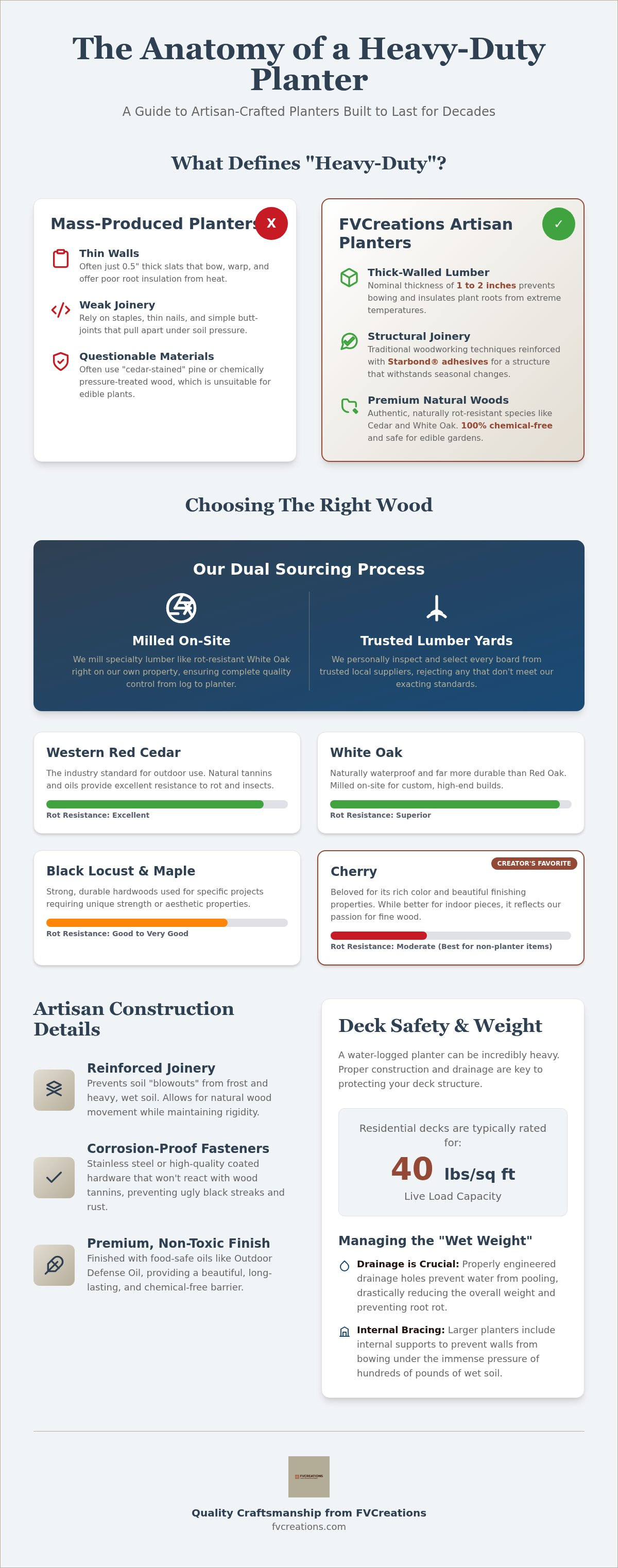
When I talk about heavy duty cedar planters for deck builds, I'm not using "heavy duty" as a catchy label. In my workshop, it means a piece of furniture built to survive the brutal cycle of soaking wet soil and baking sun. Most big box retailers sell planters made from half-inch slats that warp the first time you water them. A true heavy-duty planter uses thick-walled lumber and reinforced joinery designed to withstand the massive pressure of expanding soil. I source my materials carefully to make sure they're up to the task. I mill some of the wood right here on my property, like the rot-resistant White Oak I use for custom orders, and I pick up the rest from local lumber yards where I can personally inspect every board for quality.
Authentic Western Red Cedar (Thuja plicata) is my go-to for these builds because of its natural tannins and oils. You'll often see "cedar-stained" pine at the store, but don't be fooled. Pine lacks the inherent resistance to decay that makes cedar so reliable for outdoor living. While cedar is the standard, I also enjoy working with other species like Black Locust or Maple for specific projects. If you ever ask me about my favorite wood, though, I'll always point you toward Cherry. There's just something about the way it finishes that makes my heart skip a beat, even if it's better suited for a charcuterie board than a deck planter.
The Role of Wall Thickness in Longevity
To be considered heavy duty, I believe a planter needs a nominal thickness of 1 to 2 inches. These thick walls do more than just prevent that ugly bowing effect you see in cheap models. They actually act as thermal insulation for your plants. During a hot July afternoon, those thick cedar walls keep the soil temperature stable, protecting sensitive roots from the heat. It's the difference between a garden that struggles and one that thrives for decades.
Natural Rot Resistance vs. Chemical Treatments
I never use pressure-treated wood for my planters, especially if you're growing herbs or vegetables. Those chemical treatments have no place near your food. Cedar's natural oils do the hard work of repelling insects and resisting rot without any help from a laboratory. By combining wood I've milled myself, like White Oak (which is much more durable than Red Oak), with premium cedar, I create a sustainable, chemical-free environment for your garden. I use Starbond adhesives to reinforce the joints, ensuring the structure stays tight even as the wood moves with the seasons.
The Artisan Anatomy: How We Build for Decades of Use
Most planters you find at big-box stores are held together by hope and a few thin staples. When you look at a planter, the outside tells one story, but the joinery tells the real truth. Mass-produced kits often rely on thin plastic corners or simple butt-joints that pull apart the moment the soil gets heavy. In my shop, I build heavy duty cedar planters for deck use to withstand those forces. I've seen too many gardens fail because the corners blew out during a deep freeze. I build differently because I want your investment to last as long as your home does.
Joinery That Stands the Test of Time
I use structural joinery that accounts for how wood breathes. Whether it's the rot-resistant White Oak I mill myself or the cedar I source from local yards, every board moves differently as the humidity changes. I don't just slap boards together and hope they stay. I use traditional methods that allow for natural wood movement while keeping the frame rigid. Starbond adhesives are a shop staple for my heavy-duty builds because they provide the industrial-strength bond needed to reinforce those critical stress points. This extra layer of security prevents soil "blowouts" when the wet ground inside freezes and expands in the winter.
Hardware and Fasteners for Outdoor Defense
Tannins are what make cedar so great for rot resistance, but they have a nasty habit of reacting with cheap metal. If you use standard galvanized nails, you'll see those ugly black "bleeding" streaks on your wood within a few weeks. I only use stainless steel or high-quality coated fasteners that won't corrode or stain the wood. Every screw in my shop is countersunk and protected from the elements. For my cedar planters with legs, I use heavy-duty lag bolts. These provide the structural integrity needed to support hundreds of pounds of soil and water without wobbling.
Larger units also require internal bracing to stay square. Without it, even the thickest walls will eventually bow outward under pressure. Following container gardening best practices means acknowledging that soil and water are incredibly heavy. I add hidden internal supports to keep the structure true. While I love the strength of Black Locust or the clean look of Maple, I always find myself reaching for Cherry when I'm working on a special project. It's my personal favorite species to handle, and I bring that same level of care to every heavy duty cedar planters for deck project I finish. If you want to see what a difference real craftsmanship makes, take a look at my handcrafted outdoor collection.
Choosing Your Wood: Beyond Basic Cedar
While cedar is the undisputed king of the backyard, I often find myself reaching for other species in my workshop to meet specific needs. I source my lumber through a dual approach; I mill quite a bit right here on my property, but I also maintain close relationships with local lumber yards to find the highest-grade boards available. This variety allows me to offer more than just standard builds. Many people come to me looking for heavy duty cedar planters for deck projects, but they're often surprised to learn about the durability of other domestic hardwoods that can handle the elements just as well.
I frequently get asked about using Oak. It's vital to know the difference between Red Oak and White Oak before you start a garden project. Red Oak has open pores that act like tiny straws, sucking up moisture and leading to rot. White Oak is the opposite. Its pores are naturally clogged, making it a fantastic, rot-resistant choice for outdoor furniture. If you want a planter that looks like a piece of high-end indoor furniture but can survive a rainstorm, White Oak is the way to go. I also work with Maple when a customer wants a very specific, clean grain, though it requires a bit more care than cedar to keep it looking fresh.
The White Oak and Black Locust Alternatives
Then there's Black Locust, which I consider the "ironwood" of the garden. It's incredibly dense and lasts for decades, even in direct contact with the ground. When you look at research on wood durability, you'll see that Black Locust is one of the most decay-resistant woods in North America. However, because it's so dense, it's also very heavy. If you're planning on placing multiple large units on a residential deck, the weight of these hardwoods is something we need to calculate carefully. A Black Locust planter filled with wet soil can weigh significantly more than its cedar counterpart.
Farmer Vic’s Favorite: The Case for Cherry
If you want to know what really makes me smile when I'm at the workbench, it's Cherry. It is my favorite species, hands down. I love the way it smells, the way it cuts, and the deep, glowing patina it develops over time. While it's best kept on a covered deck or finished with Outdoor Defense Oil to handle the elements, its character is unmatched. I love using Cherry for custom-sized accent pieces that bring a touch of elegance to a heavy duty cedar planters for deck layout. It's about more than just a box for dirt; it's about creating a piece of art that lives with you and ages gracefully alongside your home.
Deck Safety: Weight, Drainage, and Protection
Dropping a massive garden bed onto your deck isn't as simple as just finding a sunny spot. When you're looking at heavy duty cedar planters for deck environments, you've got to respect the structural limits of your home. Most residential decks are engineered to support a live load of about 40 pounds per square foot. A large planter filled with wet soil can easily exceed that if you aren't careful. I've spent plenty of time milling heavy species like White Oak and Black Locust on my property, and I can tell you, that wood alone adds up quickly before you even add the dirt.
Managing the Load on Your Deck
To keep things safe, you need to calculate the "Wet Weight" of your setup. A good rule of thumb is to expect wet potting soil to weigh between 80 and 100 pounds per cubic foot. If you're worried about the strain, I always suggest positioning your planters directly over the deck joists or near the support beams. Our elevated cedar planter boxes are specifically designed for better weight distribution, making them a smart choice for older decks that might not be up to modern IRC codes.
Airflow is your best friend when it comes to preventing deck rot. If a flat-bottomed planter sits directly on your boards, moisture gets trapped, and you'll have a soft spot in your deck within two seasons. That's why every heavy duty cedar planters for deck project I build features sturdy legs or feet. This small gap allows the wood to dry out after a rainstorm, protecting both the planter and your flooring. I personally vet every piece of cedar I get from local lumber yards to ensure the grain is tight enough to handle this constant exposure to moisture.
Sealing and Weatherproofing
Once you've got the placement right, you need to protect the wood. I've tested a lot of products in my shop, but I always come back to the Real Milk Paint Co., specifically their Outdoor Defense Oil. It's a natural, food-safe finish that keeps the cedar from graying too fast while letting the wood breathe. While I love the way Cherry looks with a simple oil finish, cedar needs that extra layer of defense to stay structurally sound for decades. You can find more tips on how to maintain cedar planters for a lifetime on my blog. If you're ready to start your garden the right way, browse my handcrafted cedar planters with legs to find the perfect fit for your space.
Investing in Quality: The FVCreations Difference
Buying a garden bed shouldn't be a yearly chore. When you look at mass-market options, they're built for the shipping container, not for your home. I build heavy duty cedar planters for deck spaces with the intention that they'll be there for your grandkids to see. Every board is personally vetted by me before it ever touches a saw. I mill a good portion of my lumber right here on my property, especially the rot-resistant White Oak and dense Black Locust. For everything else, I head to local lumber yards and sort through the stacks myself. I won't use a board if the grain isn't right or if it has a knot that threatens the structural integrity.
This personal touch is what sets FVCreations apart from the big-box experience. You aren't just another order number; you're a neighbor looking to improve your outdoor living space. I'm always upfront about my lead times because quality can't be rushed. Handcrafting takes time, and I'd rather be honest about a wait than hurry a job and compromise the joinery. Whether I'm working with cedar, maple, or my personal favorite, cherry, the goal is always a piece that I'd be proud to have on my own porch. Cherry wood has a special place in my shop because of its incredible character, and I love seeing it used in custom accent pieces for protected areas.
For homeowners looking to integrate their handcrafted planters into a larger, high-end garden design, Vansta Trädgård provides exclusive orangeries and greenhouses that offer the ultimate protected environment for delicate plants and fine woodwork.
Custom Sizes for Your Unique Space
Most decks have that one awkward corner or narrow walkway where a standard box just won't fit. That's where custom commissions come in. When you measure your space, don't just look at the floor. Consider how the railing might overhang or where the sun hits throughout the day. I work one-on-one with you to design a piece that fits your specific footprint. If you need a specific height to save your back or a custom length to match your existing furniture, we can make it happen. You can explore my outdoor items collection to see the styles I've built for other folks recently.
A Sustainable Legacy
Choosing handcrafted wood products is a small but meaningful way to reduce your environmental footprint. Instead of buying a plastic-lined kit that ends up in a landfill after three years, you're investing in a natural material that lives and breathes. Understanding how long cedar planters last really comes down to the maker's choices. By using thick-walled lumber and the right adhesives, I ensure your garden bed stays strong against the elements. I invite you to join the FVCreations family. Let's build something beautiful together that makes your heavy duty cedar planters for deck project a lasting centerpiece for your home.
Start Your Sustainable Garden Legacy Today
Building a garden on your porch is about more than just finding a spot for your favorite herbs. It's about ensuring the structural integrity of your home while creating a sustainable, chemical-free growing environment. We've covered why wall thickness and artisan joinery are the real secrets to longevity, and why sourcing matters. I take great pride in selecting every board, whether I'm milling White Oak on my property or picking out the best Western Red Cedar from local yards. My neighborly artisan support means I'm with you from the first measurement to the final coat of oil.
Choosing the right heavy duty cedar planters for deck use means you won't have to worry about bowing sides or rotting floorboards. I use Starbond adhesives and stainless steel fasteners to make sure these pieces handle the wet weight of a thriving garden. While I love the strength of Black Locust, my heart always stays with the character of Cherry wood. With my no-rot cedar guarantee and hand-milled sustainable lumber, you can feel confident in your investment. I hope this guide helps you choose a piece that reflects your own commitment to quality and craftsmanship.
Browse Farmer Vic's Heavy Duty Outdoor Collection
I look forward to helping you grow something beautiful this season. Happy gardening.
Common Questions About Heavy-Duty Cedar Planters
Will a heavy-duty cedar planter stain my deck boards?
Cedar contains natural tannins that can bleed onto your deck during the first few heavy rains. I build my heavy duty cedar planters for deck use with sturdy legs to keep them off the floorboards. This gap allows moisture to evaporate and prevents the wood from trapping water against your deck. Using a high-quality finish like Outdoor Defense Oil also helps seal the wood and reduces the amount of runoff you'll see.
How much does a cedar planter weigh when filled with wet soil?
A planter filled with wet potting soil is incredibly heavy, often weighing between 80 and 100 pounds per cubic foot. When you add the weight of the thick-walled cedar or hardwoods like Black Locust, the total load adds up fast. Always check that your deck meets the residential live load requirement of 40 pounds per square foot. I recommend placing larger units near support beams or over deck joists to distribute the weight safely.
Do I need to line my cedar planter with plastic?
You don't need a plastic liner because cedar is naturally rot-resistant. In fact, plastic can often do more harm than good by trapping moisture between the liner and the wood, which leads to mold. If you want to protect the wood, I suggest using a breathable landscape fabric instead. This keeps the soil in place while allowing the wood to breathe, which is how I design all my heavy duty cedar planters for deck gardening.
Can I leave my heavy-duty cedar planters outside during winter?
Yes, you can leave these planters outside year-round. Cedar is excellent at handling freeze-thaw cycles because its fibers are flexible enough to expand and contract without cracking. I use Starbond adhesives and stainless steel fasteners to ensure the joints stay tight even in sub-zero temperatures. If you're using a denser wood like White Oak that I've milled on my property, it will also stand up beautifully to a harsh winter without needing to be moved.
Is cedar safe for growing organic vegetables and herbs?
Cedar is one of the safest materials for organic gardening because it doesn't require chemical pressure treatments to resist rot. I never use treated lumber in my workshop, so you don't have to worry about toxins leaching into your tomatoes or basil. Whether I'm using Western Red Cedar or the White Oak I mill myself, you're getting a clean, natural environment. I finish them with food-safe oils from the Real Milk Paint Co. for peace of mind.
How often should I re-apply Outdoor Defense Oil to my planters?
I recommend re-applying Outdoor Defense Oil once a year, ideally in the spring before you start planting. You'll know it's time when the wood starts to look thirsty or loses its rich color. It's a simple process that only takes a few minutes but adds years to the life of the wood. While I love the way Cherry ages, even my favorite species needs a little love to keep its character when exposed to the elements.
What is the difference between red cedar and white cedar for deck use?
Western Red Cedar is generally the superior choice for deck use because it has a higher concentration of natural oils and tannins that fight off decay. It's more durable and has that iconic deep color that many homeowners love. White Cedar is a fine alternative if you're looking for a lighter weight, but it's slightly less rot-resistant over the long term. I source both from local yards depending on what the specific project requires for strength and aesthetics.
Can I get a custom-sized planter to fit a specific corner of my deck?
I absolutely do custom commissions for non-standard spaces. Every deck is different, and I'm happy to work one-on-one with you to build a piece that fits your exact measurements. Whether you need a narrow planter for a walkway or a large L-shaped unit for a corner, we can design it together. I'll even help you choose the right wood, from standard cedar to specialty cuts like Maple or the Black Locust I mill myself.